Blowing into Bilbao

I need to be outside walking but my mind is filled with the winds of Spain’s Basque Country. It’s already been a fortnight since I said goodbye to the sad rain pouring tears onto the airport tarmac.

Following a visit of just four days, I wasn’t sure what to make of this corner of northern Spain. Bilbao had ranked on my bucket list for quite some time, and finally I had had the opportunity to explore the city. It is a beautiful place alongside a river that seems to flow with invention and creativity. From Frank Gehry’s architectural wonder that is the Gugenheim museum, to the street murals and sculptures that line the bike paths and walkways heading from the north-ish part of town south toward the old city centre. The big blessing is that the city is very walkable. It only took us 30 minutes on foot, after arriving at our accidental bus stop on one of the main thoroughfares, to get to our hotel. And some of the first sights you see are Bilbao’s bridges: interesting feats of modern architecture.

As we moved into the city’s old town, we immediately saw one of the things about Spain that I find most endearing: mixtures of people young and old, parents bringing their children home from school, grandparents playing with their kids in the park, or elderly people sharing the news of their day, surrounded by business people heading off to their next meeting. In Spain, everyone is out and about and truly living in the cities or towns they call home.

And the centre of the old town is a respectful mix of architecture old and new, bespeckled with tapas bars and restaurants so you can try at anytime any day the local pinxtos which defy the imagination. Whether it’s a tortilla (omelette) with cod and potatoes, or a stuffed pepper or grilled flank steak or pork loin, each dish is better than the one before and you never want the courses to stop coming. Even the French toast-ish dessert with a caramel cream sauce and mango ice cream felt like it should not be the end of this amazing culinary excursion.

Wandering through the old town you pass quaint little shops, mostly filled with local foods or clothing sundries; here and there a small grocery store. And on every block cute little cafés where you would sit on little stools huddled around wooden blocks and scarf down delicious cakes and rich dark coffee. Coffee so intense and aromatic, you knew you were drinking it the way it was meant to be served. Even my favourite pasteles de Belém (the custard cakes I love from Portugal) had managed to sneak their way into the local bakeries.

One morning we took time to meander through the local fish market and check out all the seafood specialities that had been brought in for daily sale. Whether it was octopus or squid, or the freshest of fish, you knew these products would soon find their way to your table in a restaurant and be prepared with the utmost care.

My main impression (or memory) of Bilbao is one of caring and comfort. From the history that surrounds you in the churches, old residential buildings and stone bridges to the welcomes that you get in cafés and restaurants, you feel that it is fine (or OK) for you to be there. There’s a small gratitude for your visit. One of my favourite afternoons was spent in the corner of a pub (the crowd predominantly local) that we ducked into to escape some torrential rain. The barman quickly found us a table in the corner where we could quietly enjoy a late lunch. But my favourite part of that experience was watching the local residents who had decided to begin their weekend early. They boisterously caught up on the news of their weeks while here and their letting out cheers and jeers depending on which team had made the last goal in the football (soccer) game being broadcast on the wide screen TV by the bar.

Bilbao felt welcoming, calm and safe. And also happy to see us. It is a bustling city nestled in a valley between the foothills of (or near) the Pyrenees. A place where you could go back time and again and discover things you hadn’t seen before. And the residents would be glad you returned for another bite to eat, another bit of history, or just to spend a little more time in their serene corner of the world.

Fès (Fez): the Final Frontier

There was something about this city. You could feel it calling even before you left the Casa Voyageur train station on the other side of the country. Way too early in the morning to embark on an almost four-hour train ride, but you could sense adventure in the air. The balmy breeze through Casablanca and its surroundings quickly left us and as the train bounded forward into a sunny, desert-esque landscape. We splurged on first class tickets to make sure we had seats waiting for us and upon finding our spots the social engagement began. For a time, we chatted with a fellow tourist from Senegal who shared bits and pieces of information about his travels throughout Morocco – he pointed out that there was a second Chefchaouen called Nador further down the northern coastline. My Moroccan colleague from Tangier begs to differ on this opinion. The voyage went fairly fast, however. A couple, of which the husband was a restaurateur who had worked all over the United States, told us of his American adventures and welcomed us to his country. He gave highlights of different sights that we needed to see and offered his appraisals of our plans for travel around the Fez area.

Arrival in Fez

When descending from the train, it was clear we were in a different region with a different climate. The temperature had jumped about 10°C and the winter coats and sweaters quickly became a burden. The sport of finding a reasonably priced cab then followed. And we did OK haggling a price of 70 dirham down to 50. Comparatively, the taxi fees aren’t terrible; there’s just a bit of competition involved relating to one’s personal pride and a need to prove that this isn’t a person’s first rodeo. That said, the driver was kind and quickly dispatched us to the Blue Gate, where a staff member from our riad would be waiting for us.

It’s hard to put into words the overwhelming of the senses that occurred next. Picked up by our riad contact, we marvelled at the amazing architecture and the bustle of the westernmost part of the old medina (market). The entry to the medina also seemingly has the only permanently functioning ATM for cash withdrawals, which is an important thing to know about travel in Morocco. In the cities, card payments are common, but in some larger and medium-sized towns, they will say cards are OK but later make an excuse to accept only cash. There’s no malicious intent involved – it appears to be solely a matter of convenience, internet connections, and possibly tax evasion.

From the market to maison

The medina was all I expected it to be and in some cases more. It was a bedlam and cacophony of selling, selling, selling. Piles of fresh fruit and vegetables: onions, oranges, tangerines, zucchini, carrots, you name it. Here and there, animal oddities would appear. You could find crates of fresh eggs overseen by a rooster and a hen or two, who gave the feeling they didn’t wish to depart with their goods. Likewise, you would see cages of pigeons; grain sacks full of flour, cornmeal, barley; and food stands offering everything from kebabs to sandwiches on to doughnuts. The doughnuts were tasty and kept us going on our afternoon train back to Casablanca later that week.

I am not sure where to begin when it comes to describing our accommodation. We stayed in two separate apartments in two riads (bed and breakfasts) run by the same family. When I think back on that experience, the words hospitality, kindness, good food and helpfulness come to mind. The interior décor of those buildings transported you to another space and time: the colourful geometric designs, the plump cushions, fluffy beds, elaborate handwoven carpets. You felt like you had stepped into an old tale about Aladdin or Sinbad (even if those took place in different countries). The talent, craftmanship and skilful mystique of those venues’ architects made the experience special.

An afternoon in the tanneries and a morning in the royal gardens

There was so much to take in in Fez. From the scrumptious breakfasts with four types of homemade bread, honey that tasted and smelled as if a colony of bees had delivered it that very morning, or the mazes of streets and alleyways that made up the old medina. There were ups and downs to navigating the old city, impacted by warnings we had been given not to stray off main streets. It was pointed out to us that offers to help tourists find their way were not always helpful. So that made me a bit more careful and mindful of using Google maps and refusing many offers for guidance. But the experience and the kindness of the family running the Fez tanneries and seeing how animal skins were cleaned, processed and decorated reassured me of the local people’s goodness and big hearts. The owners offer fresh mint to mute the smell of the animal hides and pigeon excrement used in the tanning process, but for this one time Missouri country boy it just smelled like your typical Friday at a sale barn.

Enjoying the natural surroundings of the city and the amazing ancient walls, we worked our way back up the hill to our particular gate to the city. It was a long, steady climb but the golden, tawny rock that encloses Fez is beautiful and somehow seems to warm the soul. The following day we would penetrate the wall from the other side to loiter in the royal gardens and watch locals enjoy morning walks with their children. We observed the egrets sunbathing and the occasional stork dropping from the sky to inspect what the fuss was about.

This is scattershot description of my impressions of Fez. But truth be told, I am still processing all the city had, and what more it still has, to offer.

Praha through Ree jan’s eyes

Author’s note/warning: This text is written with a good dose of sarcasm and self-deprecation. Ree assured me she had a great time during her visit to Prague. I just tend to make light of my tics and idiosyncrasies when serving in the role of tour guide.

Living in one of Europe’s most beautiful capitals can make you jaded in some ways. After 25+ years living in a city I thought I would stay in for 2-3 years max, I tend to just always look at the city’s beautiful monuments, smile, nod and make a mental check. Prague Castle – still there; the Charles Bridge – still there; National Theatre – still … well, you get the gist.

But in January I had the privilege of welcoming a good friend and fellow returned Peace Corps volunteer Ree to my adopted home town. And it gave me time to get to know the city all over again. I also quickly realised what an annoying tour guide I am. On most days I couldn’t tell you my own name but, sadly, for those brave enough to tour the city with me, every building, monument, sidewalk, street crossing, subway station and tram stop comes with a short story.

There’s a lot to do and see in Prague in less than a week. However, fortunately, Ree is a chill traveller. She endured and survived (and I think enjoyed) the wild life of southern Armenia (except for being over-potatoed) and so I was certain she would survive all I had to tell her about the Golden City or the City of Many Spires, as the Czech capital is often called. It’s also good that Ree’s a walker. That bode well for her being able to tolerate my aversion to public transport and enjoy the pedestrian life. So just to sum up a few highlights of her stay.

First stop – Vyšehrad

The Vyšehrad Hill and fortress is the site of (I think) the first permanent settlement in Prague. It offers splendid views of the Vltava River and looks at Hradčany (the location of Prague Castle) and Malá Strana where the kings and emperors who ruled the city lived for centuries. It’s also the spot where, according to legend, the Celtic queen Libuše proclaimed that a city would form here with a fame and prosperity that would last for thousands of years. I think it’s also the hill that Horymír and his trusted steed Šemík jumped from on their flight from the city before Šemík succumbed to fatigue in Neumětely (just west of Prague). I think my diatribe on the Prague skyline quickly exhausted Ree: she hadn’t counted on there being so many spires … so somewhere between the Žižkov TV tower and the Petřín Hill “Eiffel Tower” she lost track and a glazed look spread over face.

Walking through the New Town to the Old Town (also TMD – too much data)

The best part of starting a tour with Vyšehrad is that you get to descend the winding stairs down to the river and take your pick of which river bank to meander along. Now, I forget if we went to the Smíchov side or wandered up the right bank to the National Theatre. However, I’m pretty sure we stopped for a hot drink (cocoa for me, mulled wine for Ree jan) and enjoyed Prague’s plentiful medieval and baroque vistas. I’m not sure on what day or in what order, but I do know that we stopped at one of my new favourite pubs in the New Town and ordered a proper ½ litre Plzeň (Pilsner beer) for each with us and a nakládaný hermelín (a pickled cheese that is camembert adjacent); this one served with cranberry jam and walnuts. I think Ree liked it.

A day at the National Museum

I think our museum visit turned out to be a special treat for both of us. In 28 or so years, I had never taken the time to visit the monument. Mind you, I only live 10 minutes away and walk by it almost every other day. But having Ree in town was just the right occasion to test-drive the newly-refurbished building and visit its exhibits. And I can now tell you, it is worth the 10 bucks or so that you pay for the entrance fee. You have two buildings to explore: the more historic building, the National Museum proper, and several exhibits housed in the more modern (in my opinion uglier) building that used to be home to the Czechoslovak Federal Assembly. There is much to see: from displays on minerals and geology, to exhibits on prehistory – a woolly mammoth included, on to audio-visual time travel through the history of 20th century Czechoslovakia and the 30+ year-old Czech Republic.

I could recount more, but I’ve hit the one-page mark. I can just say it was an honour to share my city with Ree. It was great to revisit Prague’s history, show her my hood, and also to treat her and my friends to some rounds of the Phase 10 card game that ended up with all of us being given the bird by Jakub … but in an artistic, pretty way. Hopefully, there will be more visits in the future.

Loving Graz: one meal at a time

A couple of weekends ago, a friend and I boarded a train and head for Graz, the main city of Austria’s Styria region. The train ride is just over 7 hours but takes you through some beautiful countryside in the wine regions along the Czech-Austrian border and in the mini-mountains as it nears Graz. The railway serpentines around Semmering-Kurort are lovely as you swoosh from tunnel to tunnel and get glimpses of colourful rock formations bedecked this time of year with fall foliage.

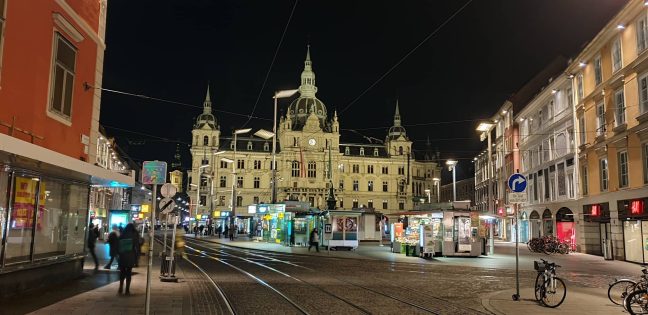
Upon arrival in Graz, you descend into a quiet-bustling regional city with the bahnhof life loud and hopping and a fitness centre right there to greet you. Our stroll from rail station to hotel took us down a busy thoroughfare to the bank of the Mur River, where the modern-ly fun and imposing Kunsthaus told us our accommodation was nearby.

Although slightly tired from the long trip, we only took a few minutes to get settled and then rushed to the city centre to see a few sights before dusk quickly arrived. Walking over one of the many bridges that provide connection to the Innere Stadt, we soon found ourselves in a maze of cute streets with an array of architectural styles that each, in their own way, explained the city’s history. After some wandering around we settled on a café that offered a great blend of coffee which I elected to sip with an accompaniment of apple strudel and vanilla ice cream. The coffee provided some warmth as we rested our feet and contemplated the words of Kurdish refugees who had assembled in front of the Graz City Hall to voice their discontent with the dire situation of their peoples in Eastern Turkey.

As we took in the city sparkling in the sunset, we also plotted our evening meal. Nothing says “I need more food.” like a huge piece of strudel and ice cream. We eventually settled on a Bierstube off the main streetcar (tram) route the runs under the Castle Hill, where we indulged in some regional draft beer (Grössl?) and delicious Käsespätzle. I also pigged out on a lovely pumpkin soup as an appetizer. After that, it was time to walk off the meal; enjoying a bit of night-time Graz and discovering sites like the local theatre, some baroque churches, local parks and bustling boulevards.

Our Saturday, as forecasted, was filled with rain. We grabbed breakfast on the opposite end of the main square, prior to walking the tram road over to where we estimated the streets leading up to the remains of the castle on the Schlossberg would be. On a tiny square below the hill, we noticed a formidable set of stairs that I pondered a few seconds before deciding that this was our way to the top: no funicular, no mountain rail. And so we began our ascent, a few steps at a time. I just focused on my breathing and in no time we got where we needed to be: greeted by the clock tower that looks out on Graz and shares the time with all people in view. Armed with our umbrellas, we moved around the hill top, snapping pics of various skyline views and looking out on the city we’d just begun to discover. The Castle Hill is today sans castle, since the fortress that once protected the city was destroyed during the Napoleonic Wars at the start of the 19th century. So with no monument in sight, it became our duty to enjoy and take in the autumnal colours: happy yellows, blazing oranges and fiery reds. We observed them all as we meandered down the back side of the hill winding down to the city centre below. Then more wandering and enjoying the city: the lovely theatre square in daylight, the beautifully carved woodwork adorning a local pharmacy, the delicious and appetizing farmers market, and interesting blips of modern architecture speckled across the cityscape. All that walking was rewarded with an amazing pork schnitzel (tenderloin) and delicious roasted potatoes. And of course some more local beer to wash it all down.

After lunch, the foodie trekking would pause, as we decided to take in the current exhibit at the Kunsthaus and enjoy the modern pieces there focused on branding and commercialism/consumerism. An abrupt return to the struggles of today’s world which we had temporarily forgotten while immersed in 16th and 17th century architecture and our passion for good food. By evening our tourist adventure was slowly winding down. We had had our fill of local food and accidentally stepped into a cute Mexican restaurant. Filled with a great mood and the lovely songs of guest singers, we enjoyed an array of folk songs, while munching on tacos, quesadillas and other culinary goodies.

Graz, you were a wonderful respite from the stress of the working world. And you’re an excellent place for a weekend get-away: filled with tasty food and architectural pleasures. Not least of all the “Mussel” building that sits in the middle of the Mur. Auf wiedersehen.

Côtes du Rhône … where memories meet and happiness flows

Since I was a teenager, France has had a special power for me. It’s “meant to be-ness” has always made it feel safe. And celebrating a good friend’s birthday in Provence in September served as an important reminder of the need to cherish special certainties.

The givens of Pete fixing amazing food while tormenting me incessantly, or Jakub telling silly dad jokes, or Natalie being armed and ready with rosé, or Laura acting as the voice of reason. Not to mention Jean making sure we were all looked after and the house in order.

An insane route to the farmhouse we were staying at had me less than certain how our celebratory week in Provence would end up. But France, this time the southern part, did not disappoint. The smell of lavender, the rugged mountains hugging our local horizon, and the poplar or sycamore-lined roadways … they all told me that life was as it should be.

It’s funny that the French created the term je ne sais quoi. Because that’s how I often feel when describing why I am at home there. It’s an “I don’t know what” sentiment. I’m never 100% certain why but I always feel welcome when I move through the fruit and veggie markets, when I sit down for un crême, or when I escape inside a house of worship that dates back to the times of The Crusades. The beauty of the Rhone Valley immediately tells visitors, without their knowing why, that everything will be all right.

Our corner of Provence that we hid out in that week afforded us the best that France has to offer. Great wines from the ancient land of Popes (a Châteauneuf-du-Pape or a Gigondas) accompanied most of our meals. The shops welcomed us with the culinary artisanry that only the French can deliver: sumptuous sausages of the Camargue, excellent terrine de foie gras, or rillettes … food shopping in France is unique. Just brush off your French vocabulary from college days and enquire after which local farmers supply the shops and to what periods these agro-culinary traditions date back.

It’s in these moments that you slowly come to understand that the “I don’t know what” may just simply be a proud love or passion for traditions in food-making, animal-raising and store-owning that transcends time. Perhaps, it’s because the river lies nearby. But in the Rhone Valley and that area of France, there’s a fluidity: a phantom of centuries of trade routes that connected Ancient Rome to the Iberian peninsula. When you submit to the region of Provence, you feel these transitory moments. Of wine poured into glasses across the years, of floral scents being gathered for perfumes that would sweeten numerous decades, or of frankincense emanating from churches that would bring the religions of the Holy Land to the Empire’s marchlands.

There’s never a single, clear cause for the serenity and happiness flowing along the Rhone in Provence, but I’m certain it has something to do with the land always seeing to residents’ and visitors’ basic needs. You eat well. You drink well. And you relax as time nourishes you with the riches of the region’s traditions.

Laissez-vous en profiter de ce que la région vous offre.   

History and Agriculture in the Wachau

In a whirlwind day trip last Saturday, I had the pleasure of re-experiencing one of the most beautiful sections of the Danube river valley: the Wachau. It includes a short section an important European waterway full of stories from history dating back to Richard the Lionheart.  In fact, it was in the village where he was imprisoned, Dürnstein, that we made our first stop. We descended our bus at the water’s edge and turned, on foot, up a slowly inclining cobblestone road that led to the village center. From the retainer walls that once protected the old town, one could take in expansive views of the Blue Danube and look west to the central Wachau valley.

Above Dürnstein village sit the ruins of the old castle where Richard was imprisoned; it stands precariously on the crags and rocky cliffs that rise above the river in this area. It was a special treat to stop here, as I had read last year about Richard the Lionheart’s capture and imprisonment in the excellent travel diary by Patrick Leigh Fermor, A Time of Gifts. I had first travelled through the Wachau in 2009 on a charity bike ride, The MAD Danube Odyssey, and was wondering how I had missed stopping at this site. 

After a quick peak at the abbey in Dürnstein and its colorful, baroque architecture, we quickly boarded our bus to move further upstream to Melk, the western gateway to the Wachau. Melk is famous for its chateau and monastery where monks still study and serve to this day. The yellow-tinged chateau, known for its role in education and the local economy, sits like a dreamy wedding cake atop a precipice looking down on the Danube. It bids welcome to all travelers as they float downstream into the Wachau region. The Melk chateau and abbey is vast in size with its large courtyards, its impressive baroque church and its library with an enormous collection of scholarly works focused on law, theology, philosophy and economics. 

It is at the western end of the chateau complex that visitors can take in breathtaking views of the Danube below, the quaint town of Melk, and the expanses of fields and forests that line the mighty river. When exiting the chateau complex at its eastern end, visitors can wander through a lovely set of French gardens that are immaculately groomed and offer pleasant respite from the bustle of the tours in the chateau/abbey proper. These quiet parks and garden paths are lined with lovely roses, blooming shrubs, and stands of asters that announce the arrival of autumn. 

After a short walk through Melk’s town center, we boarded our boat that would take us downstream to Krems. The boat ride was a wonderful way to soak in all the life and history that lines the Danube river. As we floated along, we saw the numerous vineyards that produce some of Austria’s best Grüner Veltliner wines and the orchards full of apricots and pears. In almost all larger towns of the Wachau, you can find stores that offer you multiple apricot- and pear-based products: schnapps, marmalades and jams, nectars and sirups, and very sweet wines. Also, in this area, you will find that pumpkins and squashes are very popular. That’s why many shops will also sell Kürbiskernöl (pumpkin seed oil), which is a wonderful treat for flavoring salads.

As we went downstream, we saw the castle at Schönbühel, the romantic village of Weissenkirchen, the ancient church of St. Michael with its legend of the rabbits, and the impressive Göttweig Abbey which presides over the eastern Wachau with stateliness and majesty.  Our tour wound down in Krems an der Donau, where we disembarked out boat and made our way to the town center. Krems houses a wide array of architecture and landmarks; beginning with the Center for the Arts (once a former cigarette factory) near the boat docks, then passing by the university campus and the Karikaturmuseum, before reaching the central city park and the Steiner Tor (a gate to the old town).

My visit to the Wachau was quick, but it was definitely a trip I would repeat again over a long weekend. The magnificent vistas coupled with the calming flow of one of Europe’s most important waterways make the Wachau Valley a must see. Accessible by train, bus, car or bike, it’s worth it to treat yourself perhaps to a sun-filled day of leisurely cycling followed by a big plate of hearty Austrian cuisine (perhaps the pumpkin gnocchi) and a glass of crisp, white Wachau wine. Prost und guten Appetit.

Wandering Lužnice (Pt. 2)

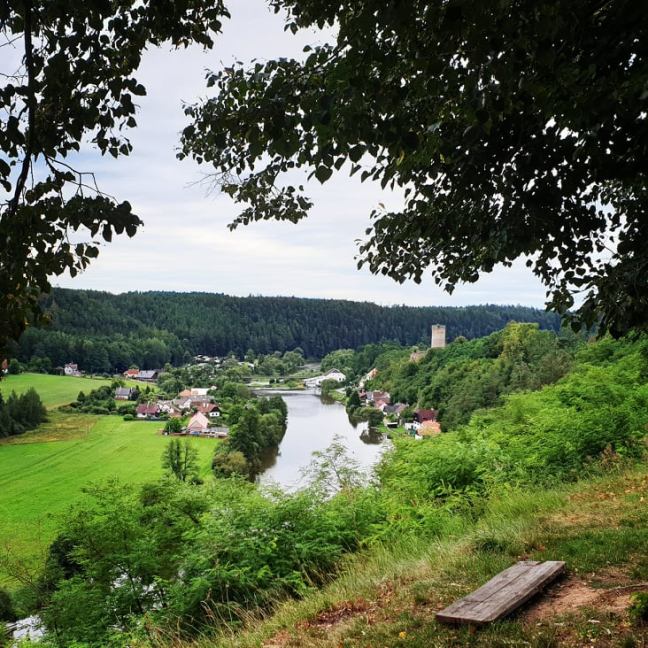
When finishing my previous post on hiking the Lužnice River trail in southern Bohemia, my friends and I had just arrived to the picturesque village of Dobronice u Bechyně. The hike into Dobronice was a tiring, but visually-pleasing finale to a long day of walking. As you approach the village, the path veers away from the river up a fairly steep hill that offers specials vistas of the Lužnice River from above. You see the water wind its way around the village below where small mills hug the right bank and the clackety-clack of the village’s single wooden bridge echoes up from the valley below. 

As you hike to the village center you first pass a look-out point just next to the Church of the Assumption of the Blessed Virgin, which sits in serene isolation at the village’s eastern edge. The marked footpath takes hikers back down to the river, while guiding them alongside the entry to the ruins of what was once Dobronice castle. The castle’s one remaining tower can be seen from the walking path and also from several points along the river below. 

We stayed overnight at a local bed and breakfast and gobbled up the tasty traditional Czech food that the innkeeper prepared. There was sumptuous roast pig, traditional beef goulash and also typical fried edam cheese (that’s the option I chose, because I hadn’t had any in a good while). The bed breakfast/inn offered nice views of the river and I fell asleep that night to the sound of stray cars clanking across the nearby bridge. 

Waking up the next day, we had a special visual treat in the fog lifting off the river and clouding the air around us as we enjoyed our breakfast. It was a quick meal, as we still had about 15 km before us and wanted to get an early start to our final destination of Bechyně. The start of the path was merciful: it began with roughly 3-4 km of tromping over footpaths through dew-covered meadows before once again returning to the mud/rock combo paths they we had regularly encountered the day before. 

It was during this segment of our hike that we got to enjoy the serenity of the Lužnice. Not many rafters and kayakers were out on the water yet, so we took advantage of the morning sun and sitting on the boulders that lay along the riverbanks. The large flat rocks offered the perfect place for sunbathing or for jumping into the refreshing water. Unfortunately though, we were short on time, so we quickly carried on along the riverside path that would intermittently offer sections of marsh where we would hop from one wood plank to the next or sections of rugged cliffs facing the river. These fascinating rock formations were frequently laden with ferns and lush moss.  

Slowly, our river path gave way to gravel roads that led to a series of small cottages that are part of the village Senožaty. I later learned that a friend of mine from East Bohemia has a cottage there where he and his family often stay in summer months. After that, our path would once again pull us away from the river rising into dense beech, pine and spruce forests that would lead to the edge of Bechyně. The forests smelled of pine needles and were just damp enough to offer prime growing conditions for the various types of mushrooms that are found throughout the Czech Republic. We even came across some chanterelles; yet not enough to pick for a good sauce to accompany our dinner.

Within 15 minutes or so, we were out of the forest and walking a field path that would lead us into Bechyně. The smells of autumn surrounded us: fields had been harvested and local apple trees had begun to shed their fruit. We stopped for a last group photo by the sign marking the town limits and then walked into the center to enjoy our “victory coffee”.  With my feet starting to protest a little too much, I left my friends to explore the beautiful chateau in Bechyně and to look at its lovely gardens. I, on the other hand, slowly began my way back to the local rail station and took in views of the public park that surrounds the town’s local spas. It was a wonderful end to the weekend: enjoyed with last-minute photos on Bechyně’s main square and catching glimpses of the town’s “rainbow bridge” as we took the train back to Tábor where we would pick up our car. It took my feet 3-4 days to forgive me for our weekend sojourn, but it was well worth it in the end.

I own nothing but I have everything

When I think back on my time in the East
And entering a land about which I knew little
With no idea what to expect
Of the people that await

And as we greeted each other with apprehension
Reservations about who I was
And what they expected of me
Twice the age of the other “invaders”

Superficial worldviews would say
Comparatively, they had little
Yet never did we/they want
For all life’s essentials

Smiles were abundant
Coffee was plenty
A step over any threshold
Was a call for plates of sweets
And the best any household had to offer

As I approach the year fifty
And berate myself
For not owning a house, not owning a car
While still asking almost daily
What ownership means

I have so many possessions
That I keep inside me
Stores of memories, laughter, tears and embraces
And stories or legends shared
Of lessons my life road has taught me

I no longer worry
About the property I have not yet collected
For my most valuable possession
Is the real estate of my heart

I own nothing, but I have everything

The (Swiss) hills are alive …

It’s been awhile since I’ve added to this blog. That’s mainly because the past few months have been about readjusting to life in Central Europe and trying to get things organized in my business. However, I recently had the good fortune, once Europe re-opened its borders, to go spend two weeks hiding out with some very special friends, Pete and Laura, at their home in St. Sulpice, Switzerland.  It’s a cute little town/village/suburb on the outskirts of Lausanne, and it must be said … they have an awesome view of Lac Léman (Lake Geneva). 

One of my favorite take-aways from my time there was all the gorgeous vistas around the lake; with mountains on every side and the confusing geography that always has you wondering: am I looking at France? Or am I looking at Switzerland.  In any case, there was so much beautiful nature to take in; including the calm waters of Lac Léman, the moody storm clouds rolling in from the Alps or creeping in from the Jura. There was also the morning songs (and sometimes cackles) from the birds who lived near the lake.  When I think back on my visit, I reckon these are some of my favorite memories…

The incessant ringing of the mountains

When we took a Sunday hike in the mountains north of Gland/Arzier, it became immediately apparent that each cow/bull has a bell. And those bells clang non-stop as the animals graze in their alpine pastures and wander to find new meadows unexplored. The sounds give the hills an almost church-like atmosphere where the carillons of cow bells call you to nature’s cathedral and invite you to commune in the lush fields and enjoy the soothing, warm winds that pass through the forests. 

The tangy taste of Gruyère cheese

This was one of my favorite moments during my visit. Parking just below the medieval village of Gruyères and walking through the old gate into this fortified settlement made me feel like I had travelled back in time. As you walk over the cobblestone-paved square and admire the shops and cafés that hark back to a time long ago, you can quickly imagine horse carts and wagons as they must have once brought in wares and crops from the surrounding area. Or vendors as they traded goods from shops and stalls in this hamlet that is home to one of my favorite cheeses. Just down the hill from Gruyères, in the town of Pringy, you can visit the Maison du Gruyère museum and buy all the delicious cheese you want. That coupled with the exquisite views of Le Moléson mountain gives you a sense of serenity and contentment that is worth they journey.

The markets of Évian

Just across Lac Léman from the port at Ouchy lies the peaceful village of Évian les Bains. The town famous for its freshwater springs and its spa hotels makes a nice day trip for visitors from Lausanne, Geneva or the surrounding areas. I travelled there with Laura to explore the Friday farmers’ markets and enjoy the promenade along the waterfront. The animated vendors as they hawk their meats, cheeses and vegetables are a wonderfully intriguing sight to observe. Or sipping a rich cup of coffee while eating a pain au chocolat is just the right treat for starting a holiday weekend.  Plus, there’s the added benefit of looking back at your holiday home on the Swiss side of the lake and taking in the serene Vaudois shores.

I am so grateful to my friends for allowing me to “disappear” at their home for the past couple of weeks. Switzerland and its captivating, hospitable and welcoming countryside was just the right antidote to this spring’s long periods of isolation mandated by the Covid world. If you get the chance to wander through the Swiss mountains and explore the paths that lead you to breathtaking views of the country’s many lakes, definitely seize that opportunity. It’s well worth it.

The sweetest part of Armenia is its fruit

I was looking at some pictures today and noticed that a year ago this time, I was a week away from getting sworn in as a Peace Corps volunteer in Armenia. In my village of Hovtashen in the Ararat region south of Yerevan mulberries (թտւթ) were everywhere. It was a strange, amusing experience. I knew mulberries from my childhood in Missouri. Taste-wise, they were tolerable, but I had never been particularly fond of them. Yet somehow, as with many of life’s simpler experiences in Armenia, the local mulberries were different. They seemed sweeter and there were two kinds: dark and white ones. I had never seen white ones elsewhere. On top of that I learned that Armenians also distill their mulberries and make a very potent alcoholic drink from them. Some might call it brandy in the way people tend to call the distillate from plums in central and eastern Europe plum brandy (locally referred to there using a variation of the word slivovice deriving from the word slivka for plum). Otherwise, in the color sense, it looks what a Missouri kid like me would have called plum moonshine, i.e. it has a color more akin to vodka. All the same, the stuff is strong. And, as I tend to do with the plum brandy from Moravia, I drank a shot first thing in the morning when I felt a cold or sore throat coming on. Just one shot, mind you.

With that intro, I wanted to highlight some of the fruit experiences I enjoyed when I was living in Armenia. So let’s begin.

Apricots / ծիրան

Apricots are synonymous with Armenia: even the orange hue in the country’s flag is referred to as apricot orange. And then there’s the taste: one that can’t be described. They are so rich, sweet and juicy and can be put to many uses. Of course, they can be eaten fresh from the tree or from the markets (if you’re a city dweller). I would always eat them with my host dad Artur when we had evening coffee. Apricots are also used to make a drink/juice referred to as կոմպոտ (compote), which is truly a thick fruit juice and not the jam-like fruit dish we know in English-speaking countries. In addition to that, apricots are dried and stored for the winter: still, the dried fruit has a flavor and juiciness that makes you think it was harvested not more than a week ago. Finally, there is the prized apricot jam that Armenian women all over the country make during late spring. I smuggled two jars of that home to give to friends.

Figs / Թուզ

These are one of my favorite fruits anytime I can get them: fresh from the market or picked from a bush in the wild. Like the mulberries mentioned above, there are two versions: the green ones and the purple/dark ones. I’m generally partial to the purple ones, as they are the variety I know from visits to the beaches of the Mediterranean. On various islands, it was common to pick a handful of figs during pitstops when returning after a day of swimming and sun. There is something about fresh figs that makes them feel like a guilty pleasure; the fact that the vendors at the outdoor markets in Vanadzor would slip me a couple extra when I was shopping always made my day.

Melons / ձմերտւկ (watermelon) and յեմիշ (cantaloupe)

By late June, melon season had arrived in Armenia and sidewalks everywhere were stocked with them. Of course, they were sold by local fruit-vegetable merchants, but it appeared that seasonal melon-vending was a way to generate cash for a number of other entrepreneurial locals as well. And thank goodness for that. Melon was another summertime staple for my coffees with Artur. Depending on what was available, we would chomp on cold watermelon with our rich, dark Armenian coffee, or we would enjoy the spicy flavor and scent of cantaloupe: both added to the spoils we collected from the family garden; specifically, the cherries.

Cherries / Բալ

As with most countries I’ve lived in, both sweet and sour versions of cherries can be found in Armenia. They are also eaten fresh or cooked for jams. And in some cases, the locals make them into the juice (compote). I actually grew quite fond of them as a nice way to round off my evening meal; a slightly healthier version of dessert. It was a joy to partake of cherries so as not to stuff myself with too much of the delicious Armenian գաթա (gata cakes) or with Armine’s delicious pastries and éclairs.

I’ve rambled on too long. But if you make it to Armenia, treat yourself to the wide variety of fruits in the outdoor markets. You won’t regret it.