Paths through ponds of history in the Třeboň region

As sleep eludes me on a humid summer night, my thoughts wander to last weekend’s trekking through the Třeboň nature preserve in South Bohemia. This region of the Czech Republic takes you back in time, at least in your imagination, to the lives of peasants and farm workers of medieval days who first built these ponds for the fishing of carp and possibly catfish. 

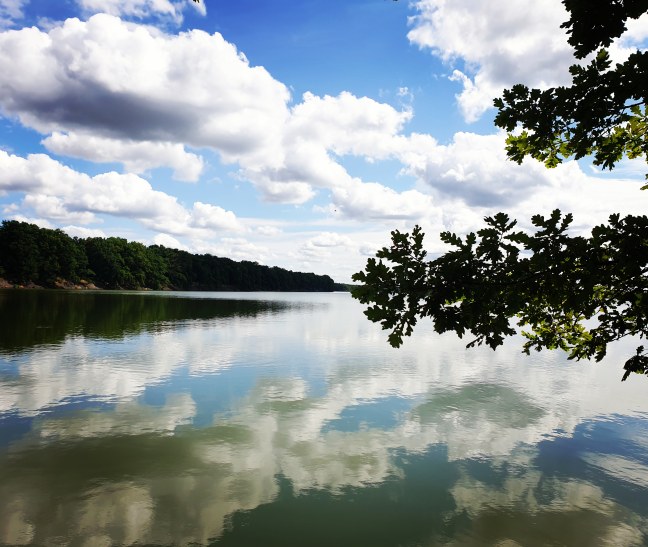
Carp is a fish traditionally associated with Christmas holidays in the Czech lands. But to meet modern consumer demand, the fish have to be raised somewhere. And where better than the murky waters of hundreds of ponds that dot the landscape along the Czech-Austrian border glimmering like numerous shards of a broken mirror whose pieces have fallen to the ground. The surfaces of the pond reflecting and taunting the clouds which will soon gather the precipitation to keep their water stocks aplenty.

The paths through this pond (or lake) district are fairly even, changing from asphalt to gravel and sometimes the plush comfort of earth and pine needles. The scent of the pine trees wafts in the air and rejuvenates your spirit in those special moments when you walk the paths alone, having found a detour void of road cyclists and tourist families out on bike journeys in the area … just because the terrain is fairly flat. Pleasant for both children wary of long adventures and parents who may have been locked in their offices too long, away from the physical conditioning offered by the Great Outdoors.

As you walk the trails, you revel in the sunshine (when available) and gawk at the many waterfowl who inhabit the lakes. No worries. They gawk right back at you: swans, mallard ducks, perhaps a few geese and here and there storks or herons who frequent the ponds from their nearby nests.

Another enchanting feature of the realm is the biodiversity of the local trees. While in most Czech forests you will find spruce, larch and pine trees interspersed with beeches and birches. The woodlands of the Třeboň area are rife with oak trees which also, in their own way, add to one’s mental image-making of long-ago medieval or renaissance times when perhaps the Czech counterpart of Robin of Sherwood or per chance one of Jan Žižka’s men rode these trails travelling to war camps or to pass a message to local nobility. It’s hard to say what might have transpired amongst these tall arboreal stands but it’s clear they have seen their fare share of history.

Most who go to the Třeboň area will want to visit the town proper and walk through its castle park. Or walk along the levees that form the ponds’ borders heading over to the Schwarzenberg family tomb or north to Rožmberk to take in the expansive surface of one of the area’s biggest bodies of water. Others will make their way eastward to visit the Czech Canada region, working their way through villages like Landštejn or Klaštér to visit castle ruins and historic monasteries on their way to the breathtaking renaissance village of Slavonice.

There is plenty to do while wandering among the ponds of South Bohemia. But the most rewarding activity is to absorb the serenity of this unassuming nature, make a small feast of the woodlands’ summer blueberry crop, and inhale the scent of the elder pine forests. They know and have seen much in their extended lifetimes. If you listen, perhaps they will share their stories.

Returning to my other HOME

Three years after Covid forced me out and a major heart surgery threw a wrench in my travel plans, I finally made it back to Armenia last weekend. It was amazing how quickly the warmth of Armenians and reconnecting with old friends melted away the anxiousness I had about travelling to the southern Caucasus region. My worries were never of the normal kind, i.e., would people and places still be as I remembered? Would there still be a connection to, and love for, the communities where I trained and worked. I was more concerned about being fit enough for the journey.  

My current adventure began with new target destinations: to see parts of the country I had not yet visited; and this thanks to having a good rental car at my disposal.  Of course, driving also made me a little anxious but having a great, funny, supportive team of fellow travellers (Jesus and Ani from Peace Corps’ A27 cohort and our new friend Marietta) made my first trip to the Vayots Dzor region perfectly enjoyable. Our journey took us to the spa town of Jermuk, or what I call Armenian Karlovy Vary (Carlsbad for German or English speakers). This small, unassuming town nestled in between cliffs and canyon made for a nice respite from the stress of air travel. It also filled me with hope for all that tourism can, and hopefully will one day, offer local and regional businesses in Armenia. Although the dominant buildings in Jermuk are large therapy and rehabilitation facilities as well as a couple of resort hotels, the town’s charm, at least for me, derives from the nature that envelops it. There are the cliffs west of the town centre formed from volcanic activity and “tubes” of basalt. These geographic features always make me think of Superman’s Fortress of Solitude. Then, as you meander to the north end of Jermuk’s “Main Street”, you will find a sign pointing you to stairs that take you down to a beautiful, breath-taking gorge or canyon and the gurgling river that soothes even the most exhausted traveller’s nerves. 

As you walk along the canyon path, you are surrounded by beautiful flora – wild roses greet you at every turn along with other colourful flowering plants (I couldn’t tell you their names for the life of me) that jump out in shades of pink, blue, yellow and purple. The trail also offers a break from the intense summer sun that warms all of southern Armenia. Cliff overhangs and large boulders (even a rock arch) cool the canyon and make the hike all the more pleasant. Finally, when you reach the river’s edge, it only takes a few more steps before you hear that a wonderful surprise awaits. The sound of rushing water shushing eager hikers soon reveals itself to be an amazing waterfall towering from the hilltop above. It carries the cool, refreshing Jermuk waters down to the river so they can travel further south to Armenia’s Syunik region.

Many travellers will journey to Jermuk to enjoy the curative spring waters, to relax or to seek rehabilitation. Odd traveller that I am, I went there to be hugged by the hillsides, calmed by the canyon river and streams and to listen to nature telling me to slow down. There is so much energy bursting in this beautiful landscape that I can’t wait to return one day: to hike more in the sun-drenched golden mountains; to watch local beekeepers as they gather their honey; to observe the farmers as they cut, mow and rake their hay into small bales; and mainly to enjoy the serenity that is, and always has been, the mountains, gorges and canyons of Armenia.

It felt good to be back in those Armenian mountains; it felt good to be back in, and embraced by, one of the lands I now call home.  

Train to the past present – back to Žďár

A trip through memories from the start of my life in the Czech Republic

Traditionally this blog space is meant for my thoughts on travel abroad and, when possible, going to fun, exciting destinations. The pandemic and personal health issues have slowed all that down for me over the past two years (as with everyone). But recovery is in full force and I had what I will call the surprising good fortune to have my train re-directed on a route through my past during my recent trip to meet up with friends in the charming wine village of Valtice

Since Czech Railways is repairing part of their northern corridor, I quickly found out that my journey would take me through the southern route crossing the Czech-Moravian Highlands (the Vysočina region) and small part of my past. It did seem odd getting on the train and looking at an itinerary that skipped from Kolín (in Central Bohemia) on to Brno (what I call the capital of Moravia). But the diversion brought back so many memories as it crossed through the towns where I spent my first years of my sojourn (now life) in the Czech Republic. 

As the morning sun stretched across the landscape, I saw the names of familiar towns pass quickly by my window: Kutná Hora (home to the beautiful St. Barbara’s Cathedral and former mining town), Čáslav (home to a military air base and easily recognisable with the bell tower that stands watch over the town centre) and then Světlá nad Sázavou, a quiet town on the Sázava River, famous for its glass-making. I had the privilege of working many times, in my later career, with a local glassworks firm and both their products and customer service were flawless.

Soon though, we would arrive at the eastern frontier of Bohemia where it disappears into Moravia. That’s when I saw it: the blue and white sign announcing our passage through Havlíčkův Brod. This was one of my main weekend haunts in the early 1990s when a 22-year-old, naïve young man from Missouri had taken on a teaching job in nearby Žďár nad Sázavou (already in Moravia) and would travel to Havlíčkův Brod to spend weekends with teacher-friends in our small expats-meet-locals community. From the window of the train I could smell the memory of a tasty soup Jodi had just made on a snowy winter Saturday, or smoking Sparta’s or “Startky” or whatever was available during pub debates with fellow Missouran, Matt from St. Louis. With Matt, Jodi and guitarist Vojta or whomever else joined our crew, we were likely drinking a Rebel or a Ježek from one of the nearby regional breweries. Quickly though my view of Havlíčkův Brod faded from sight and I began trying to remember the names of villages the local train (Os – osobák; what we dubbed the “oh so slow me” train because that sort of rhymed with the official Czech name osobní) passed through before hitting Žďár. The only ones I recalled were Přibyslav and Veselí. 

And then I saw it on the horizon, the arrival of Žďár. The first glimpse includes the garden communities on the west end of town and then the rail line widens to service incoming and outgoing freight to the largest local enterprise, Žďás. I think at one time it may have employed over half the town. Although not visible from the train, I wondered how many of my old haunts, stores, schools and restaurants were still around. I know the White Lion Hotel (Hotel Bílý lev or Bílého lva) no longer exists. I assume my place of employment, the Škola ekonomiky a cestovního ruchu and its administrators the Holemářovi are still doing fine. But what of the grocery store Mana (by now it’s likely a Lidl or Albert) and the department store we called Papír, hračky, sport (Paper, Toys, Sport)? Because that what was written of on the windows of each floor when viewed from outside. Or what became of Süssův hostinec, the pub that was so local that we foreigners were scared to enter, but which somehow became super friendly once its beer garden opened in the summer? At the time, I spoke perhaps 8 words of Czech and didn’t have the gumption to ask the locals if our entourage could “přisednout” (i.e., join their table provided chairs were available).

Of course, the train moved on quickly towards my destination of Břeclav. But my mind remained stuck at the Žďár train station. What had become of all those students from so long ago. I know Jirka Filippi is a successful corporate manager; Petr Váněk, a good friend of Jirka’s whom I once told in a moment of frustration that his English was subpar and asked what he was going to do when Jirka wasn’t there to speak for him? Well, Petr has since proven to me that perhaps it was the teacher, not the student. He’s become a successful actor and has gone on to play not only roles in Czech movies, TV shows and commercials, but also in English-language films as well. Simply put, he showed me. And I’m so proud he did. So many more names came to mind as the train progressed toward Brno: what of Marek Pospíšil, of Lenka, or Renata or Vít (I hope I have his name right: he was a young, blond, bespectacled student from Havlíčkův Brod who studied in Žďár and invited me one Saturday to meet his mother … how we had any type of conversation in Czech is beyond me; I am guessing Vít was a good interpreter).

Needless to say, I made it to Břeclav and caught my connection to Valtice, where I caught up with the Hradec crew and watched them taste (sample) more wine than any of them can possibly remember. But děkuji (thank you) to Czech Railways for those rail repairs. You took me back to a place in time where both my students and I had our futures still before us. For that I am grateful.

The Secret of (Lac) Leman

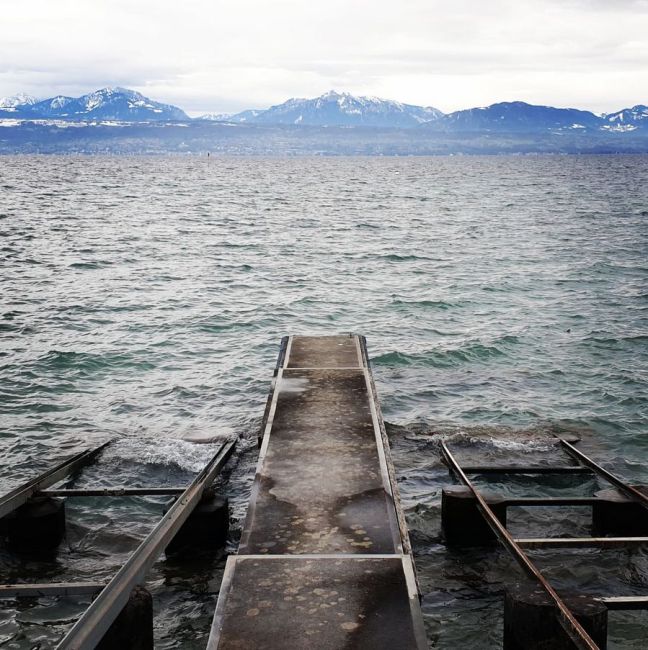
I spent my Christmas again this year in the Vaud region of Switzerland, running away from the noise of my work and the fears of my new reality after a life-changing medical experience. Returning to Saint Sulpice, I found that in addition to the care, love and attention of good friends, the nearby lake too has restorative properties. Lake Geneva, referred to locally as Lac Leman, is a vast expanse of water. It makes up part of the Rhône River, for which I’m particularly grateful, because those waters pass into France and quench the thirst of the thirsty hills in southern France (where some of my favorite wines are grown) before it (the Rhône) rolls into the Mediterranean.

But getting back to the Lake. It is a work of natural art, an expresser of moods and a giver of visual games depending on your vantage point. For me though, this year, it represented therapy; a respite from the worries of the (home) office and global concerns about whether 2022 would finally be the year the world moves past Covid life. I love the Lake especially because each morning the weather above it provides a different view: would we see France and its Alps, or would they be blanketed in lake-generated clouds and fog? Or would the sun dazzle us with how it reflected off the purple-gray mountains and their snow-crested peaks, offering incredible combinations of cerulean, azure, bronze or amethyst with its shadows and reflections. The morning view of the Lake tends to set your mood for the day.

And then there is Leman’s healing force. No wonder so many über fit Swiss folk choose the lakeside as the route for their daily runs or regular walks with their canine companions. Cozy footpaths intermingle with asphalt pavements to offer endless opportunities for the locals to see the Lake’s beauty from manifold angles. This of course gives my friends, once I’m armed with my smartphone camera and ambling along the Lake, cause for dread of my afternoon Instagram/FB posts, where I share for maybe the 9,000th time a slightly different shot of Leman: both its mood and robing for the day.

It was these daily photo sessions, my late morning promenades Ouchy-way or my walks with Jean, Izzi and Poppy that helped me feel a bit safer in my post-surgery world. And more confident in my ability to recuperate and to move forward with life. Each courteous bonjour and each playful chastising of Izzi when speaking to her in Czech made me slightly more certain that I was getting better and reminded me to be thankful for the health I had regained. It was all these faces and moods of Lac Leman that showed me each day would be different: some sunny, some overcast, some full of bluster, but all of them survivable. 

So I took to the Lake with gusto; usually a bit wobbly at first, wondering if my goals of 10K steps were perhaps a bit too ambitious. But as the waters set the tempo and empty benches along the shores invited me for a bit of rest, I learned to trust myself and work to the rhythm of Leman. The Lake is a constant. She is in no rush. She takes contentment in knowing she nourishes the lives of so many towns and villages on her shores and provides both travel routes and entertainment for the people who cross or play in her; from tourists and locals looking to make their way over to Évian-les-Bains (home of the well known spring water) or for the local ferry captains, fishermen, paddle boarders and/or windsurfers to whom the Lake offers both work and play.

From mid-December to mid-January, I had the good fortune to stay with great friends living near the Lake and take advantage of their overly-generous hospitality, and I downed all the medicine that Leman had to offer. I would soak in her sunshine, let her wind whip my hair and chill my face, listen to her stories told in the waves lapping on the shore, and watch her moods change as the clouds and light came and went. I am grateful for the Lake and knowing she is always there for me should I need to abuse her of the curative powers of her ample calm and spiritual nourishment.