Blowing into Bilbao

I need to be outside walking but my mind is filled with the winds of Spain’s Basque Country. It’s already been a fortnight since I said goodbye to the sad rain pouring tears onto the airport tarmac.

Following a visit of just four days, I wasn’t sure what to make of this corner of northern Spain. Bilbao had ranked on my bucket list for quite some time, and finally I had had the opportunity to explore the city. It is a beautiful place alongside a river that seems to flow with invention and creativity. From Frank Gehry’s architectural wonder that is the Gugenheim museum, to the street murals and sculptures that line the bike paths and walkways heading from the north-ish part of town south toward the old city centre. The big blessing is that the city is very walkable. It only took us 30 minutes on foot, after arriving at our accidental bus stop on one of the main thoroughfares, to get to our hotel. And some of the first sights you see are Bilbao’s bridges: interesting feats of modern architecture.

As we moved into the city’s old town, we immediately saw one of the things about Spain that I find most endearing: mixtures of people young and old, parents bringing their children home from school, grandparents playing with their kids in the park, or elderly people sharing the news of their day, surrounded by business people heading off to their next meeting. In Spain, everyone is out and about and truly living in the cities or towns they call home.

And the centre of the old town is a respectful mix of architecture old and new, bespeckled with tapas bars and restaurants so you can try at anytime any day the local pinxtos which defy the imagination. Whether it’s a tortilla (omelette) with cod and potatoes, or a stuffed pepper or grilled flank steak or pork loin, each dish is better than the one before and you never want the courses to stop coming. Even the French toast-ish dessert with a caramel cream sauce and mango ice cream felt like it should not be the end of this amazing culinary excursion.

Wandering through the old town you pass quaint little shops, mostly filled with local foods or clothing sundries; here and there a small grocery store. And on every block cute little cafés where you would sit on little stools huddled around wooden blocks and scarf down delicious cakes and rich dark coffee. Coffee so intense and aromatic, you knew you were drinking it the way it was meant to be served. Even my favourite pasteles de Belém (the custard cakes I love from Portugal) had managed to sneak their way into the local bakeries.

One morning we took time to meander through the local fish market and check out all the seafood specialities that had been brought in for daily sale. Whether it was octopus or squid, or the freshest of fish, you knew these products would soon find their way to your table in a restaurant and be prepared with the utmost care.

My main impression (or memory) of Bilbao is one of caring and comfort. From the history that surrounds you in the churches, old residential buildings and stone bridges to the welcomes that you get in cafés and restaurants, you feel that it is fine (or OK) for you to be there. There’s a small gratitude for your visit. One of my favourite afternoons was spent in the corner of a pub (the crowd predominantly local) that we ducked into to escape some torrential rain. The barman quickly found us a table in the corner where we could quietly enjoy a late lunch. But my favourite part of that experience was watching the local residents who had decided to begin their weekend early. They boisterously caught up on the news of their weeks while here and their letting out cheers and jeers depending on which team had made the last goal in the football (soccer) game being broadcast on the wide screen TV by the bar.

Bilbao felt welcoming, calm and safe. And also happy to see us. It is a bustling city nestled in a valley between the foothills of (or near) the Pyrenees. A place where you could go back time and again and discover things you hadn’t seen before. And the residents would be glad you returned for another bite to eat, another bit of history, or just to spend a little more time in their serene corner of the world.
Chefchaouen: Still questioning an azure, cerulean, cornflower, powder blue mystery.

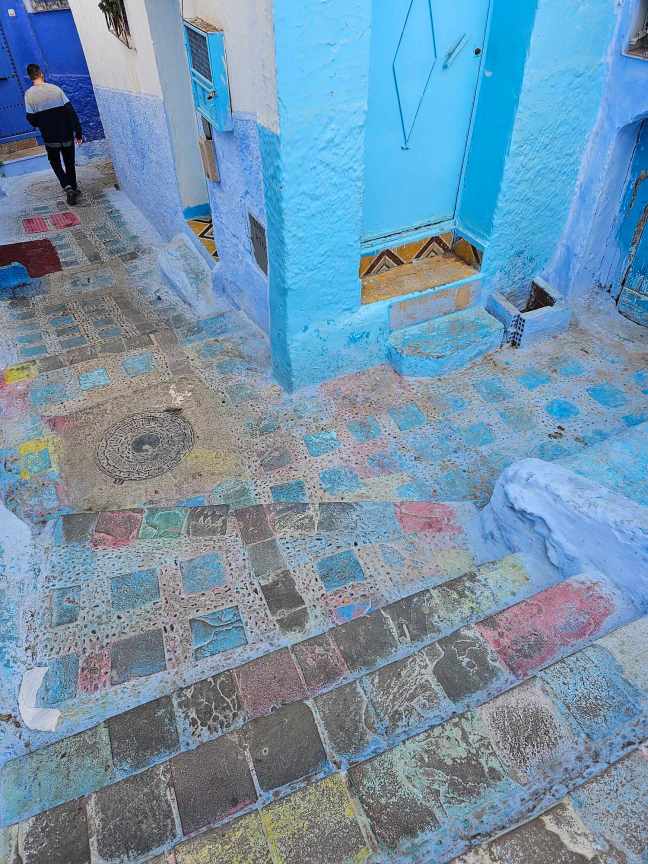
Roughly 3-4 hours north of Fès, further into the mountains, lies a magical town painted in multiple shades of blue. It is famous among tourists to Morocco. Everyone wants to visit the blue city. I have to admit that I am a failed visitor in the fact that I never asked why the buildings of this municipality tucked in the northern Atlas mountain range had been painted my favourite colour.

I do know that travelling to Chefchaouen was an adventurous, long-ish journey where you have to spend roughly four hours getting there in a mini-tour bus. Don’t get me wrong. The bus was comfortable and the driver very professional, with the patience of a saint. But the trek is long and you are very happy when you arrive. The driver is even kind enough to make a stop on the bluff overlooking the town before you move into its centre. At that stop, travellers from all parts of the world carefully cross the busy blacktop to stand in front of the nearby hill town. Interestingly, it looks a lot less blue from the bird’s eye perspective, so you wouldn’t really know it’s the destination you seek without the nearby road signs or the driver telling you that you are close to the end of your journey.

Arriving to Chefchaouen was a relief; well at least until we realised the quickest route to finding our riad (accommodation) was a journey through the people-packed, narrow streets of the old medina in the city centre. So along with Ree, who had to take a deep breath and tolerate a hangry Brenda, we plodded our way up the gradual slope. Fortunately, the blue tones on all walls along the way are calming. You just look in awe and think: who had this idea? Who does the paint touch ups? Are there restrictions on what shades of blue can be used? It immediately occurred to me that the monument protection institute in Prague would have a field day setting out rules on paint usage in this city.

Half-way up the hill, you finally make it out of the medina and you reach an open square. Much to my profound happiness. There, you have a view of the local kasbah (a former fortress and prison) with its colourful gardens and pretty views of the local terra cotta tile rooftops and the jagged hills (mountains) surrounding Chefchaouen. This was a moment of respite from the crowded medina paths but it meant the arrival of the salesmen. Stop for lunch? Would you like something to eat? Check out our shops. It was a lot to handle for someone like me who has come to love the standoffish-ness of most Czech storekeepers and sales clerks. I am a firm subscriber to the If I need something I will ask. take on shopping. Soon enough though – with the generosity of Google maps – we would find our way to our riad and the busy juice-maker (vendor) and his neighbour-carpet sellers who flanked the stairsteps nearby.

And the riad … what can I say? And where to begin? Wonderful staff and a room from a fairytale. Ree was kind enough to let me hide myself in the bed on the upper level, complete with a window nook where I could work, read and inspect the hullabaloo that seemed to be a constant on the stairs and sidewalk below.

There didn’t seem to be a strict tourist agenda for persons visiting Chefchaouen. You were in the blue city, so you enjoyed the blueness. The cute little paths and the many locals who were there to sell, sell, sell. You can watch the vagabond cats scurry from house to house or run the cobblestone sidewalks looking for food and treats. To make my hangriness subside, we agreed to find an internet-recommended restaurant where we could grab a proper lunch and catch our breath after days of being on the move. I’m not sure now what I even ate. I want to stay I started with something puff-pastry adjacent that reminded me of Greek spanakopita. And for the main – a tagine or some sort? Who knows. I mainly remember being enthralled by the mountain views around us. These rocky crags that had to be fairly tall – I was so curious about them I turned on my Mapy.cz app to get confirmation that some were indeed over 2000 metres tall. And then I realised that one should do their homework before travelling: had I know of the nearby mountains and their well-marked hiking paths, I would have booked a longer stay. The reality is that if you hike to the tops of the mountains, a view of the Mediterranean awaits you on the other side. In fact, you are perhaps only 50 km from the seashore. Oh well, there’s always next time.

I don’t know what else to say about Chefchaouen. It was a special, almost surreal place with wonderful people full of kindness and hospitality. You just kind of want to think carefully about the mini-interviews that local vendors conduct. Beyond that, I would love to go back and hike the mountains to the sea. I feel like that needs to happen. Until then.

Craziness and confusion in Casablanca

Over the year-end holidays I made my first trip to Morocco. I honestly had no idea what to expect; I just knew that I had wanted to visit the country for a long time. So we got on the plane from Lisbon and began what would be a fun, unpredictable and tiring adventure. Tiring in a good way though.

Moroccans are very hospitable. You might not initially expect that based on the line at the passport checks in the Casablanca airport. Which took forever, and forever, and forever. As my friend Ree and I waited there to be somehow  let in the country, my hangriness levels started to peak. I don’t really remember now what Ree fed me to keep me from going off the deep end, but it worked. For that matter, I also don’t know what happened to the Asian lady in front of me at the passport check. After she was questioned for 10 minutes, they took her somewhere. I didn’t see her come back.

But we eventually got through and into baggage claim, grabbed our bags, and set off to look for the train station. We quickly found it but had no idea when the train would leave. Turned out it was RIGHT THEN and THERE. So I went into party planner mode and saw Moroccan hospitality and guest care burst into action. I ordered two tickets using my rusty French, told Ree how much we needed to pay … then we ran. We ran because the train was leaving that minute but the ticket vendor called the platform and told them to hold departure for us and they did. Within two minutes we were riding through desert plains to Casa Oasis or Casa Port. Just someplace.

With a little time to relax in the train, we joked about what we had just gone through. And we were really impressed and grateful for the support from our help at the Moroccan ONCF/SNCF. Then came the arrival at the train station and our first stab at finding a Moroccan cab driver, of which there are plenty. I tried to weed through the many “helpful” people who wanted to take us “someplace” and looked for drivers at an official cab stand. That turned out not to work so well but we found a nice enough elderly driver, paid roughly 20 dirham too much to get to the hotel, and then embarked on an interesting ride. My favourite part of that journey was when I turned on Google maps to get the precise hotel location and the driver said “Wow, that GPS tracking is very useful.” I just nodded in tired agreement.

Our hotel location was decent. Lots of boutiques and shops along the busy boulevards, which led me to my first impressions of Casablanca. It is a BIG city for Morocco and feels much more USA metropolitan than Berber, north African desert chic. We bookended our stay in Morocco with a few nights in Casablanca. After our return trip to the city (and a train ride with an interesting Dutch family from whom we got ex post travel advice and discovered what all we had missed out on), we were glad to get back to our favourite hotel and relax. Once again we overpaid for the ride from the train station Casa Oasis to our hotel, but given that other costs for food, public transport, etc. were generally reasonably priced (even cheap by European standards), we just tolerated the random cab fares when necessary.

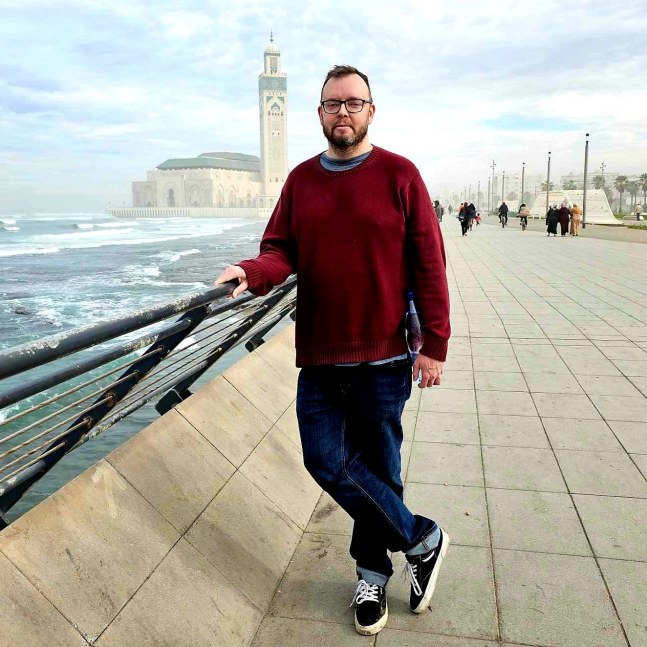
We spent the next day trying to discover Casablanca’s city centre as much as possible. As said, the town is very urban with lots of high-rises and skyscrapers with some bits of traditional architecture woven in here and there. The promenade along the coastline by the main mosque is enjoyable. Waves bustling in from the Atlantic and the misty, foggy beauty of that that semi-shrouded place of worship in morning hours gave it a special air of mystery. Walking along the coastline you could watch local young men on their sports bikes doing tricks, while their elders sat along the beachfront and promenade railing casting their fishing lines in hopes of being rewarded with some sort of nice catch for the day. We rounded out our walks with some visits to cafés and restaurants here and there; enjoying the comfort of the delicious Moroccan mint tea and the gracious kindness of our servers in various types of restaurants – Italian, Moroccan and some sort of fusion. We ate well.

Casablanca remains a sort of mystery to me. It’s a bit too modern and doesn’t have that local feel of the country’s interior,  nor is there that visible switch to a different history and culture I was hoping for. I would be happy to visit again though just to learn more about the city (after doing some online research). Plus, we were told a venture up the coast to Rabat is worthwhile. So, hang on, Casablanca. I’m not quite done with you yet.

Côtes du Rhône … where memories meet and happiness flows

Since I was a teenager, France has had a special power for me. It’s “meant to be-ness” has always made it feel safe. And celebrating a good friend’s birthday in Provence in September served as an important reminder of the need to cherish special certainties.

The givens of Pete fixing amazing food while tormenting me incessantly, or Jakub telling silly dad jokes, or Natalie being armed and ready with rosé, or Laura acting as the voice of reason. Not to mention Jean making sure we were all looked after and the house in order.

An insane route to the farmhouse we were staying at had me less than certain how our celebratory week in Provence would end up. But France, this time the southern part, did not disappoint. The smell of lavender, the rugged mountains hugging our local horizon, and the poplar or sycamore-lined roadways … they all told me that life was as it should be.

It’s funny that the French created the term je ne sais quoi. Because that’s how I often feel when describing why I am at home there. It’s an “I don’t know what” sentiment. I’m never 100% certain why but I always feel welcome when I move through the fruit and veggie markets, when I sit down for un crême, or when I escape inside a house of worship that dates back to the times of The Crusades. The beauty of the Rhone Valley immediately tells visitors, without their knowing why, that everything will be all right.

Our corner of Provence that we hid out in that week afforded us the best that France has to offer. Great wines from the ancient land of Popes (a Châteauneuf-du-Pape or a Gigondas) accompanied most of our meals. The shops welcomed us with the culinary artisanry that only the French can deliver: sumptuous sausages of the Camargue, excellent terrine de foie gras, or rillettes … food shopping in France is unique. Just brush off your French vocabulary from college days and enquire after which local farmers supply the shops and to what periods these agro-culinary traditions date back.

It’s in these moments that you slowly come to understand that the “I don’t know what” may just simply be a proud love or passion for traditions in food-making, animal-raising and store-owning that transcends time. Perhaps, it’s because the river lies nearby. But in the Rhone Valley and that area of France, there’s a fluidity: a phantom of centuries of trade routes that connected Ancient Rome to the Iberian peninsula. When you submit to the region of Provence, you feel these transitory moments. Of wine poured into glasses across the years, of floral scents being gathered for perfumes that would sweeten numerous decades, or of frankincense emanating from churches that would bring the religions of the Holy Land to the Empire’s marchlands.

There’s never a single, clear cause for the serenity and happiness flowing along the Rhone in Provence, but I’m certain it has something to do with the land always seeing to residents’ and visitors’ basic needs. You eat well. You drink well. And you relax as time nourishes you with the riches of the region’s traditions.

Laissez-vous en profiter de ce que la région vous offre.   

Train to the past present – back to Žďár

A trip through memories from the start of my life in the Czech Republic

Traditionally this blog space is meant for my thoughts on travel abroad and, when possible, going to fun, exciting destinations. The pandemic and personal health issues have slowed all that down for me over the past two years (as with everyone). But recovery is in full force and I had what I will call the surprising good fortune to have my train re-directed on a route through my past during my recent trip to meet up with friends in the charming wine village of Valtice

Since Czech Railways is repairing part of their northern corridor, I quickly found out that my journey would take me through the southern route crossing the Czech-Moravian Highlands (the Vysočina region) and small part of my past. It did seem odd getting on the train and looking at an itinerary that skipped from Kolín (in Central Bohemia) on to Brno (what I call the capital of Moravia). But the diversion brought back so many memories as it crossed through the towns where I spent my first years of my sojourn (now life) in the Czech Republic. 

As the morning sun stretched across the landscape, I saw the names of familiar towns pass quickly by my window: Kutná Hora (home to the beautiful St. Barbara’s Cathedral and former mining town), Čáslav (home to a military air base and easily recognisable with the bell tower that stands watch over the town centre) and then Světlá nad Sázavou, a quiet town on the Sázava River, famous for its glass-making. I had the privilege of working many times, in my later career, with a local glassworks firm and both their products and customer service were flawless.

Soon though, we would arrive at the eastern frontier of Bohemia where it disappears into Moravia. That’s when I saw it: the blue and white sign announcing our passage through Havlíčkův Brod. This was one of my main weekend haunts in the early 1990s when a 22-year-old, naïve young man from Missouri had taken on a teaching job in nearby Žďár nad Sázavou (already in Moravia) and would travel to Havlíčkův Brod to spend weekends with teacher-friends in our small expats-meet-locals community. From the window of the train I could smell the memory of a tasty soup Jodi had just made on a snowy winter Saturday, or smoking Sparta’s or “Startky” or whatever was available during pub debates with fellow Missouran, Matt from St. Louis. With Matt, Jodi and guitarist Vojta or whomever else joined our crew, we were likely drinking a Rebel or a Ježek from one of the nearby regional breweries. Quickly though my view of Havlíčkův Brod faded from sight and I began trying to remember the names of villages the local train (Os – osobák; what we dubbed the “oh so slow me” train because that sort of rhymed with the official Czech name osobní) passed through before hitting Žďár. The only ones I recalled were Přibyslav and Veselí. 

And then I saw it on the horizon, the arrival of Žďár. The first glimpse includes the garden communities on the west end of town and then the rail line widens to service incoming and outgoing freight to the largest local enterprise, Žďás. I think at one time it may have employed over half the town. Although not visible from the train, I wondered how many of my old haunts, stores, schools and restaurants were still around. I know the White Lion Hotel (Hotel Bílý lev or Bílého lva) no longer exists. I assume my place of employment, the Škola ekonomiky a cestovního ruchu and its administrators the Holemářovi are still doing fine. But what of the grocery store Mana (by now it’s likely a Lidl or Albert) and the department store we called Papír, hračky, sport (Paper, Toys, Sport)? Because that what was written of on the windows of each floor when viewed from outside. Or what became of Süssův hostinec, the pub that was so local that we foreigners were scared to enter, but which somehow became super friendly once its beer garden opened in the summer? At the time, I spoke perhaps 8 words of Czech and didn’t have the gumption to ask the locals if our entourage could “přisednout” (i.e., join their table provided chairs were available).

Of course, the train moved on quickly towards my destination of Břeclav. But my mind remained stuck at the Žďár train station. What had become of all those students from so long ago. I know Jirka Filippi is a successful corporate manager; Petr Váněk, a good friend of Jirka’s whom I once told in a moment of frustration that his English was subpar and asked what he was going to do when Jirka wasn’t there to speak for him? Well, Petr has since proven to me that perhaps it was the teacher, not the student. He’s become a successful actor and has gone on to play not only roles in Czech movies, TV shows and commercials, but also in English-language films as well. Simply put, he showed me. And I’m so proud he did. So many more names came to mind as the train progressed toward Brno: what of Marek Pospíšil, of Lenka, or Renata or Vít (I hope I have his name right: he was a young, blond, bespectacled student from Havlíčkův Brod who studied in Žďár and invited me one Saturday to meet his mother … how we had any type of conversation in Czech is beyond me; I am guessing Vít was a good interpreter).

Needless to say, I made it to Břeclav and caught my connection to Valtice, where I caught up with the Hradec crew and watched them taste (sample) more wine than any of them can possibly remember. But děkuji (thank you) to Czech Railways for those rail repairs. You took me back to a place in time where both my students and I had our futures still before us. For that I am grateful.

Ապրե՛ս / Ապրե՛ք (Live!)

In a week or so, 60 years will have passed since US president John F. Kennedy signed the executive order 10924 creating the Peace Corps. The date was 1 March 1961. I’ve been thinking for a couple of weeks about how to recognize that very important anniversary while combining it with my personal blog here which focuses on travel.

After a lot of thought, I decided to share with you some comments about how the US Peace Corps has influenced my views on travel and how I perceive it a bit differently now. Although cut short, my experience serving in northern Armenia helped me “travel” in multiple senses of the word. It helped me explore and learn about a country I’ve come to love more than I ever could have imagined. And it helped me advance further down a road of personal maturity and understanding (and coming to accept) what I have to give to, and what I sometimes need from, the world.

All that said, I want to share with you one of the greatest gifts the Armenians gave a language nerd like me. And that would be the word in the title to this blog entry which transliterates as apres or apreq. It is the imperative of the verb “to live” and is used in Armenia as an expression of commendation or praise. When Armenians appreciate something you’ve done or approve of your actions, they literally tell you to “Live!”. Usage of this term is so common in Armenia that I never put much thought into its broader significance and the lessons or values it could teach people from other countries: that one of the greatest gifts we have in this world is life. If you think back on the 20th century history of Armenia – both at the time of the collapse of the Ottoman Empire and after the dissolution of the Soviet Union – you realize that the Armenian people were always endangered by the ambitions of their larger neighbors or the commercial interests of other global powers. For those Armenians who lost family in the genocide of 1915 or other mass killings of Armenian populations or for families who lost sons and fathers in the wars in Artsakh, one of the most precious gifts a person has is “life” or “living”. This is a reality that most of us in Europe or the USA don’t give much thought. One of the most daring, audacious things we can do in our time on this planet is to live. Not just exist, but LIVE!

This is a point that was not lost on me the longer I stayed in Armenia and got to know the people there. I went to the Peace Corps because I wanted to learn about another culture; I had hoped that some of the skills and experience I had acquired in my professional life over 20+ years would be of some use or worth to local communities. To my surprise though, my Armenian colleagues and families taught me a small lesson of enormous value: I needed to learn to live. This meant celebrating all that life offers us from dusk till dawn: from making tahini sandwiches with my host sister Yeva and having my morning tea with her mom Zara, on to having a late evening snack with my second host dad Artur and watching bits of the TV news with him. I learned that actually living meant I needed to slow down to truly see and appreciate life. I needed to listen. I had to find value in opening up to strangers and appreciating their natural curiosity about the super tall, dark-haired man who wasn’t one of them, who wasn’t a Russian speaker, but who had somehow made his home for awhile in their bustling town.

I like to think that over time, all the progress that I made in learning how to live (how to heal myself) came from the repetition of that tiny, yet powerful, Armenian entreaty: ապրե՛ս. My Armenian friends and family constantly invited me to enjoy life, to take time to talk and share myself with them and their families, and to notice the small blessings that show up around us day in, day out. So, Armenia, thank you for helping me truly live and enjoy life: ձեզ էլ ապրե՛ք։

Armenia: I (wish I could) take away your pain

Հայաստան։ ցավդ տանեմ

One of the phrases you hear quite often when you live in Armenia, or a phrase you notice quickly as a foreigner living there, is ցավդ տանեմ. It literally means “I take your pain.”  It is a special phrase that I initially thought to be rather trite or overused because you constantly hear it said in daily conversations.

However, it took me a year of living in Armenia and about a half-year (post-Armenia) of reflecting on those words to really understand them. To actually “get them” as we say in English. Learning about Armenian culture and the aftermath of the genocide at the start of the 20th century, you begin to understand that Armenians know something about pain. They’ve had their fair share of suffering. But the special part of the unique Armenian experience, at least for me while living there, is how much of the pain of family, colleagues and even strangers they are willing to take on as their own burden. If they say ցավդ տաեեմ։  to you, they honestly mean that through some act, big or small, they would like to make your situation better.

As I watch the events unfold in Artsakh (commonly called Nagorno-Karabakh, but I use the Armenian term because of the bonds I formed with Armenians and my ties to families whose sons have been drafted), I think yet again about the selflessness of the Armenian people. They are so hospitable and welcoming, and the struggle of Armenian populations in Artsakh really is their struggle. It is also a painful situation that reminds them of the events of 1914-1923 that saw Armenians lose access to over half their native lands and be forced into a world that was sometimes welcoming, sometimes not. Of course, in many cases they had to survive the forced marches across the Syrian desert to even gain access to new lives and new opportunities.

Yet, if you look now, as their diaspora rises up to speak about the unnecessary and destabilizing conflict and aggression (fomented by present-day Armenia’s Western neighbor and easily seized upon by their Eastern one), you see the greater Armenian global family come to life. You hear the slowly growing cry of ցավդ տանեմ as Armenians from all around the world work to raise awareness of the larger problems of the Azeri-Armenian conflict and to support their kinfolk. Armenians in the diaspora from California in the USA to the shores of Lebanon, from the streets of Paris or even Prague’s Old Town Square are calling for the world to act: to see the pain and suffering caused, not so much by Azeri-Armenian-instigated fighting, i.e. that of two peoples, but rather by the work of two despots Erdogan and Aliyev, who have exacerbated conflict for political gain. These two men have taken advantage of the instability, suffering and chaos of a Covid-stricken world and are using aggression to distract domestic populations from their own shortcomings as leaders.

In 2018, the people of Armenia went to the streets, they elected a reform-minded government. They had what they called their Velvet Revolution: in fact, that makes Armenia the second country I’ve called home for a time that has had such a calm, people-driven call for change and reforms that led down the path to a peaceful, democratic existence.  I want the Armenians to be able to continue down that path.  I want to scream from the top of my lungs to all my Armenian friends, to the youth of that country, to the peoples of Artsakh seeking self-determination: ցավդ տաեեմ։  I want you all to have the peace and prosperity you so deserve, and I wish I could take away your pain.


Autumn Lockdown

Walking from coffee, 
In anticipation of rain.
Thoughts like leaves, 
Flutter through my brain.

Could I make it to the river,
Without getting wet.
To guesstimate Prague weather,
Would be a fool's bet.

The day was so indifferent,
A sky of pinks and grays.
Colored leaves squealed the end of autumn,
Through a milky, sun-tinged haze.

I thought of coming seasons,
As I climbed the Kinský garden hills.
A virus has imprisoned us,
I fear a new year void of thrills.

So now I sit by the wading pond,
As dogs circle my legs.
One dashes into the water,
While the other nears me to beg.

Soon I will rise,
For to Malá Strana I descend.
My fall stroll will finish,
Having more coffee with friends.

Wandering Lužnice (Pt. 2)

When finishing my previous post on hiking the Lužnice River trail in southern Bohemia, my friends and I had just arrived to the picturesque village of Dobronice u Bechyně. The hike into Dobronice was a tiring, but visually-pleasing finale to a long day of walking. As you approach the village, the path veers away from the river up a fairly steep hill that offers specials vistas of the Lužnice River from above. You see the water wind its way around the village below where small mills hug the right bank and the clackety-clack of the village’s single wooden bridge echoes up from the valley below. 

As you hike to the village center you first pass a look-out point just next to the Church of the Assumption of the Blessed Virgin, which sits in serene isolation at the village’s eastern edge. The marked footpath takes hikers back down to the river, while guiding them alongside the entry to the ruins of what was once Dobronice castle. The castle’s one remaining tower can be seen from the walking path and also from several points along the river below. 

We stayed overnight at a local bed and breakfast and gobbled up the tasty traditional Czech food that the innkeeper prepared. There was sumptuous roast pig, traditional beef goulash and also typical fried edam cheese (that’s the option I chose, because I hadn’t had any in a good while). The bed breakfast/inn offered nice views of the river and I fell asleep that night to the sound of stray cars clanking across the nearby bridge. 

Waking up the next day, we had a special visual treat in the fog lifting off the river and clouding the air around us as we enjoyed our breakfast. It was a quick meal, as we still had about 15 km before us and wanted to get an early start to our final destination of Bechyně. The start of the path was merciful: it began with roughly 3-4 km of tromping over footpaths through dew-covered meadows before once again returning to the mud/rock combo paths they we had regularly encountered the day before. 

It was during this segment of our hike that we got to enjoy the serenity of the Lužnice. Not many rafters and kayakers were out on the water yet, so we took advantage of the morning sun and sitting on the boulders that lay along the riverbanks. The large flat rocks offered the perfect place for sunbathing or for jumping into the refreshing water. Unfortunately though, we were short on time, so we quickly carried on along the riverside path that would intermittently offer sections of marsh where we would hop from one wood plank to the next or sections of rugged cliffs facing the river. These fascinating rock formations were frequently laden with ferns and lush moss.  

Slowly, our river path gave way to gravel roads that led to a series of small cottages that are part of the village Senožaty. I later learned that a friend of mine from East Bohemia has a cottage there where he and his family often stay in summer months. After that, our path would once again pull us away from the river rising into dense beech, pine and spruce forests that would lead to the edge of Bechyně. The forests smelled of pine needles and were just damp enough to offer prime growing conditions for the various types of mushrooms that are found throughout the Czech Republic. We even came across some chanterelles; yet not enough to pick for a good sauce to accompany our dinner.

Within 15 minutes or so, we were out of the forest and walking a field path that would lead us into Bechyně. The smells of autumn surrounded us: fields had been harvested and local apple trees had begun to shed their fruit. We stopped for a last group photo by the sign marking the town limits and then walked into the center to enjoy our “victory coffee”.  With my feet starting to protest a little too much, I left my friends to explore the beautiful chateau in Bechyně and to look at its lovely gardens. I, on the other hand, slowly began my way back to the local rail station and took in views of the public park that surrounds the town’s local spas. It was a wonderful end to the weekend: enjoyed with last-minute photos on Bechyně’s main square and catching glimpses of the town’s “rainbow bridge” as we took the train back to Tábor where we would pick up our car. It took my feet 3-4 days to forgive me for our weekend sojourn, but it was well worth it in the end.

Living in three spaces

I haven’t felt like blogging for a while. Or perhaps it’s more that I didn’t know where to go with my writing. It’s been half a year now since I returned (unexpectedly) from northern Armenia.  Now is the moment where the change starts to gel or solidify. I realize that, while I can still hold a conversation in հայերեն, it’s more difficult to recall words that used to be commonplace.  Memories are beginning to fade, and moments of daily life are more distant … saying hello to Manvel who lived in the first floor of my building. He knew three sentences in English, but he greeted me religiously every time I walked by. Always reminding me that I was welcome in Vanadzor and in Armenia in general.  I miss the moments spent persuading fruit and veg vendors that Russian wasn’t my native tongue, and that I could get through a conversation in my pigeon Armenian. I miss the lady from my “beer garden” in Tigran Mets Avenue, who gradually got used to my arriving mid-afternoon on Saturdays after a hike: book in hand, just me, myself and I … ready for a cold draught beer. 

Now as the Czech summer ends and I watch videos, listen to songs, or browse through photos so I can cling to the recollections of my Armenian adventure, I gradually merge the similarities of three specific places I once called home. 

I’m a rural person at heart. I spent my childhood wanting to escape small town life. My dad had aspirations that I would become a farmer and work with animals: as had been his dream. But my hopes went farther. I’m not sure if it was the genetics of my ever-moving paternal grandmother or the travel tales recounted by my very wise neighbor. But I knew I wanted life beyond any local farm. Funny thing is though: despite becoming a city-slicker, I never forsook my rural upbringing or time spent working with my dad, uncles and grandmother. It is the long thread of rural life that, for me, binds Missouri with rural Bohemia and the pastures of Armenia’s Lorri region. In the fields of all those lands, I see and feel the memory of my dad and his dreams; secretly hoping that some of my life’s adventures have made him proud.

Good people are worth listening to. Something inside me tends to be averse to seeking out conversation. However, many places I have lived so easily lent themselves to impromptu chats and discussion. Whether it be the doorways of stores on Brookfield’s Main Street, the garden pub of a Czech village along a random bike route, or the encounters with shepherds as they moved their herds between northern Armenia’s lush, green hills. They all began as strangers to me, yet we ended with many bonds: some had family that had emigrated, others had seen American TV shows or had travelled to Prague on a family holiday. It was my wary, skeptical entries into these numerous, ad hoc chats that confirmed to me that as citizens of the world we are all ostensibly different but very much still the same in our curiosity and desire to learn about and connect with others.

The women of my past prepared me for my future.  Then there’s the W factor. As mentioned above, it was the women of my childhood who told me of the world outside my hometown. They assured me that studying and hard work would give me access to that world. And as the years prove them right, I remember and channel their spirits as I mull new adventures and live new experiences. In my mind, I talked to Elsie as I admired the gardens of many an Armenian grandmother. I give thanks to Louise and Mildred for their nurturing my interest in languages and travel and for helping make possible my first TWA flight to Paris. I summon the courage of Jacqueline anytime I’m not sure I have what it takes to defend myself and fight for what is just in the world. How she so nonchalantly stated in that Parisian tailor’s shop: I survived the Nazis; I’m hardly going to cower to a greedy, deceitful clothing store owner.

It’s been a difficult summer reminiscing about my homes old and new. But I am forever grateful for the lessons they taught me and the people from those places who enriched my spirit more than I ever could have imagined.