Chefchaouen: Still questioning an azure, cerulean, cornflower, powder blue mystery.

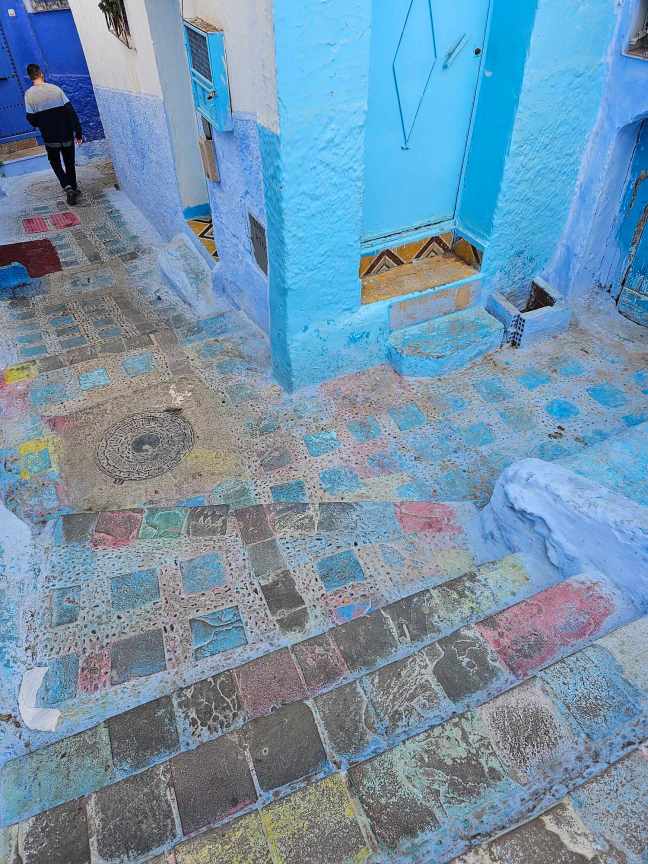
Roughly 3-4 hours north of Fès, further into the mountains, lies a magical town painted in multiple shades of blue. It is famous among tourists to Morocco. Everyone wants to visit the blue city. I have to admit that I am a failed visitor in the fact that I never asked why the buildings of this municipality tucked in the northern Atlas mountain range had been painted my favourite colour.

I do know that travelling to Chefchaouen was an adventurous, long-ish journey where you have to spend roughly four hours getting there in a mini-tour bus. Don’t get me wrong. The bus was comfortable and the driver very professional, with the patience of a saint. But the trek is long and you are very happy when you arrive. The driver is even kind enough to make a stop on the bluff overlooking the town before you move into its centre. At that stop, travellers from all parts of the world carefully cross the busy blacktop to stand in front of the nearby hill town. Interestingly, it looks a lot less blue from the bird’s eye perspective, so you wouldn’t really know it’s the destination you seek without the nearby road signs or the driver telling you that you are close to the end of your journey.

Arriving to Chefchaouen was a relief; well at least until we realised the quickest route to finding our riad (accommodation) was a journey through the people-packed, narrow streets of the old medina in the city centre. So along with Ree, who had to take a deep breath and tolerate a hangry Brenda, we plodded our way up the gradual slope. Fortunately, the blue tones on all walls along the way are calming. You just look in awe and think: who had this idea? Who does the paint touch ups? Are there restrictions on what shades of blue can be used? It immediately occurred to me that the monument protection institute in Prague would have a field day setting out rules on paint usage in this city.

Half-way up the hill, you finally make it out of the medina and you reach an open square. Much to my profound happiness. There, you have a view of the local kasbah (a former fortress and prison) with its colourful gardens and pretty views of the local terra cotta tile rooftops and the jagged hills (mountains) surrounding Chefchaouen. This was a moment of respite from the crowded medina paths but it meant the arrival of the salesmen. Stop for lunch? Would you like something to eat? Check out our shops. It was a lot to handle for someone like me who has come to love the standoffish-ness of most Czech storekeepers and sales clerks. I am a firm subscriber to the If I need something I will ask. take on shopping. Soon enough though – with the generosity of Google maps – we would find our way to our riad and the busy juice-maker (vendor) and his neighbour-carpet sellers who flanked the stairsteps nearby.

And the riad … what can I say? And where to begin? Wonderful staff and a room from a fairytale. Ree was kind enough to let me hide myself in the bed on the upper level, complete with a window nook where I could work, read and inspect the hullabaloo that seemed to be a constant on the stairs and sidewalk below.

There didn’t seem to be a strict tourist agenda for persons visiting Chefchaouen. You were in the blue city, so you enjoyed the blueness. The cute little paths and the many locals who were there to sell, sell, sell. You can watch the vagabond cats scurry from house to house or run the cobblestone sidewalks looking for food and treats. To make my hangriness subside, we agreed to find an internet-recommended restaurant where we could grab a proper lunch and catch our breath after days of being on the move. I’m not sure now what I even ate. I want to stay I started with something puff-pastry adjacent that reminded me of Greek spanakopita. And for the main – a tagine or some sort? Who knows. I mainly remember being enthralled by the mountain views around us. These rocky crags that had to be fairly tall – I was so curious about them I turned on my Mapy.cz app to get confirmation that some were indeed over 2000 metres tall. And then I realised that one should do their homework before travelling: had I know of the nearby mountains and their well-marked hiking paths, I would have booked a longer stay. The reality is that if you hike to the tops of the mountains, a view of the Mediterranean awaits you on the other side. In fact, you are perhaps only 50 km from the seashore. Oh well, there’s always next time.

I don’t know what else to say about Chefchaouen. It was a special, almost surreal place with wonderful people full of kindness and hospitality. You just kind of want to think carefully about the mini-interviews that local vendors conduct. Beyond that, I would love to go back and hike the mountains to the sea. I feel like that needs to happen. Until then.

Fès (Fez): the Final Frontier

There was something about this city. You could feel it calling even before you left the Casa Voyageur train station on the other side of the country. Way too early in the morning to embark on an almost four-hour train ride, but you could sense adventure in the air. The balmy breeze through Casablanca and its surroundings quickly left us and as the train bounded forward into a sunny, desert-esque landscape. We splurged on first class tickets to make sure we had seats waiting for us and upon finding our spots the social engagement began. For a time, we chatted with a fellow tourist from Senegal who shared bits and pieces of information about his travels throughout Morocco – he pointed out that there was a second Chefchaouen called Nador further down the northern coastline. My Moroccan colleague from Tangier begs to differ on this opinion. The voyage went fairly fast, however. A couple, of which the husband was a restaurateur who had worked all over the United States, told us of his American adventures and welcomed us to his country. He gave highlights of different sights that we needed to see and offered his appraisals of our plans for travel around the Fez area.

Arrival in Fez

When descending from the train, it was clear we were in a different region with a different climate. The temperature had jumped about 10°C and the winter coats and sweaters quickly became a burden. The sport of finding a reasonably priced cab then followed. And we did OK haggling a price of 70 dirham down to 50. Comparatively, the taxi fees aren’t terrible; there’s just a bit of competition involved relating to one’s personal pride and a need to prove that this isn’t a person’s first rodeo. That said, the driver was kind and quickly dispatched us to the Blue Gate, where a staff member from our riad would be waiting for us.

It’s hard to put into words the overwhelming of the senses that occurred next. Picked up by our riad contact, we marvelled at the amazing architecture and the bustle of the westernmost part of the old medina (market). The entry to the medina also seemingly has the only permanently functioning ATM for cash withdrawals, which is an important thing to know about travel in Morocco. In the cities, card payments are common, but in some larger and medium-sized towns, they will say cards are OK but later make an excuse to accept only cash. There’s no malicious intent involved – it appears to be solely a matter of convenience, internet connections, and possibly tax evasion.

From the market to maison

The medina was all I expected it to be and in some cases more. It was a bedlam and cacophony of selling, selling, selling. Piles of fresh fruit and vegetables: onions, oranges, tangerines, zucchini, carrots, you name it. Here and there, animal oddities would appear. You could find crates of fresh eggs overseen by a rooster and a hen or two, who gave the feeling they didn’t wish to depart with their goods. Likewise, you would see cages of pigeons; grain sacks full of flour, cornmeal, barley; and food stands offering everything from kebabs to sandwiches on to doughnuts. The doughnuts were tasty and kept us going on our afternoon train back to Casablanca later that week.

I am not sure where to begin when it comes to describing our accommodation. We stayed in two separate apartments in two riads (bed and breakfasts) run by the same family. When I think back on that experience, the words hospitality, kindness, good food and helpfulness come to mind. The interior décor of those buildings transported you to another space and time: the colourful geometric designs, the plump cushions, fluffy beds, elaborate handwoven carpets. You felt like you had stepped into an old tale about Aladdin or Sinbad (even if those took place in different countries). The talent, craftmanship and skilful mystique of those venues’ architects made the experience special.

An afternoon in the tanneries and a morning in the royal gardens

There was so much to take in in Fez. From the scrumptious breakfasts with four types of homemade bread, honey that tasted and smelled as if a colony of bees had delivered it that very morning, or the mazes of streets and alleyways that made up the old medina. There were ups and downs to navigating the old city, impacted by warnings we had been given not to stray off main streets. It was pointed out to us that offers to help tourists find their way were not always helpful. So that made me a bit more careful and mindful of using Google maps and refusing many offers for guidance. But the experience and the kindness of the family running the Fez tanneries and seeing how animal skins were cleaned, processed and decorated reassured me of the local people’s goodness and big hearts. The owners offer fresh mint to mute the smell of the animal hides and pigeon excrement used in the tanning process, but for this one time Missouri country boy it just smelled like your typical Friday at a sale barn.

Enjoying the natural surroundings of the city and the amazing ancient walls, we worked our way back up the hill to our particular gate to the city. It was a long, steady climb but the golden, tawny rock that encloses Fez is beautiful and somehow seems to warm the soul. The following day we would penetrate the wall from the other side to loiter in the royal gardens and watch locals enjoy morning walks with their children. We observed the egrets sunbathing and the occasional stork dropping from the sky to inspect what the fuss was about.

This is scattershot description of my impressions of Fez. But truth be told, I am still processing all the city had, and what more it still has, to offer.

Craziness and confusion in Casablanca

Over the year-end holidays I made my first trip to Morocco. I honestly had no idea what to expect; I just knew that I had wanted to visit the country for a long time. So we got on the plane from Lisbon and began what would be a fun, unpredictable and tiring adventure. Tiring in a good way though.

Moroccans are very hospitable. You might not initially expect that based on the line at the passport checks in the Casablanca airport. Which took forever, and forever, and forever. As my friend Ree and I waited there to be somehow  let in the country, my hangriness levels started to peak. I don’t really remember now what Ree fed me to keep me from going off the deep end, but it worked. For that matter, I also don’t know what happened to the Asian lady in front of me at the passport check. After she was questioned for 10 minutes, they took her somewhere. I didn’t see her come back.

But we eventually got through and into baggage claim, grabbed our bags, and set off to look for the train station. We quickly found it but had no idea when the train would leave. Turned out it was RIGHT THEN and THERE. So I went into party planner mode and saw Moroccan hospitality and guest care burst into action. I ordered two tickets using my rusty French, told Ree how much we needed to pay … then we ran. We ran because the train was leaving that minute but the ticket vendor called the platform and told them to hold departure for us and they did. Within two minutes we were riding through desert plains to Casa Oasis or Casa Port. Just someplace.

With a little time to relax in the train, we joked about what we had just gone through. And we were really impressed and grateful for the support from our help at the Moroccan ONCF/SNCF. Then came the arrival at the train station and our first stab at finding a Moroccan cab driver, of which there are plenty. I tried to weed through the many “helpful” people who wanted to take us “someplace” and looked for drivers at an official cab stand. That turned out not to work so well but we found a nice enough elderly driver, paid roughly 20 dirham too much to get to the hotel, and then embarked on an interesting ride. My favourite part of that journey was when I turned on Google maps to get the precise hotel location and the driver said “Wow, that GPS tracking is very useful.” I just nodded in tired agreement.

Our hotel location was decent. Lots of boutiques and shops along the busy boulevards, which led me to my first impressions of Casablanca. It is a BIG city for Morocco and feels much more USA metropolitan than Berber, north African desert chic. We bookended our stay in Morocco with a few nights in Casablanca. After our return trip to the city (and a train ride with an interesting Dutch family from whom we got ex post travel advice and discovered what all we had missed out on), we were glad to get back to our favourite hotel and relax. Once again we overpaid for the ride from the train station Casa Oasis to our hotel, but given that other costs for food, public transport, etc. were generally reasonably priced (even cheap by European standards), we just tolerated the random cab fares when necessary.

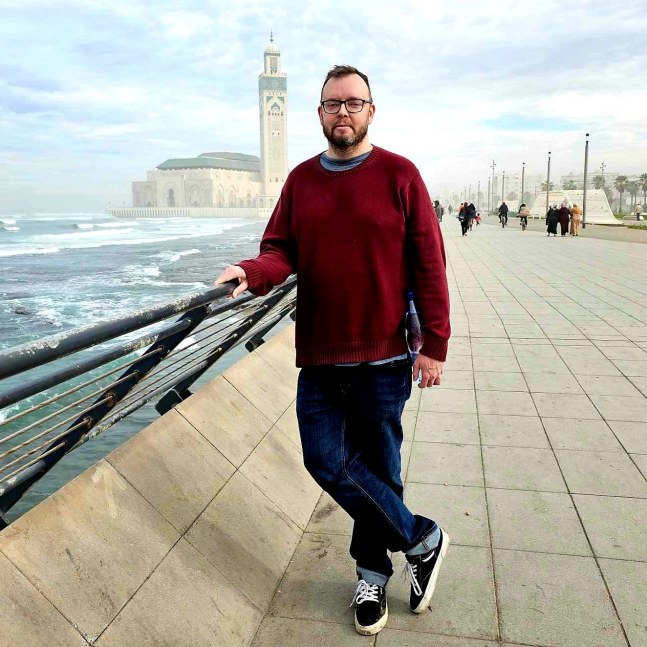
We spent the next day trying to discover Casablanca’s city centre as much as possible. As said, the town is very urban with lots of high-rises and skyscrapers with some bits of traditional architecture woven in here and there. The promenade along the coastline by the main mosque is enjoyable. Waves bustling in from the Atlantic and the misty, foggy beauty of that that semi-shrouded place of worship in morning hours gave it a special air of mystery. Walking along the coastline you could watch local young men on their sports bikes doing tricks, while their elders sat along the beachfront and promenade railing casting their fishing lines in hopes of being rewarded with some sort of nice catch for the day. We rounded out our walks with some visits to cafés and restaurants here and there; enjoying the comfort of the delicious Moroccan mint tea and the gracious kindness of our servers in various types of restaurants – Italian, Moroccan and some sort of fusion. We ate well.

Casablanca remains a sort of mystery to me. It’s a bit too modern and doesn’t have that local feel of the country’s interior,  nor is there that visible switch to a different history and culture I was hoping for. I would be happy to visit again though just to learn more about the city (after doing some online research). Plus, we were told a venture up the coast to Rabat is worthwhile. So, hang on, Casablanca. I’m not quite done with you yet.

Almost there – reflections on a continuing journey

A year and a half since I opened my eyes

Learning to breathe and re-learning to see

I got a second chance

But how to use it?

Reassessed, re-aware…

At almost fifty I was finally learning

The importance of love, the treasure of friends

The luck in knowing someone was there…

To hold my hand

I had to extend it

Had to admit this man is NOT an island

In time the water eventually recedes

And connects us to the main

With my new eyes and engine

I could discern – what was vital and what was nonsense

Watching all the chasing

The inebriation of ambition

Each new dawn, every additional mountain climbed

That was my high

The crutches were gone

But the nervousness wasn’t

Learning to breathe again steadied me

The power of NO saved me

It was time to be selfish

Accepting that unhappy me could not bring joy to others

Reading in the park

Watching the kids become adults

Switching off the devices

All that got me to here

And soon a new chapter opens

Time to leave the sounds

Reroute them to the periphery

Accept my new opportunities and seize them

I will be fine … the tests say so

So now I will move on

Embrace each day as a gift

No tomorrow is guaranteed

But as I advance on this journey

I know how to fill each day

And who will hold my hand along the way

Breathe.

Ապրե՛ս / Ապրե՛ք (Live!)

In a week or so, 60 years will have passed since US president John F. Kennedy signed the executive order 10924 creating the Peace Corps. The date was 1 March 1961. I’ve been thinking for a couple of weeks about how to recognize that very important anniversary while combining it with my personal blog here which focuses on travel.

After a lot of thought, I decided to share with you some comments about how the US Peace Corps has influenced my views on travel and how I perceive it a bit differently now. Although cut short, my experience serving in northern Armenia helped me “travel” in multiple senses of the word. It helped me explore and learn about a country I’ve come to love more than I ever could have imagined. And it helped me advance further down a road of personal maturity and understanding (and coming to accept) what I have to give to, and what I sometimes need from, the world.

All that said, I want to share with you one of the greatest gifts the Armenians gave a language nerd like me. And that would be the word in the title to this blog entry which transliterates as apres or apreq. It is the imperative of the verb “to live” and is used in Armenia as an expression of commendation or praise. When Armenians appreciate something you’ve done or approve of your actions, they literally tell you to “Live!”. Usage of this term is so common in Armenia that I never put much thought into its broader significance and the lessons or values it could teach people from other countries: that one of the greatest gifts we have in this world is life. If you think back on the 20th century history of Armenia – both at the time of the collapse of the Ottoman Empire and after the dissolution of the Soviet Union – you realize that the Armenian people were always endangered by the ambitions of their larger neighbors or the commercial interests of other global powers. For those Armenians who lost family in the genocide of 1915 or other mass killings of Armenian populations or for families who lost sons and fathers in the wars in Artsakh, one of the most precious gifts a person has is “life” or “living”. This is a reality that most of us in Europe or the USA don’t give much thought. One of the most daring, audacious things we can do in our time on this planet is to live. Not just exist, but LIVE!

This is a point that was not lost on me the longer I stayed in Armenia and got to know the people there. I went to the Peace Corps because I wanted to learn about another culture; I had hoped that some of the skills and experience I had acquired in my professional life over 20+ years would be of some use or worth to local communities. To my surprise though, my Armenian colleagues and families taught me a small lesson of enormous value: I needed to learn to live. This meant celebrating all that life offers us from dusk till dawn: from making tahini sandwiches with my host sister Yeva and having my morning tea with her mom Zara, on to having a late evening snack with my second host dad Artur and watching bits of the TV news with him. I learned that actually living meant I needed to slow down to truly see and appreciate life. I needed to listen. I had to find value in opening up to strangers and appreciating their natural curiosity about the super tall, dark-haired man who wasn’t one of them, who wasn’t a Russian speaker, but who had somehow made his home for awhile in their bustling town.

I like to think that over time, all the progress that I made in learning how to live (how to heal myself) came from the repetition of that tiny, yet powerful, Armenian entreaty: ապրե՛ս. My Armenian friends and family constantly invited me to enjoy life, to take time to talk and share myself with them and their families, and to notice the small blessings that show up around us day in, day out. So, Armenia, thank you for helping me truly live and enjoy life: ձեզ էլ ապրե՛ք։

Seeking Serenity in the Orbe Valley (Pt. 2)

In my last post, I spoke of my holiday hiking with friends met in Prague who now live in Lausanne. We decided that in today’s Covid-impacted world the best spiritual rejuvenation would come from getting out of the city and back to nature. Luckily, some of Switzerland’s most interesting and intriguing natural sites are to be found at the foot of the Jura mountains: not far from our home base in Lausanne. Our preferred destination is Les Clées (reached easily by car). Our first hike this season, a new one to me, was a footpath heading west of Les Clées village: in direction of the French border. 

I have to admit that his hike was not full-on serene for me. The nature was amazing and beautiful, but the precarious path and the threat of a possible fall off a steep incline down into the Orbe River had me a bit ill-at-ease at times. Initially, the route is wider and you focus more on questioning why you had such a big breakfast OR you wish you’d had more to eat. You need a good store of energy to push yourself up the constantly ascending path. However, quickly the route narrows and you look at the rushing Orbe below and wonder how rapidly you might plummet down to the water.

As with all things Swiss, this path is impeccably organized. Should you happen on an outshoot of rock: no worries. The locals long ago carved a tunnel into the grey-white rock so that hikers can easily navigate through the mountainside when need be. Likewise, this section of the Orbe River Path also has ample swells of fresh-water springs that trickle slowly to the rapids down below. In the winter season, these water flows offer an additional, amazing spectacle: icicle cascades. Passages through the rock tunnels along the route have an almost 2m tall person like myself dodging a number of frozen-water daggers: a) so as not to hit my head, b) in order to preserve the beauty the icicles contribute to this magical, wintertime, natural kingdom.

The hike provides ample amounts of calm and solace, with the only creatures interrupting our thoughts being Izzi our Vizsla canine companion (she’s afraid of the icy footbridges) and our Jack Russell named Poppy, who shoots up and down the path and sometimes along the icy cliffside without thought for potential consequences. Ultimately though, there is an incredible reward toward the end of the trail. These are the Le Day waterfalls (the Saut du Day) which tower over you as you reach a broadening of the Orbe River where it shallows out and serves up rocky sandbars that are perfect for a picnic. It was at the waterfalls that we went crazy with our cameras and took multiple pics of our beautiful surroundings. We let the dogs test the icy waters and run to their hearts’ content. Plus, it was there that we came across our first humans: other locals on holiday, who also apparently needed to escape their isolating in place for just an hour or two.

I am thankful to have spent a part of my holidays admiring the Orbe River and the gorge through which it passes. It is a calming, fascinating place where I never cease to be in awe of how the water swiftly flows, sharing its gurgles with the random hikers who pass alongside it. I give thanks to the Swiss people who look after the nearby paths and make such wonderful views of nature accessible to all who journey to the area for a walk. As I sit here in Day 4 of my post-holiday quarantine, I can still hear the river calling me. Come back one day. I’ll be waiting. And surely I will return: for a future dose of much needed and appreciated serenity.       

Armenia: I (wish I could) take away your pain

Հայաստան։ ցավդ տանեմ

One of the phrases you hear quite often when you live in Armenia, or a phrase you notice quickly as a foreigner living there, is ցավդ տանեմ. It literally means “I take your pain.”  It is a special phrase that I initially thought to be rather trite or overused because you constantly hear it said in daily conversations.

However, it took me a year of living in Armenia and about a half-year (post-Armenia) of reflecting on those words to really understand them. To actually “get them” as we say in English. Learning about Armenian culture and the aftermath of the genocide at the start of the 20th century, you begin to understand that Armenians know something about pain. They’ve had their fair share of suffering. But the special part of the unique Armenian experience, at least for me while living there, is how much of the pain of family, colleagues and even strangers they are willing to take on as their own burden. If they say ցավդ տաեեմ։  to you, they honestly mean that through some act, big or small, they would like to make your situation better.

As I watch the events unfold in Artsakh (commonly called Nagorno-Karabakh, but I use the Armenian term because of the bonds I formed with Armenians and my ties to families whose sons have been drafted), I think yet again about the selflessness of the Armenian people. They are so hospitable and welcoming, and the struggle of Armenian populations in Artsakh really is their struggle. It is also a painful situation that reminds them of the events of 1914-1923 that saw Armenians lose access to over half their native lands and be forced into a world that was sometimes welcoming, sometimes not. Of course, in many cases they had to survive the forced marches across the Syrian desert to even gain access to new lives and new opportunities.

Yet, if you look now, as their diaspora rises up to speak about the unnecessary and destabilizing conflict and aggression (fomented by present-day Armenia’s Western neighbor and easily seized upon by their Eastern one), you see the greater Armenian global family come to life. You hear the slowly growing cry of ցավդ տանեմ as Armenians from all around the world work to raise awareness of the larger problems of the Azeri-Armenian conflict and to support their kinfolk. Armenians in the diaspora from California in the USA to the shores of Lebanon, from the streets of Paris or even Prague’s Old Town Square are calling for the world to act: to see the pain and suffering caused, not so much by Azeri-Armenian-instigated fighting, i.e. that of two peoples, but rather by the work of two despots Erdogan and Aliyev, who have exacerbated conflict for political gain. These two men have taken advantage of the instability, suffering and chaos of a Covid-stricken world and are using aggression to distract domestic populations from their own shortcomings as leaders.

In 2018, the people of Armenia went to the streets, they elected a reform-minded government. They had what they called their Velvet Revolution: in fact, that makes Armenia the second country I’ve called home for a time that has had such a calm, people-driven call for change and reforms that led down the path to a peaceful, democratic existence.  I want the Armenians to be able to continue down that path.  I want to scream from the top of my lungs to all my Armenian friends, to the youth of that country, to the peoples of Artsakh seeking self-determination: ցավդ տաեեմ։  I want you all to have the peace and prosperity you so deserve, and I wish I could take away your pain.


History and Agriculture in the Wachau

In a whirlwind day trip last Saturday, I had the pleasure of re-experiencing one of the most beautiful sections of the Danube river valley: the Wachau. It includes a short section an important European waterway full of stories from history dating back to Richard the Lionheart.  In fact, it was in the village where he was imprisoned, Dürnstein, that we made our first stop. We descended our bus at the water’s edge and turned, on foot, up a slowly inclining cobblestone road that led to the village center. From the retainer walls that once protected the old town, one could take in expansive views of the Blue Danube and look west to the central Wachau valley.

Above Dürnstein village sit the ruins of the old castle where Richard was imprisoned; it stands precariously on the crags and rocky cliffs that rise above the river in this area. It was a special treat to stop here, as I had read last year about Richard the Lionheart’s capture and imprisonment in the excellent travel diary by Patrick Leigh Fermor, A Time of Gifts. I had first travelled through the Wachau in 2009 on a charity bike ride, The MAD Danube Odyssey, and was wondering how I had missed stopping at this site. 

After a quick peak at the abbey in Dürnstein and its colorful, baroque architecture, we quickly boarded our bus to move further upstream to Melk, the western gateway to the Wachau. Melk is famous for its chateau and monastery where monks still study and serve to this day. The yellow-tinged chateau, known for its role in education and the local economy, sits like a dreamy wedding cake atop a precipice looking down on the Danube. It bids welcome to all travelers as they float downstream into the Wachau region. The Melk chateau and abbey is vast in size with its large courtyards, its impressive baroque church and its library with an enormous collection of scholarly works focused on law, theology, philosophy and economics. 

It is at the western end of the chateau complex that visitors can take in breathtaking views of the Danube below, the quaint town of Melk, and the expanses of fields and forests that line the mighty river. When exiting the chateau complex at its eastern end, visitors can wander through a lovely set of French gardens that are immaculately groomed and offer pleasant respite from the bustle of the tours in the chateau/abbey proper. These quiet parks and garden paths are lined with lovely roses, blooming shrubs, and stands of asters that announce the arrival of autumn. 

After a short walk through Melk’s town center, we boarded our boat that would take us downstream to Krems. The boat ride was a wonderful way to soak in all the life and history that lines the Danube river. As we floated along, we saw the numerous vineyards that produce some of Austria’s best Grüner Veltliner wines and the orchards full of apricots and pears. In almost all larger towns of the Wachau, you can find stores that offer you multiple apricot- and pear-based products: schnapps, marmalades and jams, nectars and sirups, and very sweet wines. Also, in this area, you will find that pumpkins and squashes are very popular. That’s why many shops will also sell Kürbiskernöl (pumpkin seed oil), which is a wonderful treat for flavoring salads.

As we went downstream, we saw the castle at Schönbühel, the romantic village of Weissenkirchen, the ancient church of St. Michael with its legend of the rabbits, and the impressive Göttweig Abbey which presides over the eastern Wachau with stateliness and majesty.  Our tour wound down in Krems an der Donau, where we disembarked out boat and made our way to the town center. Krems houses a wide array of architecture and landmarks; beginning with the Center for the Arts (once a former cigarette factory) near the boat docks, then passing by the university campus and the Karikaturmuseum, before reaching the central city park and the Steiner Tor (a gate to the old town).

My visit to the Wachau was quick, but it was definitely a trip I would repeat again over a long weekend. The magnificent vistas coupled with the calming flow of one of Europe’s most important waterways make the Wachau Valley a must see. Accessible by train, bus, car or bike, it’s worth it to treat yourself perhaps to a sun-filled day of leisurely cycling followed by a big plate of hearty Austrian cuisine (perhaps the pumpkin gnocchi) and a glass of crisp, white Wachau wine. Prost und guten Appetit.

Wandering Lužnice (Pt. 1)

It was a couple weeks ago that two friends and I went hiking along the Lužnice River in southern Bohemia. The Lužnice (called the Lainsitz in German) originates in Austria and we decided to walk the stretch from Planá nad Lužnicí to Běchyně. This portion features serene, mildly-flowing waters that attract swimmers, cyclists, rafters, and hikers like ourselves.

Our first afternoon, a roughly 17km trek, had us walking through various towns and villages just south of the larger town/city, Tábor. It’s an area full of small cottages and well-kept gardens, where local residents use the path along the river to make their trips to visit friends or to their local grocers more pleasant. The first part of the route was rendered more enjoyable by the cool breeze flowing up off the water and the views of gardens that townsfolk seemingly attend to with great care. The river path is brightened with the radiant yellow of sunflowers, the blazing reds of dahlias and cosmos, and the regal purply-blues of late-summer asters.

As we neared the first crossing to head up into the forests south of Tábor, my friends decided to take a dip in the river and to enjoy the refreshing chill of the water. Such a treat was much needed in the sweltering heat of that Friday’s 36-37°C sun. After taking some time to rest and dry off, we stopped for a quick beer in Sezimovo Ústí and then crossed the pedestrian bridge into the forests and glades on the opposite side. The welcome shade cooled us off as we made our way to the Tábor Zoo in the village, Větrovy. By the time we neared the village, the forest had given way and the late afternoon sun was punishing. As we neared the center of the village, we quickly acquiesced to the bidding of a local ice cream salesman, whose wares we hadn’t realized we so sorely needed. It would be his vanilla/pistachio soft-serve that sustained us all the way down the hill into Tábor. In roughly an hour, we descended into the city; via the quiet villages of Horky and Čelkovice. That night the beers served with dinner never tasted better. Then we capped of the evening with a brief tasting of Romanian wines that my friends would later bring back to Prague in ample supply.

The second day, after a night of troubled sleep in a mistakenly-booked B&B that turned out to be a hostel, saw us up early to get a quick start at the 20+ km that lie before us. This was admittedly the most beautiful part of our hike as we set out from Tábor with riverside views of First Republic villas and once active mills that had previously ground grain for nearby villagers and Tábor residents. It was during this portion of our hike that we met our first rafters and kayakers who had chosen to spend their weekend “taming” the Lužnice. Our path and the terrain along it varied repeatedly: with different segments of asphalt road amendable to cyclists interspersed with muddy marshlands and sometimes precariously placed boulders. Here, the river twists and turns until you get to the highly anticipated points that the Toulavá Lužnice website describes in its path highlights: the cliff tunnel after the Breda path intersection and the hanging boardwalk that takes you around the bend right to the Příběnice camping area. It was in Příběnice where a belated lunch (coupled with slower-than-average service and a missing Wi-Fi connection) sent one of my friends into a panic.

But luckily abundant beer would soothe his nerves. Once again, the Czech tradition of generously placing pubs along bike routes and hiking paths did not disappoint. And soon we were fortified with the golden treasure that is Pilsner beer. A second pitstop at the nearby campsite close to the Lužničanka settlement would fortify us even more. Soon we would be nearing the Empire-style bridge below Stadlec after braving the muddy, uneven path that would become slightly more treacherous as we ceded way to families of cyclists who hadn’t anticipated the difficult terrain. Many of them would find themselves faced with the repeated choice: ride and risk flying into the water or just carry their bicycles a good part of the way. It was under the Stadlec Bridge where we would take some extra time to rest our weary feet and enjoy the coolness of the Lužnice’s now rapid-flowing waters. Swimming and soaking our sore limbs, we admired the rafters as they worked to negotiate the sluices below the bridge.

Soon, we reluctantly shoed back up and embarked on the last part of our journey for that day: heading to our accommodation in Dobronice. It was that early evening segment of the Lužnice path that tested our mettle. With the final few kilometers making the whole day’s pedestrian (meant here in the hiking sense) efforts all worthwhile. We pushed our way up the final ascent just before Dobronice where we got our first views of the winding waterway from up above. We took a short pause at the Chapel of the Assumption of the Blessed Virgin to get some glimpses of the sunset and to admire the mills along the river below, near which we would soon be having dinner and getting a good night’s sleep.

Living in three spaces

I haven’t felt like blogging for a while. Or perhaps it’s more that I didn’t know where to go with my writing. It’s been half a year now since I returned (unexpectedly) from northern Armenia.  Now is the moment where the change starts to gel or solidify. I realize that, while I can still hold a conversation in հայերեն, it’s more difficult to recall words that used to be commonplace.  Memories are beginning to fade, and moments of daily life are more distant … saying hello to Manvel who lived in the first floor of my building. He knew three sentences in English, but he greeted me religiously every time I walked by. Always reminding me that I was welcome in Vanadzor and in Armenia in general.  I miss the moments spent persuading fruit and veg vendors that Russian wasn’t my native tongue, and that I could get through a conversation in my pigeon Armenian. I miss the lady from my “beer garden” in Tigran Mets Avenue, who gradually got used to my arriving mid-afternoon on Saturdays after a hike: book in hand, just me, myself and I … ready for a cold draught beer. 

Now as the Czech summer ends and I watch videos, listen to songs, or browse through photos so I can cling to the recollections of my Armenian adventure, I gradually merge the similarities of three specific places I once called home. 

I’m a rural person at heart. I spent my childhood wanting to escape small town life. My dad had aspirations that I would become a farmer and work with animals: as had been his dream. But my hopes went farther. I’m not sure if it was the genetics of my ever-moving paternal grandmother or the travel tales recounted by my very wise neighbor. But I knew I wanted life beyond any local farm. Funny thing is though: despite becoming a city-slicker, I never forsook my rural upbringing or time spent working with my dad, uncles and grandmother. It is the long thread of rural life that, for me, binds Missouri with rural Bohemia and the pastures of Armenia’s Lorri region. In the fields of all those lands, I see and feel the memory of my dad and his dreams; secretly hoping that some of my life’s adventures have made him proud.

Good people are worth listening to. Something inside me tends to be averse to seeking out conversation. However, many places I have lived so easily lent themselves to impromptu chats and discussion. Whether it be the doorways of stores on Brookfield’s Main Street, the garden pub of a Czech village along a random bike route, or the encounters with shepherds as they moved their herds between northern Armenia’s lush, green hills. They all began as strangers to me, yet we ended with many bonds: some had family that had emigrated, others had seen American TV shows or had travelled to Prague on a family holiday. It was my wary, skeptical entries into these numerous, ad hoc chats that confirmed to me that as citizens of the world we are all ostensibly different but very much still the same in our curiosity and desire to learn about and connect with others.

The women of my past prepared me for my future.  Then there’s the W factor. As mentioned above, it was the women of my childhood who told me of the world outside my hometown. They assured me that studying and hard work would give me access to that world. And as the years prove them right, I remember and channel their spirits as I mull new adventures and live new experiences. In my mind, I talked to Elsie as I admired the gardens of many an Armenian grandmother. I give thanks to Louise and Mildred for their nurturing my interest in languages and travel and for helping make possible my first TWA flight to Paris. I summon the courage of Jacqueline anytime I’m not sure I have what it takes to defend myself and fight for what is just in the world. How she so nonchalantly stated in that Parisian tailor’s shop: I survived the Nazis; I’m hardly going to cower to a greedy, deceitful clothing store owner.

It’s been a difficult summer reminiscing about my homes old and new. But I am forever grateful for the lessons they taught me and the people from those places who enriched my spirit more than I ever could have imagined.