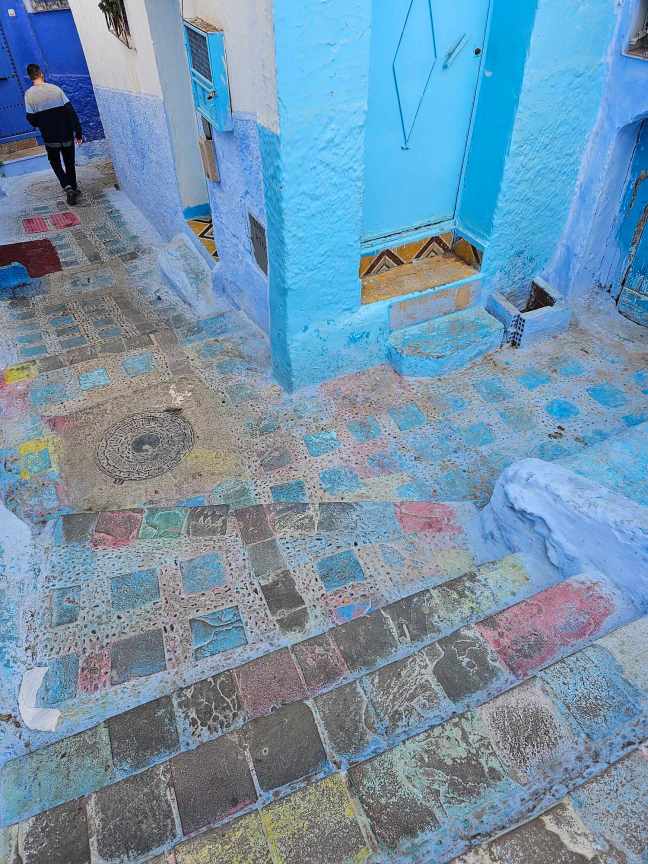
Chefchaouen: Still questioning an azure, cerulean, cornflower, powder blue mystery.

Roughly 3-4 hours north of Fès, further into the mountains, lies a magical town painted in multiple shades of blue. It is famous among tourists to Morocco. Everyone wants to visit the blue city. I have to admit that I am a failed visitor in the fact that I never asked why the buildings of this municipality tucked in the northern Atlas mountain range had been painted my favourite colour.

I do know that travelling to Chefchaouen was an adventurous, long-ish journey where you have to spend roughly four hours getting there in a mini-tour bus. Don’t get me wrong. The bus was comfortable and the driver very professional, with the patience of a saint. But the trek is long and you are very happy when you arrive. The driver is even kind enough to make a stop on the bluff overlooking the town before you move into its centre. At that stop, travellers from all parts of the world carefully cross the busy blacktop to stand in front of the nearby hill town. Interestingly, it looks a lot less blue from the bird’s eye perspective, so you wouldn’t really know it’s the destination you seek without the nearby road signs or the driver telling you that you are close to the end of your journey.

Arriving to Chefchaouen was a relief; well at least until we realised the quickest route to finding our riad (accommodation) was a journey through the people-packed, narrow streets of the old medina in the city centre. So along with Ree, who had to take a deep breath and tolerate a hangry Brenda, we plodded our way up the gradual slope. Fortunately, the blue tones on all walls along the way are calming. You just look in awe and think: who had this idea? Who does the paint touch ups? Are there restrictions on what shades of blue can be used? It immediately occurred to me that the monument protection institute in Prague would have a field day setting out rules on paint usage in this city.

Half-way up the hill, you finally make it out of the medina and you reach an open square. Much to my profound happiness. There, you have a view of the local kasbah (a former fortress and prison) with its colourful gardens and pretty views of the local terra cotta tile rooftops and the jagged hills (mountains) surrounding Chefchaouen. This was a moment of respite from the crowded medina paths but it meant the arrival of the salesmen. Stop for lunch? Would you like something to eat? Check out our shops. It was a lot to handle for someone like me who has come to love the standoffish-ness of most Czech storekeepers and sales clerks. I am a firm subscriber to the If I need something I will ask. take on shopping. Soon enough though – with the generosity of Google maps – we would find our way to our riad and the busy juice-maker (vendor) and his neighbour-carpet sellers who flanked the stairsteps nearby.

And the riad … what can I say? And where to begin? Wonderful staff and a room from a fairytale. Ree was kind enough to let me hide myself in the bed on the upper level, complete with a window nook where I could work, read and inspect the hullabaloo that seemed to be a constant on the stairs and sidewalk below.

There didn’t seem to be a strict tourist agenda for persons visiting Chefchaouen. You were in the blue city, so you enjoyed the blueness. The cute little paths and the many locals who were there to sell, sell, sell. You can watch the vagabond cats scurry from house to house or run the cobblestone sidewalks looking for food and treats. To make my hangriness subside, we agreed to find an internet-recommended restaurant where we could grab a proper lunch and catch our breath after days of being on the move. I’m not sure now what I even ate. I want to stay I started with something puff-pastry adjacent that reminded me of Greek spanakopita. And for the main – a tagine or some sort? Who knows. I mainly remember being enthralled by the mountain views around us. These rocky crags that had to be fairly tall – I was so curious about them I turned on my Mapy.cz app to get confirmation that some were indeed over 2000 metres tall. And then I realised that one should do their homework before travelling: had I know of the nearby mountains and their well-marked hiking paths, I would have booked a longer stay. The reality is that if you hike to the tops of the mountains, a view of the Mediterranean awaits you on the other side. In fact, you are perhaps only 50 km from the seashore. Oh well, there’s always next time.

I don’t know what else to say about Chefchaouen. It was a special, almost surreal place with wonderful people full of kindness and hospitality. You just kind of want to think carefully about the mini-interviews that local vendors conduct. Beyond that, I would love to go back and hike the mountains to the sea. I feel like that needs to happen. Until then.

Fès (Fez): the Final Frontier

There was something about this city. You could feel it calling even before you left the Casa Voyageur train station on the other side of the country. Way too early in the morning to embark on an almost four-hour train ride, but you could sense adventure in the air. The balmy breeze through Casablanca and its surroundings quickly left us and as the train bounded forward into a sunny, desert-esque landscape. We splurged on first class tickets to make sure we had seats waiting for us and upon finding our spots the social engagement began. For a time, we chatted with a fellow tourist from Senegal who shared bits and pieces of information about his travels throughout Morocco – he pointed out that there was a second Chefchaouen called Nador further down the northern coastline. My Moroccan colleague from Tangier begs to differ on this opinion. The voyage went fairly fast, however. A couple, of which the husband was a restaurateur who had worked all over the United States, told us of his American adventures and welcomed us to his country. He gave highlights of different sights that we needed to see and offered his appraisals of our plans for travel around the Fez area.

Arrival in Fez

When descending from the train, it was clear we were in a different region with a different climate. The temperature had jumped about 10°C and the winter coats and sweaters quickly became a burden. The sport of finding a reasonably priced cab then followed. And we did OK haggling a price of 70 dirham down to 50. Comparatively, the taxi fees aren’t terrible; there’s just a bit of competition involved relating to one’s personal pride and a need to prove that this isn’t a person’s first rodeo. That said, the driver was kind and quickly dispatched us to the Blue Gate, where a staff member from our riad would be waiting for us.

It’s hard to put into words the overwhelming of the senses that occurred next. Picked up by our riad contact, we marvelled at the amazing architecture and the bustle of the westernmost part of the old medina (market). The entry to the medina also seemingly has the only permanently functioning ATM for cash withdrawals, which is an important thing to know about travel in Morocco. In the cities, card payments are common, but in some larger and medium-sized towns, they will say cards are OK but later make an excuse to accept only cash. There’s no malicious intent involved – it appears to be solely a matter of convenience, internet connections, and possibly tax evasion.

From the market to maison

The medina was all I expected it to be and in some cases more. It was a bedlam and cacophony of selling, selling, selling. Piles of fresh fruit and vegetables: onions, oranges, tangerines, zucchini, carrots, you name it. Here and there, animal oddities would appear. You could find crates of fresh eggs overseen by a rooster and a hen or two, who gave the feeling they didn’t wish to depart with their goods. Likewise, you would see cages of pigeons; grain sacks full of flour, cornmeal, barley; and food stands offering everything from kebabs to sandwiches on to doughnuts. The doughnuts were tasty and kept us going on our afternoon train back to Casablanca later that week.

I am not sure where to begin when it comes to describing our accommodation. We stayed in two separate apartments in two riads (bed and breakfasts) run by the same family. When I think back on that experience, the words hospitality, kindness, good food and helpfulness come to mind. The interior décor of those buildings transported you to another space and time: the colourful geometric designs, the plump cushions, fluffy beds, elaborate handwoven carpets. You felt like you had stepped into an old tale about Aladdin or Sinbad (even if those took place in different countries). The talent, craftmanship and skilful mystique of those venues’ architects made the experience special.

An afternoon in the tanneries and a morning in the royal gardens

There was so much to take in in Fez. From the scrumptious breakfasts with four types of homemade bread, honey that tasted and smelled as if a colony of bees had delivered it that very morning, or the mazes of streets and alleyways that made up the old medina. There were ups and downs to navigating the old city, impacted by warnings we had been given not to stray off main streets. It was pointed out to us that offers to help tourists find their way were not always helpful. So that made me a bit more careful and mindful of using Google maps and refusing many offers for guidance. But the experience and the kindness of the family running the Fez tanneries and seeing how animal skins were cleaned, processed and decorated reassured me of the local people’s goodness and big hearts. The owners offer fresh mint to mute the smell of the animal hides and pigeon excrement used in the tanning process, but for this one time Missouri country boy it just smelled like your typical Friday at a sale barn.

Enjoying the natural surroundings of the city and the amazing ancient walls, we worked our way back up the hill to our particular gate to the city. It was a long, steady climb but the golden, tawny rock that encloses Fez is beautiful and somehow seems to warm the soul. The following day we would penetrate the wall from the other side to loiter in the royal gardens and watch locals enjoy morning walks with their children. We observed the egrets sunbathing and the occasional stork dropping from the sky to inspect what the fuss was about.

This is scattershot description of my impressions of Fez. But truth be told, I am still processing all the city had, and what more it still has, to offer.

Craziness and confusion in Casablanca

Over the year-end holidays I made my first trip to Morocco. I honestly had no idea what to expect; I just knew that I had wanted to visit the country for a long time. So we got on the plane from Lisbon and began what would be a fun, unpredictable and tiring adventure. Tiring in a good way though.

Moroccans are very hospitable. You might not initially expect that based on the line at the passport checks in the Casablanca airport. Which took forever, and forever, and forever. As my friend Ree and I waited there to be somehow  let in the country, my hangriness levels started to peak. I don’t really remember now what Ree fed me to keep me from going off the deep end, but it worked. For that matter, I also don’t know what happened to the Asian lady in front of me at the passport check. After she was questioned for 10 minutes, they took her somewhere. I didn’t see her come back.

But we eventually got through and into baggage claim, grabbed our bags, and set off to look for the train station. We quickly found it but had no idea when the train would leave. Turned out it was RIGHT THEN and THERE. So I went into party planner mode and saw Moroccan hospitality and guest care burst into action. I ordered two tickets using my rusty French, told Ree how much we needed to pay … then we ran. We ran because the train was leaving that minute but the ticket vendor called the platform and told them to hold departure for us and they did. Within two minutes we were riding through desert plains to Casa Oasis or Casa Port. Just someplace.

With a little time to relax in the train, we joked about what we had just gone through. And we were really impressed and grateful for the support from our help at the Moroccan ONCF/SNCF. Then came the arrival at the train station and our first stab at finding a Moroccan cab driver, of which there are plenty. I tried to weed through the many “helpful” people who wanted to take us “someplace” and looked for drivers at an official cab stand. That turned out not to work so well but we found a nice enough elderly driver, paid roughly 20 dirham too much to get to the hotel, and then embarked on an interesting ride. My favourite part of that journey was when I turned on Google maps to get the precise hotel location and the driver said “Wow, that GPS tracking is very useful.” I just nodded in tired agreement.

Our hotel location was decent. Lots of boutiques and shops along the busy boulevards, which led me to my first impressions of Casablanca. It is a BIG city for Morocco and feels much more USA metropolitan than Berber, north African desert chic. We bookended our stay in Morocco with a few nights in Casablanca. After our return trip to the city (and a train ride with an interesting Dutch family from whom we got ex post travel advice and discovered what all we had missed out on), we were glad to get back to our favourite hotel and relax. Once again we overpaid for the ride from the train station Casa Oasis to our hotel, but given that other costs for food, public transport, etc. were generally reasonably priced (even cheap by European standards), we just tolerated the random cab fares when necessary.

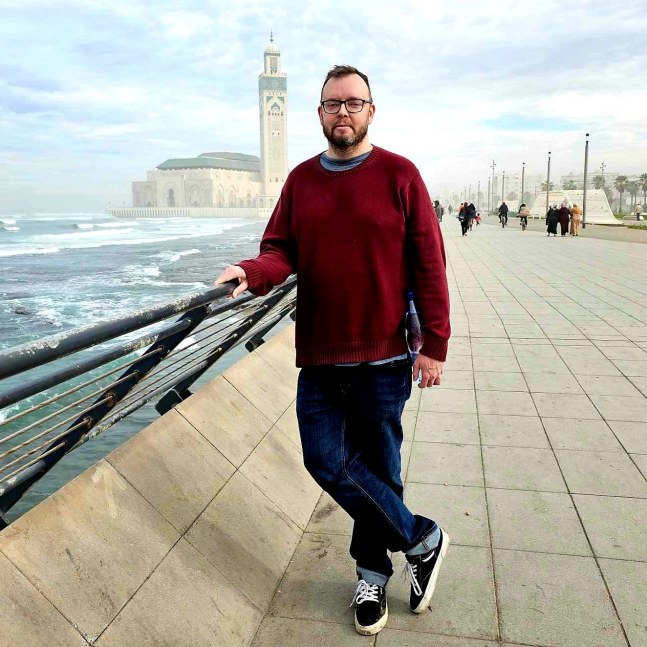
We spent the next day trying to discover Casablanca’s city centre as much as possible. As said, the town is very urban with lots of high-rises and skyscrapers with some bits of traditional architecture woven in here and there. The promenade along the coastline by the main mosque is enjoyable. Waves bustling in from the Atlantic and the misty, foggy beauty of that that semi-shrouded place of worship in morning hours gave it a special air of mystery. Walking along the coastline you could watch local young men on their sports bikes doing tricks, while their elders sat along the beachfront and promenade railing casting their fishing lines in hopes of being rewarded with some sort of nice catch for the day. We rounded out our walks with some visits to cafés and restaurants here and there; enjoying the comfort of the delicious Moroccan mint tea and the gracious kindness of our servers in various types of restaurants – Italian, Moroccan and some sort of fusion. We ate well.

Casablanca remains a sort of mystery to me. It’s a bit too modern and doesn’t have that local feel of the country’s interior,  nor is there that visible switch to a different history and culture I was hoping for. I would be happy to visit again though just to learn more about the city (after doing some online research). Plus, we were told a venture up the coast to Rabat is worthwhile. So, hang on, Casablanca. I’m not quite done with you yet.