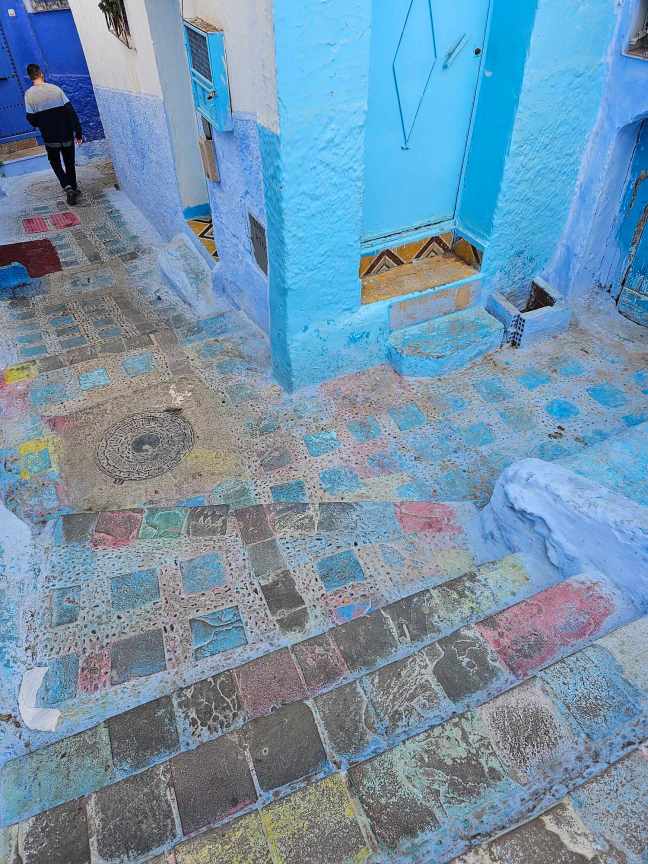
Chefchaouen: Still questioning an azure, cerulean, cornflower, powder blue mystery.

Roughly 3-4 hours north of Fès, further into the mountains, lies a magical town painted in multiple shades of blue. It is famous among tourists to Morocco. Everyone wants to visit the blue city. I have to admit that I am a failed visitor in the fact that I never asked why the buildings of this municipality tucked in the northern Atlas mountain range had been painted my favourite colour.

I do know that travelling to Chefchaouen was an adventurous, long-ish journey where you have to spend roughly four hours getting there in a mini-tour bus. Don’t get me wrong. The bus was comfortable and the driver very professional, with the patience of a saint. But the trek is long and you are very happy when you arrive. The driver is even kind enough to make a stop on the bluff overlooking the town before you move into its centre. At that stop, travellers from all parts of the world carefully cross the busy blacktop to stand in front of the nearby hill town. Interestingly, it looks a lot less blue from the bird’s eye perspective, so you wouldn’t really know it’s the destination you seek without the nearby road signs or the driver telling you that you are close to the end of your journey.

Arriving to Chefchaouen was a relief; well at least until we realised the quickest route to finding our riad (accommodation) was a journey through the people-packed, narrow streets of the old medina in the city centre. So along with Ree, who had to take a deep breath and tolerate a hangry Brenda, we plodded our way up the gradual slope. Fortunately, the blue tones on all walls along the way are calming. You just look in awe and think: who had this idea? Who does the paint touch ups? Are there restrictions on what shades of blue can be used? It immediately occurred to me that the monument protection institute in Prague would have a field day setting out rules on paint usage in this city.

Half-way up the hill, you finally make it out of the medina and you reach an open square. Much to my profound happiness. There, you have a view of the local kasbah (a former fortress and prison) with its colourful gardens and pretty views of the local terra cotta tile rooftops and the jagged hills (mountains) surrounding Chefchaouen. This was a moment of respite from the crowded medina paths but it meant the arrival of the salesmen. Stop for lunch? Would you like something to eat? Check out our shops. It was a lot to handle for someone like me who has come to love the standoffish-ness of most Czech storekeepers and sales clerks. I am a firm subscriber to the If I need something I will ask. take on shopping. Soon enough though – with the generosity of Google maps – we would find our way to our riad and the busy juice-maker (vendor) and his neighbour-carpet sellers who flanked the stairsteps nearby.

And the riad … what can I say? And where to begin? Wonderful staff and a room from a fairytale. Ree was kind enough to let me hide myself in the bed on the upper level, complete with a window nook where I could work, read and inspect the hullabaloo that seemed to be a constant on the stairs and sidewalk below.

There didn’t seem to be a strict tourist agenda for persons visiting Chefchaouen. You were in the blue city, so you enjoyed the blueness. The cute little paths and the many locals who were there to sell, sell, sell. You can watch the vagabond cats scurry from house to house or run the cobblestone sidewalks looking for food and treats. To make my hangriness subside, we agreed to find an internet-recommended restaurant where we could grab a proper lunch and catch our breath after days of being on the move. I’m not sure now what I even ate. I want to stay I started with something puff-pastry adjacent that reminded me of Greek spanakopita. And for the main – a tagine or some sort? Who knows. I mainly remember being enthralled by the mountain views around us. These rocky crags that had to be fairly tall – I was so curious about them I turned on my Mapy.cz app to get confirmation that some were indeed over 2000 metres tall. And then I realised that one should do their homework before travelling: had I know of the nearby mountains and their well-marked hiking paths, I would have booked a longer stay. The reality is that if you hike to the tops of the mountains, a view of the Mediterranean awaits you on the other side. In fact, you are perhaps only 50 km from the seashore. Oh well, there’s always next time.

I don’t know what else to say about Chefchaouen. It was a special, almost surreal place with wonderful people full of kindness and hospitality. You just kind of want to think carefully about the mini-interviews that local vendors conduct. Beyond that, I would love to go back and hike the mountains to the sea. I feel like that needs to happen. Until then.

Returning to my other HOME

Three years after Covid forced me out and a major heart surgery threw a wrench in my travel plans, I finally made it back to Armenia last weekend. It was amazing how quickly the warmth of Armenians and reconnecting with old friends melted away the anxiousness I had about travelling to the southern Caucasus region. My worries were never of the normal kind, i.e., would people and places still be as I remembered? Would there still be a connection to, and love for, the communities where I trained and worked. I was more concerned about being fit enough for the journey.  

My current adventure began with new target destinations: to see parts of the country I had not yet visited; and this thanks to having a good rental car at my disposal.  Of course, driving also made me a little anxious but having a great, funny, supportive team of fellow travellers (Jesus and Ani from Peace Corps’ A27 cohort and our new friend Marietta) made my first trip to the Vayots Dzor region perfectly enjoyable. Our journey took us to the spa town of Jermuk, or what I call Armenian Karlovy Vary (Carlsbad for German or English speakers). This small, unassuming town nestled in between cliffs and canyon made for a nice respite from the stress of air travel. It also filled me with hope for all that tourism can, and hopefully will one day, offer local and regional businesses in Armenia. Although the dominant buildings in Jermuk are large therapy and rehabilitation facilities as well as a couple of resort hotels, the town’s charm, at least for me, derives from the nature that envelops it. There are the cliffs west of the town centre formed from volcanic activity and “tubes” of basalt. These geographic features always make me think of Superman’s Fortress of Solitude. Then, as you meander to the north end of Jermuk’s “Main Street”, you will find a sign pointing you to stairs that take you down to a beautiful, breath-taking gorge or canyon and the gurgling river that soothes even the most exhausted traveller’s nerves. 

As you walk along the canyon path, you are surrounded by beautiful flora – wild roses greet you at every turn along with other colourful flowering plants (I couldn’t tell you their names for the life of me) that jump out in shades of pink, blue, yellow and purple. The trail also offers a break from the intense summer sun that warms all of southern Armenia. Cliff overhangs and large boulders (even a rock arch) cool the canyon and make the hike all the more pleasant. Finally, when you reach the river’s edge, it only takes a few more steps before you hear that a wonderful surprise awaits. The sound of rushing water shushing eager hikers soon reveals itself to be an amazing waterfall towering from the hilltop above. It carries the cool, refreshing Jermuk waters down to the river so they can travel further south to Armenia’s Syunik region.

Many travellers will journey to Jermuk to enjoy the curative spring waters, to relax or to seek rehabilitation. Odd traveller that I am, I went there to be hugged by the hillsides, calmed by the canyon river and streams and to listen to nature telling me to slow down. There is so much energy bursting in this beautiful landscape that I can’t wait to return one day: to hike more in the sun-drenched golden mountains; to watch local beekeepers as they gather their honey; to observe the farmers as they cut, mow and rake their hay into small bales; and mainly to enjoy the serenity that is, and always has been, the mountains, gorges and canyons of Armenia.

It felt good to be back in those Armenian mountains; it felt good to be back in, and embraced by, one of the lands I now call home.  

Seeking Serenity in the Orbe Valley (Pt. 2)

In my last post, I spoke of my holiday hiking with friends met in Prague who now live in Lausanne. We decided that in today’s Covid-impacted world the best spiritual rejuvenation would come from getting out of the city and back to nature. Luckily, some of Switzerland’s most interesting and intriguing natural sites are to be found at the foot of the Jura mountains: not far from our home base in Lausanne. Our preferred destination is Les Clées (reached easily by car). Our first hike this season, a new one to me, was a footpath heading west of Les Clées village: in direction of the French border. 

I have to admit that his hike was not full-on serene for me. The nature was amazing and beautiful, but the precarious path and the threat of a possible fall off a steep incline down into the Orbe River had me a bit ill-at-ease at times. Initially, the route is wider and you focus more on questioning why you had such a big breakfast OR you wish you’d had more to eat. You need a good store of energy to push yourself up the constantly ascending path. However, quickly the route narrows and you look at the rushing Orbe below and wonder how rapidly you might plummet down to the water.

As with all things Swiss, this path is impeccably organized. Should you happen on an outshoot of rock: no worries. The locals long ago carved a tunnel into the grey-white rock so that hikers can easily navigate through the mountainside when need be. Likewise, this section of the Orbe River Path also has ample swells of fresh-water springs that trickle slowly to the rapids down below. In the winter season, these water flows offer an additional, amazing spectacle: icicle cascades. Passages through the rock tunnels along the route have an almost 2m tall person like myself dodging a number of frozen-water daggers: a) so as not to hit my head, b) in order to preserve the beauty the icicles contribute to this magical, wintertime, natural kingdom.

The hike provides ample amounts of calm and solace, with the only creatures interrupting our thoughts being Izzi our Vizsla canine companion (she’s afraid of the icy footbridges) and our Jack Russell named Poppy, who shoots up and down the path and sometimes along the icy cliffside without thought for potential consequences. Ultimately though, there is an incredible reward toward the end of the trail. These are the Le Day waterfalls (the Saut du Day) which tower over you as you reach a broadening of the Orbe River where it shallows out and serves up rocky sandbars that are perfect for a picnic. It was at the waterfalls that we went crazy with our cameras and took multiple pics of our beautiful surroundings. We let the dogs test the icy waters and run to their hearts’ content. Plus, it was there that we came across our first humans: other locals on holiday, who also apparently needed to escape their isolating in place for just an hour or two.

I am thankful to have spent a part of my holidays admiring the Orbe River and the gorge through which it passes. It is a calming, fascinating place where I never cease to be in awe of how the water swiftly flows, sharing its gurgles with the random hikers who pass alongside it. I give thanks to the Swiss people who look after the nearby paths and make such wonderful views of nature accessible to all who journey to the area for a walk. As I sit here in Day 4 of my post-holiday quarantine, I can still hear the river calling me. Come back one day. I’ll be waiting. And surely I will return: for a future dose of much needed and appreciated serenity.       

Seeking Serenity in the Orbe Valley (Pt. 1)

Thanks to a friend’s accidental click-and-point approach to trail searches on a map of Switzerland, I was fortunate enough to come to know the peaceful beauty of the Orbe River this past year. I first hiked the river trails in June 2020, during an escape to Switzerland once Europe’s borders opened up after Round 1 of the Covid pandemic.

The Orbe is a meandering, bubbly, mountain river-stream deep in the Vaud region of Switzerland. It touches upon the base of the Jura Mountains some 40 or so kilometers north of Lausanne. My entry point to the river hiking routes has always been the quaint, little village of Les Clées, with its picturesque tower, church and stone bridges. From Les Clées, one can follow hiking and cycling routes east down to the town of Orbe or take the narrow hill paths to the West over to the waterfalls hidden next to the village of Le Day.

The best qualities of both paths include the calmness, the embrace of forest silence, and the soothing whispers of the Orbe as it gurgles to you from the sometimes scary drop below. The walk toward the town of Orbe begins as most of us imagine a Swiss hike should. The hiker trapses through meadows that hug the village of Les Clées. Soon, you approach the forest line, after passing a cow or two, and you walk along a sandy-rock path high above the mountain stream. The path offers tiny bits of natural wonder as you gaze at the stunning emerald moss that covers many of the trees and listen to the trickles of water from springs flowing from the hillsides. At times, wooden bridges help you over sections of the path, where the abundant water sources make the route too muddy to pass. Then a fork in the trail gives you the option to descend down to the bubbling, gurgling Orbe.

The descent can be daunting when the path is snowy or muddy. But with patience and care, you can make it down to the water safely. Plus, a slow downward walk affords the opportunity to notice the handiwork that has gone into developing forest staircases and root-formed guard rails that keep hikers from sliding directly down to the stream. At the bottom, the blue metal bridge gives a moment of respite and as the water lulls walkers into reflection. The blue of the bridge, the deep greens of the fluffy moss, the brown-grey-green-blue hues of the water and rocks offer a color harmony that overwhelm even a colorblind hiker like myself. My judgment of the various tones and hues is not that of the majority, yet still the natural color symphony takes my breath away. 

After several minutes of absorbing the sounds of the Orbe and its calming rush through the mountain rocks, I head upward along the what I call the southern bank, making my way back to Les Clées. That side of the stream offers vistas of the springs and waterfalls on the northern side; particularly, when hiking in late fall or winter after the leaves have fallen from the trees. Walkers have better views of the water as the hiking path rises above it and the mind quickly becomes overwhelmed by still more natural beauty. Part of you wants to sit and take in the river or, on a hot day, jump into the cool, soothing waters. Another part of you wants to indulge in the escape offered by these seemingly ancient forests in which you imagine Roman soldiers must have marched or where you feel like you may have been transported to the green moon of Endor as described in George Lucas’ Star Wars movies.

As you near the end of what I call the “East to Orbe” circuit (by returning to Les Clées), you catch glimpses cross-river of the green fields where the cows you saw earlier continue to graze or you notice from afar the village’s unmistakable tower. It lets you know that your car, and some well-earned rest, is not far away. This path has become a staple activity during my visits to friends in Lausanne. It puts my spirit at peace and makes me grateful for the simplicity of nature. The opportunities the Orbe offers for quiet hiking, smiles of non-speak with friends, and the curious meandering of our canine companions (specifically memories of my dear Mica) are priceless. In a restless world of Covid angst, the Orbe River surges with serenity.