Côtes du Rhône … where memories meet and happiness flows

Since I was a teenager, France has had a special power for me. It’s “meant to be-ness” has always made it feel safe. And celebrating a good friend’s birthday in Provence in September served as an important reminder of the need to cherish special certainties.

The givens of Pete fixing amazing food while tormenting me incessantly, or Jakub telling silly dad jokes, or Natalie being armed and ready with rosé, or Laura acting as the voice of reason. Not to mention Jean making sure we were all looked after and the house in order.

An insane route to the farmhouse we were staying at had me less than certain how our celebratory week in Provence would end up. But France, this time the southern part, did not disappoint. The smell of lavender, the rugged mountains hugging our local horizon, and the poplar or sycamore-lined roadways … they all told me that life was as it should be.

It’s funny that the French created the term je ne sais quoi. Because that’s how I often feel when describing why I am at home there. It’s an “I don’t know what” sentiment. I’m never 100% certain why but I always feel welcome when I move through the fruit and veggie markets, when I sit down for un crême, or when I escape inside a house of worship that dates back to the times of The Crusades. The beauty of the Rhone Valley immediately tells visitors, without their knowing why, that everything will be all right.

Our corner of Provence that we hid out in that week afforded us the best that France has to offer. Great wines from the ancient land of Popes (a Châteauneuf-du-Pape or a Gigondas) accompanied most of our meals. The shops welcomed us with the culinary artisanry that only the French can deliver: sumptuous sausages of the Camargue, excellent terrine de foie gras, or rillettes … food shopping in France is unique. Just brush off your French vocabulary from college days and enquire after which local farmers supply the shops and to what periods these agro-culinary traditions date back.

It’s in these moments that you slowly come to understand that the “I don’t know what” may just simply be a proud love or passion for traditions in food-making, animal-raising and store-owning that transcends time. Perhaps, it’s because the river lies nearby. But in the Rhone Valley and that area of France, there’s a fluidity: a phantom of centuries of trade routes that connected Ancient Rome to the Iberian peninsula. When you submit to the region of Provence, you feel these transitory moments. Of wine poured into glasses across the years, of floral scents being gathered for perfumes that would sweeten numerous decades, or of frankincense emanating from churches that would bring the religions of the Holy Land to the Empire’s marchlands.

There’s never a single, clear cause for the serenity and happiness flowing along the Rhone in Provence, but I’m certain it has something to do with the land always seeing to residents’ and visitors’ basic needs. You eat well. You drink well. And you relax as time nourishes you with the riches of the region’s traditions.

Laissez-vous en profiter de ce que la région vous offre.   
Meeting Missouri in the Moselle Valley

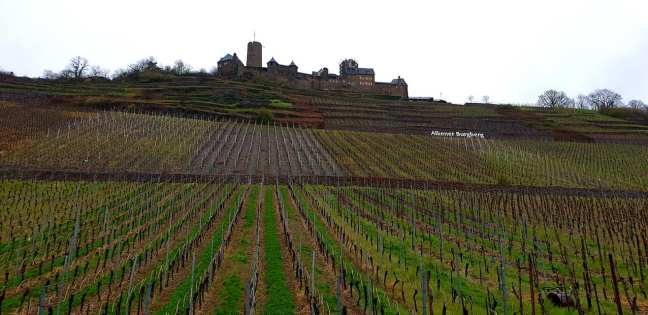
A couple weeks back I coerced a small group of close friends to road trip with me to spend my birthday south of Koblenz, Germany just below the point where the Moselle River flows into the Rhine. I had read somewhere years ago that many of the German immigrants who came to inhabit the area along the banks of the Missouri River (in the segment between Jefferson City and St. Louis) had once lived on the banks of the Moselle. They had made wine in Deutschland and later came to practice the same art in their chosen destination in middle America.

Although the steepness of the bluffs along the Moselle River was much more striking, I could see bits of Missouri in this landscape near the Franco-German border. The river was wide, a muddy green, as well as quick flowing: much like the Missouri River which also bears the nickname “Big Muddy”. However, what the Missouri lacks is the quant little villages and towns tucked in small valleys and ravines along the river banks where, theoretically, you can traipse from house to house ringing doorbells and asking to sample the last season’s wines.

As I chauffeured Laura, Natalie, Pete & Jakub between Moselle Valley hamlets, it became clear that there were a number of local rules that complicated the “drop by anytime” philosophy. The first was that the Weingüter operate only during afternoons on weekends. So after a couple of failed attempts in Kattenes, we decided to move on to the bigger town of Cochem. There, sampling the Moselle Rieslings was less about which vintners were open and willing to show off their wares and more about finding a restaurant with a good selection of local wines. 

In this beautiful Moselle Valley town dominated by a beautiful, yet haunting, castle, we snuck from restaurant to bistro and on stopping to enjoy the light, fragrant white wines and taking advantage of a decent block of sun we’d been offered on an otherwise rainy weekend. It was relaxing to absorb the warming sun along the near-flooding river and observe how spring was slowly starting in the region. That’s when we also got wind of another rule: tourist season along the Moselle doesn’t really start until Easter weekend so it’s better to come visit after that, once wine cellar owners are ready for the Riesling-imbibing crowds.

Still, despite our seemingly premature arrival, we did have a fun culinary and oenological weekend in the villages we visited. Whether it was Niederfell or Cochem or Alken, we had some good wine and spirits and indulged in the very tasty local version of schnitzel made using a special mustard to marinate the meat. Also, hats off to the patient restaurant owners and cooks who took the time to explain their local gastronomy and cuisine to us and who tolerated our crowd when perhaps a few too many wines had been sampled. Or the day of wine-tasting had started too early. 

Plus, kudos to the local tourist/hiker clubs or trailblazers who set up wonderful walking paths leading through local forests and taking wanderers to the tops of the bluffs that look out over the river valley. Despite some kinks in the weather, it was a wonderful weekend in one of Germany’s celebrated wine regions. The natural beauty coupled with the shenanigans of good friends made turning 50 a tolerable experience. 

I would like to close by thanking Werner Sander and his team at the Café-Konditorei-Pension Sander for their amazing hospitality and excellent pastries. Plus, a big thanks to the staff at the Moselblick Niederfell restaurant for the beer sampling and the wonderful service, food, and mainly patience during my birthday dinner. And finally, a big shout out to our new friends from Tortesia who made a great weekend even more special. A weekend in the Moselle Valley … I highly recommend it.  

Train to the past present – back to Žďár

A trip through memories from the start of my life in the Czech Republic

Traditionally this blog space is meant for my thoughts on travel abroad and, when possible, going to fun, exciting destinations. The pandemic and personal health issues have slowed all that down for me over the past two years (as with everyone). But recovery is in full force and I had what I will call the surprising good fortune to have my train re-directed on a route through my past during my recent trip to meet up with friends in the charming wine village of Valtice

Since Czech Railways is repairing part of their northern corridor, I quickly found out that my journey would take me through the southern route crossing the Czech-Moravian Highlands (the Vysočina region) and small part of my past. It did seem odd getting on the train and looking at an itinerary that skipped from Kolín (in Central Bohemia) on to Brno (what I call the capital of Moravia). But the diversion brought back so many memories as it crossed through the towns where I spent my first years of my sojourn (now life) in the Czech Republic. 

As the morning sun stretched across the landscape, I saw the names of familiar towns pass quickly by my window: Kutná Hora (home to the beautiful St. Barbara’s Cathedral and former mining town), Čáslav (home to a military air base and easily recognisable with the bell tower that stands watch over the town centre) and then Světlá nad Sázavou, a quiet town on the Sázava River, famous for its glass-making. I had the privilege of working many times, in my later career, with a local glassworks firm and both their products and customer service were flawless.

Soon though, we would arrive at the eastern frontier of Bohemia where it disappears into Moravia. That’s when I saw it: the blue and white sign announcing our passage through Havlíčkův Brod. This was one of my main weekend haunts in the early 1990s when a 22-year-old, naïve young man from Missouri had taken on a teaching job in nearby Žďár nad Sázavou (already in Moravia) and would travel to Havlíčkův Brod to spend weekends with teacher-friends in our small expats-meet-locals community. From the window of the train I could smell the memory of a tasty soup Jodi had just made on a snowy winter Saturday, or smoking Sparta’s or “Startky” or whatever was available during pub debates with fellow Missouran, Matt from St. Louis. With Matt, Jodi and guitarist Vojta or whomever else joined our crew, we were likely drinking a Rebel or a Ježek from one of the nearby regional breweries. Quickly though my view of Havlíčkův Brod faded from sight and I began trying to remember the names of villages the local train (Os – osobák; what we dubbed the “oh so slow me” train because that sort of rhymed with the official Czech name osobní) passed through before hitting Žďár. The only ones I recalled were Přibyslav and Veselí. 

And then I saw it on the horizon, the arrival of Žďár. The first glimpse includes the garden communities on the west end of town and then the rail line widens to service incoming and outgoing freight to the largest local enterprise, Žďás. I think at one time it may have employed over half the town. Although not visible from the train, I wondered how many of my old haunts, stores, schools and restaurants were still around. I know the White Lion Hotel (Hotel Bílý lev or Bílého lva) no longer exists. I assume my place of employment, the Škola ekonomiky a cestovního ruchu and its administrators the Holemářovi are still doing fine. But what of the grocery store Mana (by now it’s likely a Lidl or Albert) and the department store we called Papír, hračky, sport (Paper, Toys, Sport)? Because that what was written of on the windows of each floor when viewed from outside. Or what became of Süssův hostinec, the pub that was so local that we foreigners were scared to enter, but which somehow became super friendly once its beer garden opened in the summer? At the time, I spoke perhaps 8 words of Czech and didn’t have the gumption to ask the locals if our entourage could “přisednout” (i.e., join their table provided chairs were available).

Of course, the train moved on quickly towards my destination of Břeclav. But my mind remained stuck at the Žďár train station. What had become of all those students from so long ago. I know Jirka Filippi is a successful corporate manager; Petr Váněk, a good friend of Jirka’s whom I once told in a moment of frustration that his English was subpar and asked what he was going to do when Jirka wasn’t there to speak for him? Well, Petr has since proven to me that perhaps it was the teacher, not the student. He’s become a successful actor and has gone on to play not only roles in Czech movies, TV shows and commercials, but also in English-language films as well. Simply put, he showed me. And I’m so proud he did. So many more names came to mind as the train progressed toward Brno: what of Marek Pospíšil, of Lenka, or Renata or Vít (I hope I have his name right: he was a young, blond, bespectacled student from Havlíčkův Brod who studied in Žďár and invited me one Saturday to meet his mother … how we had any type of conversation in Czech is beyond me; I am guessing Vít was a good interpreter).

Needless to say, I made it to Břeclav and caught my connection to Valtice, where I caught up with the Hradec crew and watched them taste (sample) more wine than any of them can possibly remember. But děkuji (thank you) to Czech Railways for those rail repairs. You took me back to a place in time where both my students and I had our futures still before us. For that I am grateful.