Go to Prčice …

Do Prčic … it’s a funny phrase you learn when you first explore the Czech language. It essentially works out to mean “Oh crap”, “gosh darn it”, or “F*(k” in English. But it literally means “go to Prčice” a small village in the southeastern part of Central Bohemia. Besides being the namesake of a crazy, fun, torturous hike from Prague that takes place about this time in May every year, the area around Prčice is fun for day-walking and exploring.

I was just there last weekend and got to wear out my legs and take in springtime in the rolling hills of this area. It offers everything from sweet-smelling apple groves, to overabundant fields of rapeseed plants, on to nonplussed herds of cattle (Herefords, Charolais and Simmentals) grazing in newly vernal pastures. I love the area because it offers quiet, beautiful walks through fields and forests that are interspersed with ponds and lakes and sometimes the occasional horse farm.

The area is also beautiful because of the varied sites the villages have to offer: the colorful facades of homes and farms decorated in the village baroque (selské baroko) style or the animals, usually chickens, ducks or geese, who come to greet you as you pass the gates to their yards. Oftentimes tourist paths lead you alongside cool, babbling streams where frogs sing and make their homes or where ducks have recently begun to raise their young.

In the fields near Prčice, Javorová skála and Vojkov/Podolí, you can sometimes catch sight of deer as they make their way to the fields to seek food at dusk. Or, if you walk quietly, in the adjacent forests, you might happen across a random doe or buck, as they return to their herds in the nearby fields. Other times, you come across discoveries that can be less pleasant for certain hikers: like a mother garter snake protecting her nest of babies.

My favorite sites in the Prčice area include the climb up to Javorová skála to see the old post office that someone transplanted from the Czech Republic’s highest peak Sněžka to this random hilltop in Central Bohemia. Of, if you go a little farther, you can climb on top of Čertovo břemeno (which translates as the devil’s burden/load) which is rumored to be a huge boulder that that devil had been carrying to drop atop, and destroy, a newly-built village church before it’s consecration. Luckily, the devil was late in his mission and the church was consecrated before he could destroy it. So, he dropped the boulder in shock (or perhaps disappointment), leaving it perched atop a nearby hill.

Most recently, I took time during a hike to enjoy the teaching trail (naučná stezka in Czech) that is named after Sidonie Nadherná of Borotín, a Bohemian baroness who is famous for hosting literary salons and is known to have corresponded with German poet Rainer Rilke. The trail takes you through a newly-restored horse farm and riding school in another village called Podolí. It’s such a beautiful area, I took the opportunity to each my lunch under a lovely oak grove while I watched the farm’s owners lead their horses to and from the fields and exercise them. There are so many hidden gems in villages of Central Bohemia, so I as close this text, I can definitely advise … go to Prčice (or any of the villages nearby).
Finding peace and gratitude along the Vltava

I realized after writing my last blog entry that perhaps my words had been too aggressive. Most likely in a time of crisis few readers cared to hear my complaints about being lost in the quarantined world of Prague after leaving the Peace Corps. Those words did not come from a place of anger though: more of frustration because I had not yet been able to see friends I was missing for over a year. So that’s why I put my butt on a train and headed up the Vltava River.

It’s hard to explain the Vltava. It’s like the spinal cord of Bohemia or the Czech lands. It was on the hills above the river that Libuše had her vision of a city whose glory and light would shine for thousands of years. That city being Prague of course. It is where, per local legend, Horymír, atop his horse Šemík, jumped the waterway and fled en route to Neumětely. Along this river vagabond-hikers set up camps and spent their weekends in nature, or southern Bohemians first brewed the original Budvar (today’s Budweiser) in České Budějovice. But for me, the Vltava River represents calm. It represents continuity and simple beauty. It’s a river that runs from an unassuming source in the mountains and hills of the Šumava and carries its natural sustenance and history all the way to the Czech capital and beyond.

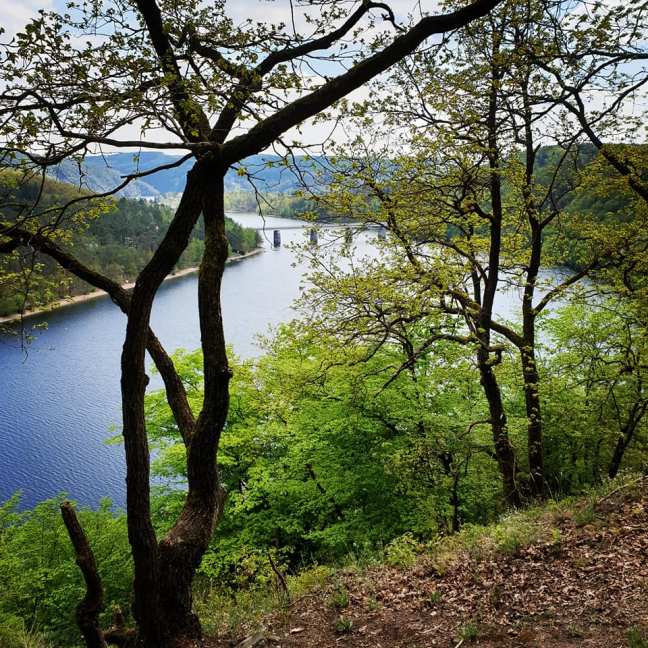
During the past week, I took a couple of short trips along the river, south of Prague (just under an hour away by car or train). Once at my destination, I either hiked my way back toward the city or did a forest circuit. My Tuesday hike was a celebration of spring. As I tromped up the hill away from the banks of the Vltava, I reveled in the embrace of fruit trees’ hugging branches as they shadowed the forest paths and ancient roads. The melodious hum of bees and wasps busy at work accompanied me along rows of cherry, apple and apricot trees in full bloom. As the sun shone and warmed the road, for the first time since returning home, I felt at peace. It was the peace at spring: of the healing sun and nature’s rebirth. Because of current restrictions, I was one of few people in the forest. Still, that made me all the more aware of how grateful I should be. I advanced along the path to reach the tops of bluffs along the river. There, I found the remains of campfires local villagers had enjoyed and later extinguished; I saw the view of the railroad bridge over the Vltava that I had travelled across only moments before. In a brisk wind looking down at Bohemia’s natural life source, I imagined all those who had come before me. How emperors and kings had traveled that river in the age of the Holy Roman Empire or Austria-Hungary. Or how the labors of loggers in the southern forests had sent wood down elaborate canal systems and into the river so that it could float to Prague for use on major construction projects of the day.

And on my trip yesterday, I saw a river full of hope. It was a Vltava that was enjoying a break from the busy swarms of Prague residents who rush to its banks as soon as warm weather allows. The river was calm, but it was ready… for people to return. That’s when I felt the most gratitude: as I watched random boats laze on the water floating around the area stilled by the Slapy dam. I was grateful for the river and the stories she knows: the stories she tells. I was grateful for the sustenance she brings in nourishment for the fruit trees and berry bushes along her banks. I was thankful for the livelihoods she supports as tourists and locals visit her to swim in her refreshing waters and relax over a half-liter of Bohemia’s most famous golden lagers. Yes, the river is my constant – a source of relaxation, beauty, learning and life. As long as she flows, I will live happily and delight in returning to hear her tales and will remain forever grateful for them.