Praha through Ree jan’s eyes

Author’s note/warning: This text is written with a good dose of sarcasm and self-deprecation. Ree assured me she had a great time during her visit to Prague. I just tend to make light of my tics and idiosyncrasies when serving in the role of tour guide.

Living in one of Europe’s most beautiful capitals can make you jaded in some ways. After 25+ years living in a city I thought I would stay in for 2-3 years max, I tend to just always look at the city’s beautiful monuments, smile, nod and make a mental check. Prague Castle – still there; the Charles Bridge – still there; National Theatre – still … well, you get the gist.

But in January I had the privilege of welcoming a good friend and fellow returned Peace Corps volunteer Ree to my adopted home town. And it gave me time to get to know the city all over again. I also quickly realised what an annoying tour guide I am. On most days I couldn’t tell you my own name but, sadly, for those brave enough to tour the city with me, every building, monument, sidewalk, street crossing, subway station and tram stop comes with a short story.

There’s a lot to do and see in Prague in less than a week. However, fortunately, Ree is a chill traveller. She endured and survived (and I think enjoyed) the wild life of southern Armenia (except for being over-potatoed) and so I was certain she would survive all I had to tell her about the Golden City or the City of Many Spires, as the Czech capital is often called. It’s also good that Ree’s a walker. That bode well for her being able to tolerate my aversion to public transport and enjoy the pedestrian life. So just to sum up a few highlights of her stay.

First stop – Vyšehrad

The Vyšehrad Hill and fortress is the site of (I think) the first permanent settlement in Prague. It offers splendid views of the Vltava River and looks at Hradčany (the location of Prague Castle) and Malá Strana where the kings and emperors who ruled the city lived for centuries. It’s also the spot where, according to legend, the Celtic queen Libuše proclaimed that a city would form here with a fame and prosperity that would last for thousands of years. I think it’s also the hill that Horymír and his trusted steed Šemík jumped from on their flight from the city before Šemík succumbed to fatigue in Neumětely (just west of Prague). I think my diatribe on the Prague skyline quickly exhausted Ree: she hadn’t counted on there being so many spires … so somewhere between the Žižkov TV tower and the Petřín Hill “Eiffel Tower” she lost track and a glazed look spread over face.

Walking through the New Town to the Old Town (also TMD – too much data)

The best part of starting a tour with Vyšehrad is that you get to descend the winding stairs down to the river and take your pick of which river bank to meander along. Now, I forget if we went to the Smíchov side or wandered up the right bank to the National Theatre. However, I’m pretty sure we stopped for a hot drink (cocoa for me, mulled wine for Ree jan) and enjoyed Prague’s plentiful medieval and baroque vistas. I’m not sure on what day or in what order, but I do know that we stopped at one of my new favourite pubs in the New Town and ordered a proper ½ litre Plzeň (Pilsner beer) for each with us and a nakládaný hermelín (a pickled cheese that is camembert adjacent); this one served with cranberry jam and walnuts. I think Ree liked it.

A day at the National Museum

I think our museum visit turned out to be a special treat for both of us. In 28 or so years, I had never taken the time to visit the monument. Mind you, I only live 10 minutes away and walk by it almost every other day. But having Ree in town was just the right occasion to test-drive the newly-refurbished building and visit its exhibits. And I can now tell you, it is worth the 10 bucks or so that you pay for the entrance fee. You have two buildings to explore: the more historic building, the National Museum proper, and several exhibits housed in the more modern (in my opinion uglier) building that used to be home to the Czechoslovak Federal Assembly. There is much to see: from displays on minerals and geology, to exhibits on prehistory – a woolly mammoth included, on to audio-visual time travel through the history of 20th century Czechoslovakia and the 30+ year-old Czech Republic.

I could recount more, but I’ve hit the one-page mark. I can just say it was an honour to share my city with Ree. It was great to revisit Prague’s history, show her my hood, and also to treat her and my friends to some rounds of the Phase 10 card game that ended up with all of us being given the bird by Jakub … but in an artistic, pretty way. Hopefully, there will be more visits in the future.
Almost there – reflections on a continuing journey

A year and a half since I opened my eyes

Learning to breathe and re-learning to see

I got a second chance

But how to use it?

Reassessed, re-aware…

At almost fifty I was finally learning

The importance of love, the treasure of friends

The luck in knowing someone was there…

To hold my hand

I had to extend it

Had to admit this man is NOT an island

In time the water eventually recedes

And connects us to the main

With my new eyes and engine

I could discern – what was vital and what was nonsense

Watching all the chasing

The inebriation of ambition

Each new dawn, every additional mountain climbed

That was my high

The crutches were gone

But the nervousness wasn’t

Learning to breathe again steadied me

The power of NO saved me

It was time to be selfish

Accepting that unhappy me could not bring joy to others

Reading in the park

Watching the kids become adults

Switching off the devices

All that got me to here

And soon a new chapter opens

Time to leave the sounds

Reroute them to the periphery

Accept my new opportunities and seize them

I will be fine … the tests say so

So now I will move on

Embrace each day as a gift

No tomorrow is guaranteed

But as I advance on this journey

I know how to fill each day

And who will hold my hand along the way

Breathe.

Train to the past present – back to Žďár

A trip through memories from the start of my life in the Czech Republic

Traditionally this blog space is meant for my thoughts on travel abroad and, when possible, going to fun, exciting destinations. The pandemic and personal health issues have slowed all that down for me over the past two years (as with everyone). But recovery is in full force and I had what I will call the surprising good fortune to have my train re-directed on a route through my past during my recent trip to meet up with friends in the charming wine village of Valtice

Since Czech Railways is repairing part of their northern corridor, I quickly found out that my journey would take me through the southern route crossing the Czech-Moravian Highlands (the Vysočina region) and small part of my past. It did seem odd getting on the train and looking at an itinerary that skipped from Kolín (in Central Bohemia) on to Brno (what I call the capital of Moravia). But the diversion brought back so many memories as it crossed through the towns where I spent my first years of my sojourn (now life) in the Czech Republic. 

As the morning sun stretched across the landscape, I saw the names of familiar towns pass quickly by my window: Kutná Hora (home to the beautiful St. Barbara’s Cathedral and former mining town), Čáslav (home to a military air base and easily recognisable with the bell tower that stands watch over the town centre) and then Světlá nad Sázavou, a quiet town on the Sázava River, famous for its glass-making. I had the privilege of working many times, in my later career, with a local glassworks firm and both their products and customer service were flawless.

Soon though, we would arrive at the eastern frontier of Bohemia where it disappears into Moravia. That’s when I saw it: the blue and white sign announcing our passage through Havlíčkův Brod. This was one of my main weekend haunts in the early 1990s when a 22-year-old, naïve young man from Missouri had taken on a teaching job in nearby Žďár nad Sázavou (already in Moravia) and would travel to Havlíčkův Brod to spend weekends with teacher-friends in our small expats-meet-locals community. From the window of the train I could smell the memory of a tasty soup Jodi had just made on a snowy winter Saturday, or smoking Sparta’s or “Startky” or whatever was available during pub debates with fellow Missouran, Matt from St. Louis. With Matt, Jodi and guitarist Vojta or whomever else joined our crew, we were likely drinking a Rebel or a Ježek from one of the nearby regional breweries. Quickly though my view of Havlíčkův Brod faded from sight and I began trying to remember the names of villages the local train (Os – osobák; what we dubbed the “oh so slow me” train because that sort of rhymed with the official Czech name osobní) passed through before hitting Žďár. The only ones I recalled were Přibyslav and Veselí. 

And then I saw it on the horizon, the arrival of Žďár. The first glimpse includes the garden communities on the west end of town and then the rail line widens to service incoming and outgoing freight to the largest local enterprise, Žďás. I think at one time it may have employed over half the town. Although not visible from the train, I wondered how many of my old haunts, stores, schools and restaurants were still around. I know the White Lion Hotel (Hotel Bílý lev or Bílého lva) no longer exists. I assume my place of employment, the Škola ekonomiky a cestovního ruchu and its administrators the Holemářovi are still doing fine. But what of the grocery store Mana (by now it’s likely a Lidl or Albert) and the department store we called Papír, hračky, sport (Paper, Toys, Sport)? Because that what was written of on the windows of each floor when viewed from outside. Or what became of Süssův hostinec, the pub that was so local that we foreigners were scared to enter, but which somehow became super friendly once its beer garden opened in the summer? At the time, I spoke perhaps 8 words of Czech and didn’t have the gumption to ask the locals if our entourage could “přisednout” (i.e., join their table provided chairs were available).

Of course, the train moved on quickly towards my destination of Břeclav. But my mind remained stuck at the Žďár train station. What had become of all those students from so long ago. I know Jirka Filippi is a successful corporate manager; Petr Váněk, a good friend of Jirka’s whom I once told in a moment of frustration that his English was subpar and asked what he was going to do when Jirka wasn’t there to speak for him? Well, Petr has since proven to me that perhaps it was the teacher, not the student. He’s become a successful actor and has gone on to play not only roles in Czech movies, TV shows and commercials, but also in English-language films as well. Simply put, he showed me. And I’m so proud he did. So many more names came to mind as the train progressed toward Brno: what of Marek Pospíšil, of Lenka, or Renata or Vít (I hope I have his name right: he was a young, blond, bespectacled student from Havlíčkův Brod who studied in Žďár and invited me one Saturday to meet his mother … how we had any type of conversation in Czech is beyond me; I am guessing Vít was a good interpreter).

Needless to say, I made it to Břeclav and caught my connection to Valtice, where I caught up with the Hradec crew and watched them taste (sample) more wine than any of them can possibly remember. But děkuji (thank you) to Czech Railways for those rail repairs. You took me back to a place in time where both my students and I had our futures still before us. For that I am grateful.

Floral Time Travel

Lockdown in Prague is slowly ending and we have been blessed with quite a few sunny, if not exceedingly warm, spring days. Since I have not been able to travel in recent months, I was having difficulty coming up with a topic for my blog. Yet, in recent days, my mind has kept wandering back to my hometown in northern Missouri and the first enchanted garden I came to know in the 800 block of Hansen Avenue.

I was an awkward kid who grew into an awkward adult. But one thing I always recall when spring arrives each year in the escape provide by gardening in my yard and improving my flower beds using skills learned from my neighbor Elsie. Spring was always a time of cleaning: raking leaves out of flower beds, weeding around bulbs that were sure to soon send up their first shoots and trimming the borders of various garden areas and shoring up the rocks and railroad ties that formed them.

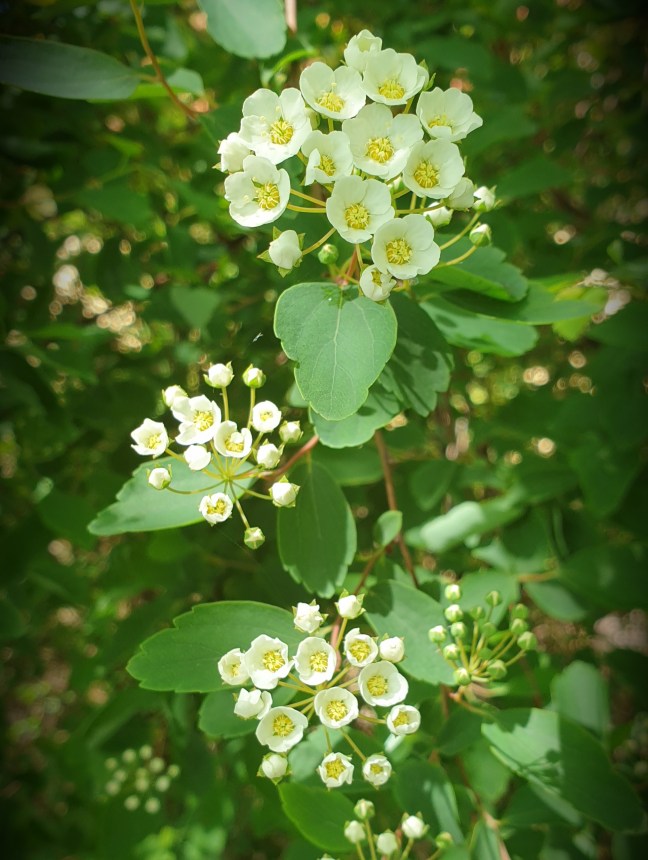
As my mind walks through that garden of some 35 years ago, my first thought it of coreopsis and black-eyed susans. Those vibrant yellow flowers in a circular bed near the street curb  welcomed all those who walked up my neighbor’s driveway. From that small patch, interspersed with irises of different shades, we would walk along the row of bridal’s wreath spirea that provided a nice, natural foundation to the front of the house. The spirea was also a lovely, mid-spring bloom that cast long fountains of ivory flowers downward toward a lawn filled with sheep’s sorrel – which I quickly learned had a tangy, lemony taste. Then, moving the right of the house and walking toward the back lot, there was just a tiny strip of mums and succulents that did their best to thrive in the overly-shaded side yard more or less hidden by the house next door. Only when one arrived toward the back porch did more colorful shrubs (lilacs, quince and wild roses) and bunches of peonies begin to fill the landscape with lush green leaves. Peonies of every hue imaginable: deep purples or violets, crisp whites and soft, pastel pinks that announced to all visitors that spring was out in full force.

The path to the back of the yard was lined with an ample hedge of both white and purple lilacs, along with a deeper purple bloom that Elsie called French lilac. They had an equally lovely scent as that of traditional lilacs, albeit with smaller, more delicate and darker flowers. Those purple sprays then gave way to a number of quince bushes which sat, as did the lilacs, under an immense persimmon tree. It was toward the back of the garden that many of the spring flowers ceded place to plants that would bloom in early or late summer: asters, Jerusalem artichokes (what we also called Missouri sunflower) and various sets of roses (both wild and cultivated). As the garden soil progressed into a rockier, rougher terrain toward the back alley of the lot, more roses peaked out through spaces they carved out for themselves in a lush bed of vinca minor (which we usually called periwinkle).

It was the repetition of this garden tour that taught me all about the therapy offered by gardening. I learned when and how to plant specific varieties and to save transplanting peonies till late summer – right after the gladiola had bloomed. It was transplanting time that would become a favorite moment in my year, where I would proudly bring my neighbor a shade of iris I knew she did not have; or she would provide me roots for peonies in new colors that would add to the alleys of those flowers at the back of our family’s lot.

So many years ago, but I still travel (in my mind) back to Hansen Avenue every spring. I remind myself of the flower names and types that Elsie so carefully planted in my head: Hosta, sempervirens, Solomon’s seal and more. Although that garden no longer stands, it blooms in my heart each spring: as I see the first flowers on the lily of the valley, or notice the lush pink of the bleeding hearts and the faded yellow of the forsythia flowers that have run their course. With all those colors, scents and memories of floral names, my heart becomes full and I appreciate the repetition of these memory-travels. Although I will never likely return in person, my mind always has a ticket those gardens of my childhood and their announcement of spring.

Wandering Lužnice (Pt. 2)

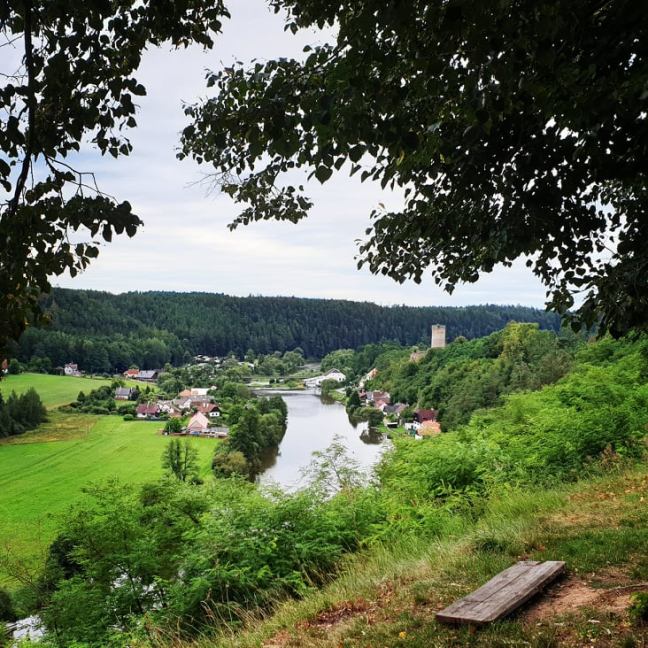
When finishing my previous post on hiking the Lužnice River trail in southern Bohemia, my friends and I had just arrived to the picturesque village of Dobronice u Bechyně. The hike into Dobronice was a tiring, but visually-pleasing finale to a long day of walking. As you approach the village, the path veers away from the river up a fairly steep hill that offers specials vistas of the Lužnice River from above. You see the water wind its way around the village below where small mills hug the right bank and the clackety-clack of the village’s single wooden bridge echoes up from the valley below. 

As you hike to the village center you first pass a look-out point just next to the Church of the Assumption of the Blessed Virgin, which sits in serene isolation at the village’s eastern edge. The marked footpath takes hikers back down to the river, while guiding them alongside the entry to the ruins of what was once Dobronice castle. The castle’s one remaining tower can be seen from the walking path and also from several points along the river below. 

We stayed overnight at a local bed and breakfast and gobbled up the tasty traditional Czech food that the innkeeper prepared. There was sumptuous roast pig, traditional beef goulash and also typical fried edam cheese (that’s the option I chose, because I hadn’t had any in a good while). The bed breakfast/inn offered nice views of the river and I fell asleep that night to the sound of stray cars clanking across the nearby bridge. 

Waking up the next day, we had a special visual treat in the fog lifting off the river and clouding the air around us as we enjoyed our breakfast. It was a quick meal, as we still had about 15 km before us and wanted to get an early start to our final destination of Bechyně. The start of the path was merciful: it began with roughly 3-4 km of tromping over footpaths through dew-covered meadows before once again returning to the mud/rock combo paths they we had regularly encountered the day before. 

It was during this segment of our hike that we got to enjoy the serenity of the Lužnice. Not many rafters and kayakers were out on the water yet, so we took advantage of the morning sun and sitting on the boulders that lay along the riverbanks. The large flat rocks offered the perfect place for sunbathing or for jumping into the refreshing water. Unfortunately though, we were short on time, so we quickly carried on along the riverside path that would intermittently offer sections of marsh where we would hop from one wood plank to the next or sections of rugged cliffs facing the river. These fascinating rock formations were frequently laden with ferns and lush moss.  

Slowly, our river path gave way to gravel roads that led to a series of small cottages that are part of the village Senožaty. I later learned that a friend of mine from East Bohemia has a cottage there where he and his family often stay in summer months. After that, our path would once again pull us away from the river rising into dense beech, pine and spruce forests that would lead to the edge of Bechyně. The forests smelled of pine needles and were just damp enough to offer prime growing conditions for the various types of mushrooms that are found throughout the Czech Republic. We even came across some chanterelles; yet not enough to pick for a good sauce to accompany our dinner.

Within 15 minutes or so, we were out of the forest and walking a field path that would lead us into Bechyně. The smells of autumn surrounded us: fields had been harvested and local apple trees had begun to shed their fruit. We stopped for a last group photo by the sign marking the town limits and then walked into the center to enjoy our “victory coffee”.  With my feet starting to protest a little too much, I left my friends to explore the beautiful chateau in Bechyně and to look at its lovely gardens. I, on the other hand, slowly began my way back to the local rail station and took in views of the public park that surrounds the town’s local spas. It was a wonderful end to the weekend: enjoyed with last-minute photos on Bechyně’s main square and catching glimpses of the town’s “rainbow bridge” as we took the train back to Tábor where we would pick up our car. It took my feet 3-4 days to forgive me for our weekend sojourn, but it was well worth it in the end.

Wandering Lužnice (Pt. 1)

It was a couple weeks ago that two friends and I went hiking along the Lužnice River in southern Bohemia. The Lužnice (called the Lainsitz in German) originates in Austria and we decided to walk the stretch from Planá nad Lužnicí to Běchyně. This portion features serene, mildly-flowing waters that attract swimmers, cyclists, rafters, and hikers like ourselves.

Our first afternoon, a roughly 17km trek, had us walking through various towns and villages just south of the larger town/city, Tábor. It’s an area full of small cottages and well-kept gardens, where local residents use the path along the river to make their trips to visit friends or to their local grocers more pleasant. The first part of the route was rendered more enjoyable by the cool breeze flowing up off the water and the views of gardens that townsfolk seemingly attend to with great care. The river path is brightened with the radiant yellow of sunflowers, the blazing reds of dahlias and cosmos, and the regal purply-blues of late-summer asters.

As we neared the first crossing to head up into the forests south of Tábor, my friends decided to take a dip in the river and to enjoy the refreshing chill of the water. Such a treat was much needed in the sweltering heat of that Friday’s 36-37°C sun. After taking some time to rest and dry off, we stopped for a quick beer in Sezimovo Ústí and then crossed the pedestrian bridge into the forests and glades on the opposite side. The welcome shade cooled us off as we made our way to the Tábor Zoo in the village, Větrovy. By the time we neared the village, the forest had given way and the late afternoon sun was punishing. As we neared the center of the village, we quickly acquiesced to the bidding of a local ice cream salesman, whose wares we hadn’t realized we so sorely needed. It would be his vanilla/pistachio soft-serve that sustained us all the way down the hill into Tábor. In roughly an hour, we descended into the city; via the quiet villages of Horky and Čelkovice. That night the beers served with dinner never tasted better. Then we capped of the evening with a brief tasting of Romanian wines that my friends would later bring back to Prague in ample supply.

The second day, after a night of troubled sleep in a mistakenly-booked B&B that turned out to be a hostel, saw us up early to get a quick start at the 20+ km that lie before us. This was admittedly the most beautiful part of our hike as we set out from Tábor with riverside views of First Republic villas and once active mills that had previously ground grain for nearby villagers and Tábor residents. It was during this portion of our hike that we met our first rafters and kayakers who had chosen to spend their weekend “taming” the Lužnice. Our path and the terrain along it varied repeatedly: with different segments of asphalt road amendable to cyclists interspersed with muddy marshlands and sometimes precariously placed boulders. Here, the river twists and turns until you get to the highly anticipated points that the Toulavá Lužnice website describes in its path highlights: the cliff tunnel after the Breda path intersection and the hanging boardwalk that takes you around the bend right to the Příběnice camping area. It was in Příběnice where a belated lunch (coupled with slower-than-average service and a missing Wi-Fi connection) sent one of my friends into a panic.

But luckily abundant beer would soothe his nerves. Once again, the Czech tradition of generously placing pubs along bike routes and hiking paths did not disappoint. And soon we were fortified with the golden treasure that is Pilsner beer. A second pitstop at the nearby campsite close to the Lužničanka settlement would fortify us even more. Soon we would be nearing the Empire-style bridge below Stadlec after braving the muddy, uneven path that would become slightly more treacherous as we ceded way to families of cyclists who hadn’t anticipated the difficult terrain. Many of them would find themselves faced with the repeated choice: ride and risk flying into the water or just carry their bicycles a good part of the way. It was under the Stadlec Bridge where we would take some extra time to rest our weary feet and enjoy the coolness of the Lužnice’s now rapid-flowing waters. Swimming and soaking our sore limbs, we admired the rafters as they worked to negotiate the sluices below the bridge.

Soon, we reluctantly shoed back up and embarked on the last part of our journey for that day: heading to our accommodation in Dobronice. It was that early evening segment of the Lužnice path that tested our mettle. With the final few kilometers making the whole day’s pedestrian (meant here in the hiking sense) efforts all worthwhile. We pushed our way up the final ascent just before Dobronice where we got our first views of the winding waterway from up above. We took a short pause at the Chapel of the Assumption of the Blessed Virgin to get some glimpses of the sunset and to admire the mills along the river below, near which we would soon be having dinner and getting a good night’s sleep.

Lorri marz (Լոռի մարզ) – where the animals run the show

I was trying to get into the mood to write and share something with my readers that would have an interesting, cohesive element. I have lived in the Czech Republic for almost 26 years now and just got back from a sabbatical in Armenia. When I write I like to think of things about both countries that are similar to, and which in some ways remind me of, my childhood in Missouri. The answer was animals.

I grew up in a rural community in northern Missouri. Although I didn’t live on a farm, most of my younger life was farm-adjacent. My maternal grandfather and his brothers grew angus cattle; my paternal grandmother kept a small number of animals in her backyard farm; and my dad raised cattle, sheep, or what have you on land he rented. It always surprises my friends from the city, when I tell them stories of how I spent the late springtime of my pre-teen years plucking chickens or how, as an even younger child, I helped my dad and his friends butcher cattle or pigs. I never had big jobs, mind you; I usually just stirred the pork fat so that it didn’t scald or burn OR I helped feed chunks of beef into the meat-grinder.

That said, my stay in Armenia often brought back memories of my rural childhood and farm-adjacent life. One occurrence that always made me smile was the work of local shepherds. On occasion I would run into them on hikes. But even more amusing was when they were moving animals to new pastures or mountain fields and the cattle “would come to town.” It didn’t happen that often, but it was always entertaining to watch the disinterested bovines wander through the streets of Vanadzor: rarely in a hurry to get anywhere and giving curious looks when drivers would become irate at the animals’ lack of urgency.

Other times, I would meet some smaller animals in the park. Usually, the sheep or goats showed up during a sunny afternoon when I went to the Sayat Nova այգի to read. As the bushes swished behind my bench, I assumed that either squirrels or birds were foraging. But no, it was the “children“ of a local shepherd who had come to dine on overgrown grass or on the tasty leaves of the abundant shrubbery.

As I watched them, it came to mind that domesticated animals are a unifying force across the world. In almost any country, you can wake up to the crows of an early-rising rooster. Or you can slalom on your bike as curious hens scurry across roads or field paths in search of bugs for their lunch. In Armenia, I most loved the proximity of the animals; for it took me back to my childhood. A time when I knew the provenance of the meat and dairy products we put on our table; also an age when I had a love-hate relationship with chores related to caring for livestock. These days though, the animals of the Czech countryside and Armenia’s Lorri region bring back fond memories: of driving with my late dad to check his cattle, of working with my grandma to gather eggs or feed her hens. So many nights my parents spent worrying about whether the “cattle were out.” My dad would surely chuckle if he saw that the cows of Armenia certainly are out: AND they rule the roads.

Finding peace and gratitude along the Vltava

I realized after writing my last blog entry that perhaps my words had been too aggressive. Most likely in a time of crisis few readers cared to hear my complaints about being lost in the quarantined world of Prague after leaving the Peace Corps. Those words did not come from a place of anger though: more of frustration because I had not yet been able to see friends I was missing for over a year. So that’s why I put my butt on a train and headed up the Vltava River.

It’s hard to explain the Vltava. It’s like the spinal cord of Bohemia or the Czech lands. It was on the hills above the river that Libuše had her vision of a city whose glory and light would shine for thousands of years. That city being Prague of course. It is where, per local legend, Horymír, atop his horse Šemík, jumped the waterway and fled en route to Neumětely. Along this river vagabond-hikers set up camps and spent their weekends in nature, or southern Bohemians first brewed the original Budvar (today’s Budweiser) in České Budějovice. But for me, the Vltava River represents calm. It represents continuity and simple beauty. It’s a river that runs from an unassuming source in the mountains and hills of the Šumava and carries its natural sustenance and history all the way to the Czech capital and beyond.

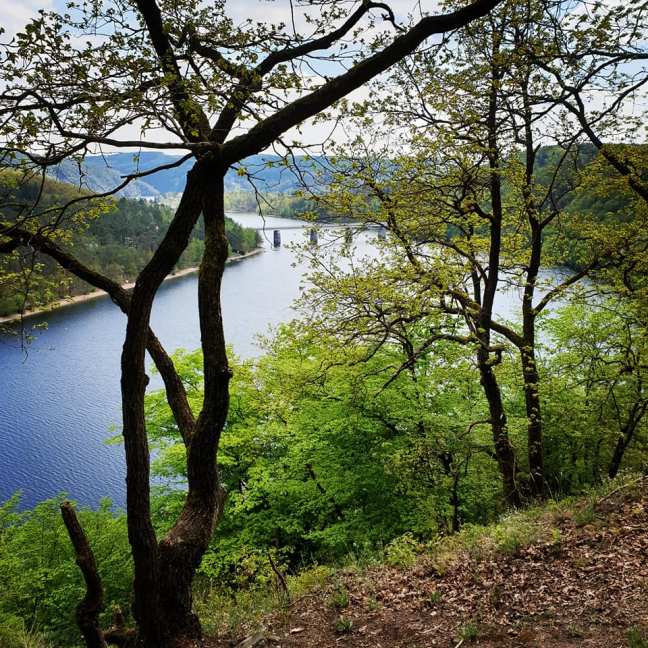
During the past week, I took a couple of short trips along the river, south of Prague (just under an hour away by car or train). Once at my destination, I either hiked my way back toward the city or did a forest circuit. My Tuesday hike was a celebration of spring. As I tromped up the hill away from the banks of the Vltava, I reveled in the embrace of fruit trees’ hugging branches as they shadowed the forest paths and ancient roads. The melodious hum of bees and wasps busy at work accompanied me along rows of cherry, apple and apricot trees in full bloom. As the sun shone and warmed the road, for the first time since returning home, I felt at peace. It was the peace at spring: of the healing sun and nature’s rebirth. Because of current restrictions, I was one of few people in the forest. Still, that made me all the more aware of how grateful I should be. I advanced along the path to reach the tops of bluffs along the river. There, I found the remains of campfires local villagers had enjoyed and later extinguished; I saw the view of the railroad bridge over the Vltava that I had travelled across only moments before. In a brisk wind looking down at Bohemia’s natural life source, I imagined all those who had come before me. How emperors and kings had traveled that river in the age of the Holy Roman Empire or Austria-Hungary. Or how the labors of loggers in the southern forests had sent wood down elaborate canal systems and into the river so that it could float to Prague for use on major construction projects of the day.

And on my trip yesterday, I saw a river full of hope. It was a Vltava that was enjoying a break from the busy swarms of Prague residents who rush to its banks as soon as warm weather allows. The river was calm, but it was ready… for people to return. That’s when I felt the most gratitude: as I watched random boats laze on the water floating around the area stilled by the Slapy dam. I was grateful for the river and the stories she knows: the stories she tells. I was grateful for the sustenance she brings in nourishment for the fruit trees and berry bushes along her banks. I was thankful for the livelihoods she supports as tourists and locals visit her to swim in her refreshing waters and relax over a half-liter of Bohemia’s most famous golden lagers. Yes, the river is my constant – a source of relaxation, beauty, learning and life. As long as she flows, I will live happily and delight in returning to hear her tales and will remain forever grateful for them.