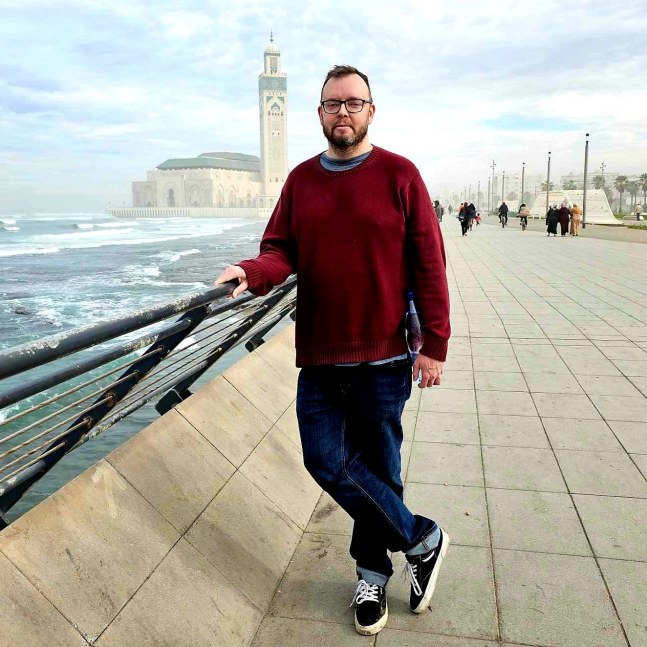
Craziness and confusion in Casablanca

Over the year-end holidays I made my first trip to Morocco. I honestly had no idea what to expect; I just knew that I had wanted to visit the country for a long time. So we got on the plane from Lisbon and began what would be a fun, unpredictable and tiring adventure. Tiring in a good way though.

Moroccans are very hospitable. You might not initially expect that based on the line at the passport checks in the Casablanca airport. Which took forever, and forever, and forever. As my friend Ree and I waited there to be somehow  let in the country, my hangriness levels started to peak. I don’t really remember now what Ree fed me to keep me from going off the deep end, but it worked. For that matter, I also don’t know what happened to the Asian lady in front of me at the passport check. After she was questioned for 10 minutes, they took her somewhere. I didn’t see her come back.

But we eventually got through and into baggage claim, grabbed our bags, and set off to look for the train station. We quickly found it but had no idea when the train would leave. Turned out it was RIGHT THEN and THERE. So I went into party planner mode and saw Moroccan hospitality and guest care burst into action. I ordered two tickets using my rusty French, told Ree how much we needed to pay … then we ran. We ran because the train was leaving that minute but the ticket vendor called the platform and told them to hold departure for us and they did. Within two minutes we were riding through desert plains to Casa Oasis or Casa Port. Just someplace.

With a little time to relax in the train, we joked about what we had just gone through. And we were really impressed and grateful for the support from our help at the Moroccan ONCF/SNCF. Then came the arrival at the train station and our first stab at finding a Moroccan cab driver, of which there are plenty. I tried to weed through the many “helpful” people who wanted to take us “someplace” and looked for drivers at an official cab stand. That turned out not to work so well but we found a nice enough elderly driver, paid roughly 20 dirham too much to get to the hotel, and then embarked on an interesting ride. My favourite part of that journey was when I turned on Google maps to get the precise hotel location and the driver said “Wow, that GPS tracking is very useful.” I just nodded in tired agreement.

Our hotel location was decent. Lots of boutiques and shops along the busy boulevards, which led me to my first impressions of Casablanca. It is a BIG city for Morocco and feels much more USA metropolitan than Berber, north African desert chic. We bookended our stay in Morocco with a few nights in Casablanca. After our return trip to the city (and a train ride with an interesting Dutch family from whom we got ex post travel advice and discovered what all we had missed out on), we were glad to get back to our favourite hotel and relax. Once again we overpaid for the ride from the train station Casa Oasis to our hotel, but given that other costs for food, public transport, etc. were generally reasonably priced (even cheap by European standards), we just tolerated the random cab fares when necessary.

We spent the next day trying to discover Casablanca’s city centre as much as possible. As said, the town is very urban with lots of high-rises and skyscrapers with some bits of traditional architecture woven in here and there. The promenade along the coastline by the main mosque is enjoyable. Waves bustling in from the Atlantic and the misty, foggy beauty of that that semi-shrouded place of worship in morning hours gave it a special air of mystery. Walking along the coastline you could watch local young men on their sports bikes doing tricks, while their elders sat along the beachfront and promenade railing casting their fishing lines in hopes of being rewarded with some sort of nice catch for the day. We rounded out our walks with some visits to cafés and restaurants here and there; enjoying the comfort of the delicious Moroccan mint tea and the gracious kindness of our servers in various types of restaurants – Italian, Moroccan and some sort of fusion. We ate well.

Casablanca remains a sort of mystery to me. It’s a bit too modern and doesn’t have that local feel of the country’s interior,  nor is there that visible switch to a different history and culture I was hoping for. I would be happy to visit again though just to learn more about the city (after doing some online research). Plus, we were told a venture up the coast to Rabat is worthwhile. So, hang on, Casablanca. I’m not quite done with you yet.

Ապրե՛ս / Ապրե՛ք (Live!)

In a week or so, 60 years will have passed since US president John F. Kennedy signed the executive order 10924 creating the Peace Corps. The date was 1 March 1961. I’ve been thinking for a couple of weeks about how to recognize that very important anniversary while combining it with my personal blog here which focuses on travel.

After a lot of thought, I decided to share with you some comments about how the US Peace Corps has influenced my views on travel and how I perceive it a bit differently now. Although cut short, my experience serving in northern Armenia helped me “travel” in multiple senses of the word. It helped me explore and learn about a country I’ve come to love more than I ever could have imagined. And it helped me advance further down a road of personal maturity and understanding (and coming to accept) what I have to give to, and what I sometimes need from, the world.

All that said, I want to share with you one of the greatest gifts the Armenians gave a language nerd like me. And that would be the word in the title to this blog entry which transliterates as apres or apreq. It is the imperative of the verb “to live” and is used in Armenia as an expression of commendation or praise. When Armenians appreciate something you’ve done or approve of your actions, they literally tell you to “Live!”. Usage of this term is so common in Armenia that I never put much thought into its broader significance and the lessons or values it could teach people from other countries: that one of the greatest gifts we have in this world is life. If you think back on the 20th century history of Armenia – both at the time of the collapse of the Ottoman Empire and after the dissolution of the Soviet Union – you realize that the Armenian people were always endangered by the ambitions of their larger neighbors or the commercial interests of other global powers. For those Armenians who lost family in the genocide of 1915 or other mass killings of Armenian populations or for families who lost sons and fathers in the wars in Artsakh, one of the most precious gifts a person has is “life” or “living”. This is a reality that most of us in Europe or the USA don’t give much thought. One of the most daring, audacious things we can do in our time on this planet is to live. Not just exist, but LIVE!

This is a point that was not lost on me the longer I stayed in Armenia and got to know the people there. I went to the Peace Corps because I wanted to learn about another culture; I had hoped that some of the skills and experience I had acquired in my professional life over 20+ years would be of some use or worth to local communities. To my surprise though, my Armenian colleagues and families taught me a small lesson of enormous value: I needed to learn to live. This meant celebrating all that life offers us from dusk till dawn: from making tahini sandwiches with my host sister Yeva and having my morning tea with her mom Zara, on to having a late evening snack with my second host dad Artur and watching bits of the TV news with him. I learned that actually living meant I needed to slow down to truly see and appreciate life. I needed to listen. I had to find value in opening up to strangers and appreciating their natural curiosity about the super tall, dark-haired man who wasn’t one of them, who wasn’t a Russian speaker, but who had somehow made his home for awhile in their bustling town.

I like to think that over time, all the progress that I made in learning how to live (how to heal myself) came from the repetition of that tiny, yet powerful, Armenian entreaty: ապրե՛ս. My Armenian friends and family constantly invited me to enjoy life, to take time to talk and share myself with them and their families, and to notice the small blessings that show up around us day in, day out. So, Armenia, thank you for helping me truly live and enjoy life: ձեզ էլ ապրե՛ք։

Living in three spaces

I haven’t felt like blogging for a while. Or perhaps it’s more that I didn’t know where to go with my writing. It’s been half a year now since I returned (unexpectedly) from northern Armenia.  Now is the moment where the change starts to gel or solidify. I realize that, while I can still hold a conversation in հայերեն, it’s more difficult to recall words that used to be commonplace.  Memories are beginning to fade, and moments of daily life are more distant … saying hello to Manvel who lived in the first floor of my building. He knew three sentences in English, but he greeted me religiously every time I walked by. Always reminding me that I was welcome in Vanadzor and in Armenia in general.  I miss the moments spent persuading fruit and veg vendors that Russian wasn’t my native tongue, and that I could get through a conversation in my pigeon Armenian. I miss the lady from my “beer garden” in Tigran Mets Avenue, who gradually got used to my arriving mid-afternoon on Saturdays after a hike: book in hand, just me, myself and I … ready for a cold draught beer. 

Now as the Czech summer ends and I watch videos, listen to songs, or browse through photos so I can cling to the recollections of my Armenian adventure, I gradually merge the similarities of three specific places I once called home. 

I’m a rural person at heart. I spent my childhood wanting to escape small town life. My dad had aspirations that I would become a farmer and work with animals: as had been his dream. But my hopes went farther. I’m not sure if it was the genetics of my ever-moving paternal grandmother or the travel tales recounted by my very wise neighbor. But I knew I wanted life beyond any local farm. Funny thing is though: despite becoming a city-slicker, I never forsook my rural upbringing or time spent working with my dad, uncles and grandmother. It is the long thread of rural life that, for me, binds Missouri with rural Bohemia and the pastures of Armenia’s Lorri region. In the fields of all those lands, I see and feel the memory of my dad and his dreams; secretly hoping that some of my life’s adventures have made him proud.

Good people are worth listening to. Something inside me tends to be averse to seeking out conversation. However, many places I have lived so easily lent themselves to impromptu chats and discussion. Whether it be the doorways of stores on Brookfield’s Main Street, the garden pub of a Czech village along a random bike route, or the encounters with shepherds as they moved their herds between northern Armenia’s lush, green hills. They all began as strangers to me, yet we ended with many bonds: some had family that had emigrated, others had seen American TV shows or had travelled to Prague on a family holiday. It was my wary, skeptical entries into these numerous, ad hoc chats that confirmed to me that as citizens of the world we are all ostensibly different but very much still the same in our curiosity and desire to learn about and connect with others.

The women of my past prepared me for my future.  Then there’s the W factor. As mentioned above, it was the women of my childhood who told me of the world outside my hometown. They assured me that studying and hard work would give me access to that world. And as the years prove them right, I remember and channel their spirits as I mull new adventures and live new experiences. In my mind, I talked to Elsie as I admired the gardens of many an Armenian grandmother. I give thanks to Louise and Mildred for their nurturing my interest in languages and travel and for helping make possible my first TWA flight to Paris. I summon the courage of Jacqueline anytime I’m not sure I have what it takes to defend myself and fight for what is just in the world. How she so nonchalantly stated in that Parisian tailor’s shop: I survived the Nazis; I’m hardly going to cower to a greedy, deceitful clothing store owner.

It’s been a difficult summer reminiscing about my homes old and new. But I am forever grateful for the lessons they taught me and the people from those places who enriched my spirit more than I ever could have imagined.   

I own nothing but I have everything

When I think back on my time in the East
And entering a land about which I knew little
With no idea what to expect
Of the people that await

And as we greeted each other with apprehension
Reservations about who I was
And what they expected of me
Twice the age of the other “invaders”

Superficial worldviews would say
Comparatively, they had little
Yet never did we/they want
For all life’s essentials

Smiles were abundant
Coffee was plenty
A step over any threshold
Was a call for plates of sweets
And the best any household had to offer

As I approach the year fifty
And berate myself
For not owning a house, not owning a car
While still asking almost daily
What ownership means

I have so many possessions
That I keep inside me
Stores of memories, laughter, tears and embraces
And stories or legends shared
Of lessons my life road has taught me

I no longer worry
About the property I have not yet collected
For my most valuable possession
Is the real estate of my heart

I own nothing, but I have everything