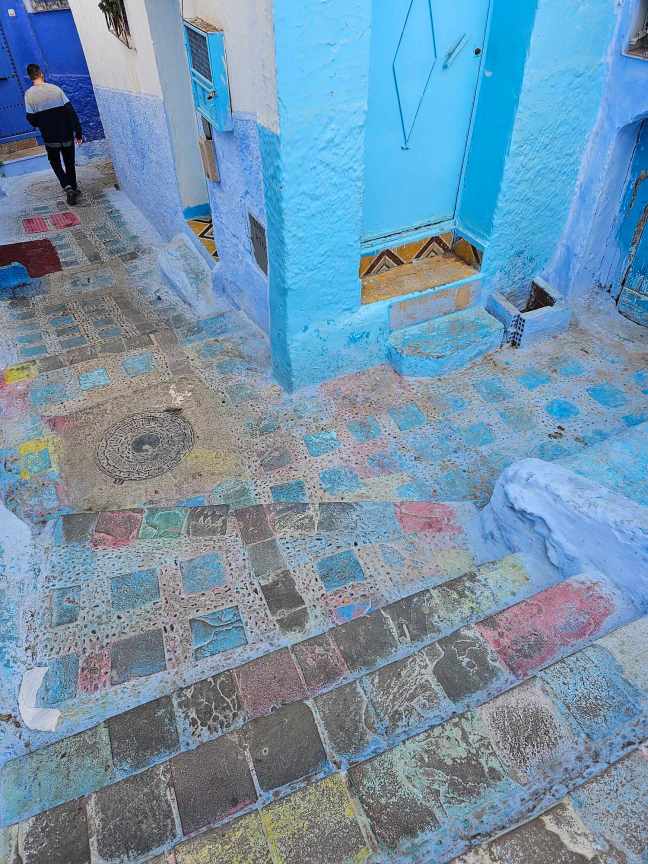
Chefchaouen: Still questioning an azure, cerulean, cornflower, powder blue mystery.

Roughly 3-4 hours north of Fès, further into the mountains, lies a magical town painted in multiple shades of blue. It is famous among tourists to Morocco. Everyone wants to visit the blue city. I have to admit that I am a failed visitor in the fact that I never asked why the buildings of this municipality tucked in the northern Atlas mountain range had been painted my favourite colour.

I do know that travelling to Chefchaouen was an adventurous, long-ish journey where you have to spend roughly four hours getting there in a mini-tour bus. Don’t get me wrong. The bus was comfortable and the driver very professional, with the patience of a saint. But the trek is long and you are very happy when you arrive. The driver is even kind enough to make a stop on the bluff overlooking the town before you move into its centre. At that stop, travellers from all parts of the world carefully cross the busy blacktop to stand in front of the nearby hill town. Interestingly, it looks a lot less blue from the bird’s eye perspective, so you wouldn’t really know it’s the destination you seek without the nearby road signs or the driver telling you that you are close to the end of your journey.

Arriving to Chefchaouen was a relief; well at least until we realised the quickest route to finding our riad (accommodation) was a journey through the people-packed, narrow streets of the old medina in the city centre. So along with Ree, who had to take a deep breath and tolerate a hangry Brenda, we plodded our way up the gradual slope. Fortunately, the blue tones on all walls along the way are calming. You just look in awe and think: who had this idea? Who does the paint touch ups? Are there restrictions on what shades of blue can be used? It immediately occurred to me that the monument protection institute in Prague would have a field day setting out rules on paint usage in this city.

Half-way up the hill, you finally make it out of the medina and you reach an open square. Much to my profound happiness. There, you have a view of the local kasbah (a former fortress and prison) with its colourful gardens and pretty views of the local terra cotta tile rooftops and the jagged hills (mountains) surrounding Chefchaouen. This was a moment of respite from the crowded medina paths but it meant the arrival of the salesmen. Stop for lunch? Would you like something to eat? Check out our shops. It was a lot to handle for someone like me who has come to love the standoffish-ness of most Czech storekeepers and sales clerks. I am a firm subscriber to the If I need something I will ask. take on shopping. Soon enough though – with the generosity of Google maps – we would find our way to our riad and the busy juice-maker (vendor) and his neighbour-carpet sellers who flanked the stairsteps nearby.

And the riad … what can I say? And where to begin? Wonderful staff and a room from a fairytale. Ree was kind enough to let me hide myself in the bed on the upper level, complete with a window nook where I could work, read and inspect the hullabaloo that seemed to be a constant on the stairs and sidewalk below.

There didn’t seem to be a strict tourist agenda for persons visiting Chefchaouen. You were in the blue city, so you enjoyed the blueness. The cute little paths and the many locals who were there to sell, sell, sell. You can watch the vagabond cats scurry from house to house or run the cobblestone sidewalks looking for food and treats. To make my hangriness subside, we agreed to find an internet-recommended restaurant where we could grab a proper lunch and catch our breath after days of being on the move. I’m not sure now what I even ate. I want to stay I started with something puff-pastry adjacent that reminded me of Greek spanakopita. And for the main – a tagine or some sort? Who knows. I mainly remember being enthralled by the mountain views around us. These rocky crags that had to be fairly tall – I was so curious about them I turned on my Mapy.cz app to get confirmation that some were indeed over 2000 metres tall. And then I realised that one should do their homework before travelling: had I know of the nearby mountains and their well-marked hiking paths, I would have booked a longer stay. The reality is that if you hike to the tops of the mountains, a view of the Mediterranean awaits you on the other side. In fact, you are perhaps only 50 km from the seashore. Oh well, there’s always next time.

I don’t know what else to say about Chefchaouen. It was a special, almost surreal place with wonderful people full of kindness and hospitality. You just kind of want to think carefully about the mini-interviews that local vendors conduct. Beyond that, I would love to go back and hike the mountains to the sea. I feel like that needs to happen. Until then.

The (Swiss) hills are alive …

It’s been awhile since I’ve added to this blog. That’s mainly because the past few months have been about readjusting to life in Central Europe and trying to get things organized in my business. However, I recently had the good fortune, once Europe re-opened its borders, to go spend two weeks hiding out with some very special friends, Pete and Laura, at their home in St. Sulpice, Switzerland.  It’s a cute little town/village/suburb on the outskirts of Lausanne, and it must be said … they have an awesome view of Lac Léman (Lake Geneva). 

One of my favorite take-aways from my time there was all the gorgeous vistas around the lake; with mountains on every side and the confusing geography that always has you wondering: am I looking at France? Or am I looking at Switzerland.  In any case, there was so much beautiful nature to take in; including the calm waters of Lac Léman, the moody storm clouds rolling in from the Alps or creeping in from the Jura. There was also the morning songs (and sometimes cackles) from the birds who lived near the lake.  When I think back on my visit, I reckon these are some of my favorite memories…

The incessant ringing of the mountains

When we took a Sunday hike in the mountains north of Gland/Arzier, it became immediately apparent that each cow/bull has a bell. And those bells clang non-stop as the animals graze in their alpine pastures and wander to find new meadows unexplored. The sounds give the hills an almost church-like atmosphere where the carillons of cow bells call you to nature’s cathedral and invite you to commune in the lush fields and enjoy the soothing, warm winds that pass through the forests. 

The tangy taste of Gruyère cheese

This was one of my favorite moments during my visit. Parking just below the medieval village of Gruyères and walking through the old gate into this fortified settlement made me feel like I had travelled back in time. As you walk over the cobblestone-paved square and admire the shops and cafés that hark back to a time long ago, you can quickly imagine horse carts and wagons as they must have once brought in wares and crops from the surrounding area. Or vendors as they traded goods from shops and stalls in this hamlet that is home to one of my favorite cheeses. Just down the hill from Gruyères, in the town of Pringy, you can visit the Maison du Gruyère museum and buy all the delicious cheese you want. That coupled with the exquisite views of Le Moléson mountain gives you a sense of serenity and contentment that is worth they journey.

The markets of Évian

Just across Lac Léman from the port at Ouchy lies the peaceful village of Évian les Bains. The town famous for its freshwater springs and its spa hotels makes a nice day trip for visitors from Lausanne, Geneva or the surrounding areas. I travelled there with Laura to explore the Friday farmers’ markets and enjoy the promenade along the waterfront. The animated vendors as they hawk their meats, cheeses and vegetables are a wonderfully intriguing sight to observe. Or sipping a rich cup of coffee while eating a pain au chocolat is just the right treat for starting a holiday weekend.  Plus, there’s the added benefit of looking back at your holiday home on the Swiss side of the lake and taking in the serene Vaudois shores.

I am so grateful to my friends for allowing me to “disappear” at their home for the past couple of weeks. Switzerland and its captivating, hospitable and welcoming countryside was just the right antidote to this spring’s long periods of isolation mandated by the Covid world. If you get the chance to wander through the Swiss mountains and explore the paths that lead you to breathtaking views of the country’s many lakes, definitely seize that opportunity. It’s well worth it.

Solace in the hills (how I fell in love with northern Armenia)

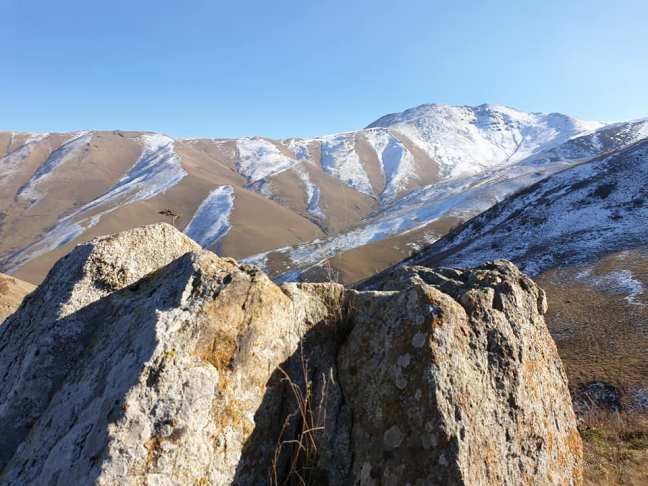
I became enamored with the mostly barren mountains of Armenia’s Lori region the first time my marshutni (minibus used for public transport) crossed over the mountain pass that enters the area just south of Spitak.  After a half-hour of travelling the road that lies in the shadow of Mt. Aragats northern side, the winding descent into Lori left my mouth gaping.

It’s hard to describe. There are the colors: the multiple shades of tan, brown and gray that make up the hillsides; tones which juxtapose nicely with the blotches of alabaster snow scattered on the mountaintops and the various shades of pale blue that tint the local skies.

The mountains of the Lori region are like a mother’s embrace. They fold over on you and welcome you each time you venture out to explore them.  Plus, there is a certain mysticism you feel as you climb each hill and arrive at increasingly better vantage points from which to look at nearby cities and villages.  The peaks of Lori offer a bird’s eye view of Armenia’s third-largest city Vanadzor or further west you can look down and take in the sprawl of Spitak, the town at the epicenter of the earthquake that hit Armenia in 1988.

Yet what’s even more special about the mountains of northern Armenia is the solitude they offer.  So many conversations I’ve had with local city-dwellers or even villagers begin with the question: why do you need to climb a mountain?  And my response, which is invariably the same, goes like this: to see if I can.  Each time I embark on a hike through the hills of Lori, I gain so much more than just a good workout. There is an opportunity to take in the silence, to revel in the ancientness of the land and to surmise what nomads or tradesman might have wandered these peaks and valley centuries ago as they made their way from Asia to Europe.

Perhaps my biggest joy derived from running to the hills nearby my beloved Vanadzor is knowing that, most likely, the journey will involve just me, my thoughts and the random shepherds I happen upon during my walk.  I recall a funny conversation I had with a shepherd one Saturday as plodded my way up Karmirsar (Red Mountain).  “Why are you here?”, the shepherd asked.  I shrugged and replied, “To enjoy the mountains and to imagine their history.” He offered a confused look and went on guiding his cattle down the hillside.  To be honest, I didn’t really know why I was there, except perhaps to enjoy the beautiful views and to soak in the warmth of the autumn sun.  But the truth is the hills of the Lori region have a very specific energy.  So, maybe I was just there to recharge.