Ապրե՛ս / Ապրե՛ք (Live!)

In a week or so, 60 years will have passed since US president John F. Kennedy signed the executive order 10924 creating the Peace Corps. The date was 1 March 1961. I’ve been thinking for a couple of weeks about how to recognize that very important anniversary while combining it with my personal blog here which focuses on travel.

After a lot of thought, I decided to share with you some comments about how the US Peace Corps has influenced my views on travel and how I perceive it a bit differently now. Although cut short, my experience serving in northern Armenia helped me “travel” in multiple senses of the word. It helped me explore and learn about a country I’ve come to love more than I ever could have imagined. And it helped me advance further down a road of personal maturity and understanding (and coming to accept) what I have to give to, and what I sometimes need from, the world.

All that said, I want to share with you one of the greatest gifts the Armenians gave a language nerd like me. And that would be the word in the title to this blog entry which transliterates as apres or apreq. It is the imperative of the verb “to live” and is used in Armenia as an expression of commendation or praise. When Armenians appreciate something you’ve done or approve of your actions, they literally tell you to “Live!”. Usage of this term is so common in Armenia that I never put much thought into its broader significance and the lessons or values it could teach people from other countries: that one of the greatest gifts we have in this world is life. If you think back on the 20th century history of Armenia – both at the time of the collapse of the Ottoman Empire and after the dissolution of the Soviet Union – you realize that the Armenian people were always endangered by the ambitions of their larger neighbors or the commercial interests of other global powers. For those Armenians who lost family in the genocide of 1915 or other mass killings of Armenian populations or for families who lost sons and fathers in the wars in Artsakh, one of the most precious gifts a person has is “life” or “living”. This is a reality that most of us in Europe or the USA don’t give much thought. One of the most daring, audacious things we can do in our time on this planet is to live. Not just exist, but LIVE!

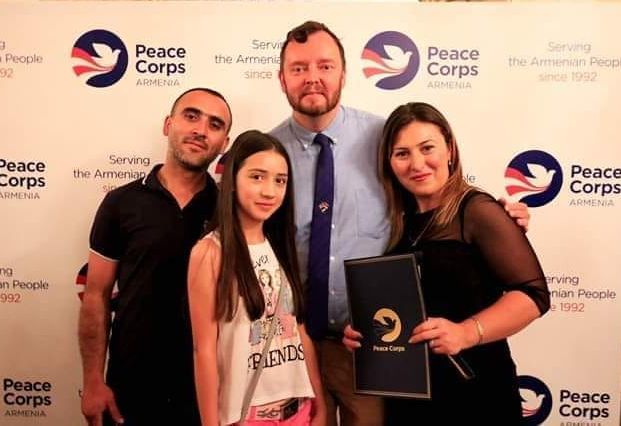
This is a point that was not lost on me the longer I stayed in Armenia and got to know the people there. I went to the Peace Corps because I wanted to learn about another culture; I had hoped that some of the skills and experience I had acquired in my professional life over 20+ years would be of some use or worth to local communities. To my surprise though, my Armenian colleagues and families taught me a small lesson of enormous value: I needed to learn to live. This meant celebrating all that life offers us from dusk till dawn: from making tahini sandwiches with my host sister Yeva and having my morning tea with her mom Zara, on to having a late evening snack with my second host dad Artur and watching bits of the TV news with him. I learned that actually living meant I needed to slow down to truly see and appreciate life. I needed to listen. I had to find value in opening up to strangers and appreciating their natural curiosity about the super tall, dark-haired man who wasn’t one of them, who wasn’t a Russian speaker, but who had somehow made his home for awhile in their bustling town.

I like to think that over time, all the progress that I made in learning how to live (how to heal myself) came from the repetition of that tiny, yet powerful, Armenian entreaty: ապրե՛ս. My Armenian friends and family constantly invited me to enjoy life, to take time to talk and share myself with them and their families, and to notice the small blessings that show up around us day in, day out. So, Armenia, thank you for helping me truly live and enjoy life: ձեզ էլ ապրե՛ք։
How I gained a new family (Pt. 1)

I woke up this morning in a state of denial and confusion.  It’s hard to say if I’m really happy or sad.  When the corona virus started to put into question the future of my Peace Corps service in Armenia, I wasn’t sure how severe the situation was.  Our group had been put on stand-by and was ready to evacuate if need be. In the end we did.  For me, that day was 18 March 2020.

So now I am on my couch, the morning after arriving back to Prague (the place I’d called home for 25 years prior to applying to Peace Corps), and I am trying to sort through feelings.  For the moment, it all feels like a weird dream.  But the most urgent thing I want to write about, or the thing that constantly comes to mind, is the feeling of family.  After just one year in Armenia, I feel that I have been separated from part of my family (my fellow volunteers who have gone back to their homes in the USA) and have left another family behind (all the Armenians with whom I had the good fortune to work and collaborate during that short year in their country).

Prior to leaving Armenia, I took part in a TV interview to speak about my service in the north central part of the country.  Since I attempted to brave that process while speaking in my pigeon Armenian, I found it difficult at times to say eloquently just how much the chance at experiencing life there meant to me. I had arrived there a burnt out PR/marketing manager and had no idea what I sought from my service experience.  I only knew I needed change and wanted to do something a bit more meaningful personally; something that would hopefully make other people’s lives better.  Right now, it’s too soon to say for certain, if that happened.  However, based on the constant pain this separation has caused in my heart, I think I can say some change happened.

Firstly, I would like to speak to the change a small family in southern Armenia caused in my life and hopefully I in theirs.  It’s important to know that I was an “odd man out”-type volunteers. At 47, I was twice the age of most of my other fellow volunteers and that was, I believe, a bit odd for the host families. These Armenian families are so gracious, and they take you into their homes not having any clue what sort of situation they will find themselves in.  From my end, I am older and never had a family of my own. I had lived alone for most of my adult life.  Suddenly, I was living in a family with three daughters, mom and dad, and a grandfather.  I had my own room, but it was clear the impositions that I was putting on the family.  All the daughters had to pick up camp and move to another bedroom shared with their parents: all because of me.  It was only over time that I came to realize this, and it touched my heart how much space this family was willing to give up take me in and learn what life in America was like.

That said, I was concerned that I had failed them on that count as well.  I used to joke with them that they ordered a US Peace Corps volunteer but ended up getting a “fake” one.  I make this comment, because I didn’t check all the boxes for what most families expected.  As said above, I was older. I didn’t have much immediate experience on what life was currently like in the USA, because I had only been travelling there for work or family visits over the past 20+ years. Then, add to that the fact that when I reverted to my previous daily language I was speaking in Czech: an idiom that had been my daily go-to for the past 20 years. It made my family laugh when I kept explaining that the filler words I would slip into sentences, mostly unwittingly, were Czech … not my mother tongue, English.  We just agreed I was weird and laughed.  Yet it did help us mark some progress, when I went from saying moment (the Czech term for asking someone to “wait a minute”) and advancing to mi rope / մի րոպե: the proper Armenian expression.

With my abrupt departure from Armenia, it was painful not to get to see my first host family in person one last time.  Although I know we will meet again soon after the world heals itself and the corona virus comes under control.  However, there is solace in the fact that the weird, old volunteer that I am is now forever irrevocably bound to an Armenian family: and not just one.  As my hopes for this family’s future diminish my temporary sorrows. I left behind what might be a future educator, a future artist or a future actress. I can’t wait to see all the good things that Ema, Lilit and Eva will do with their lives.  And that hope keeps my current pain at bay.

Note: there are lot of thoughts going through my head at the moment (post-service), and I will write one or two more comments on my connections and shared experiences with Armenian families in my future blog updates.

Disclaimer:  This blog is used to express my own thoughts and feelings. My comments are purely my own and do not reflect any official views or opinions of the US Peace Corps or the US government. Likewise, the US Peace Corps bears no liability for any of the content I post.