Seeking Serenity in the Orbe Valley (Pt. 2)

In my last post, I spoke of my holiday hiking with friends met in Prague who now live in Lausanne. We decided that in today’s Covid-impacted world the best spiritual rejuvenation would come from getting out of the city and back to nature. Luckily, some of Switzerland’s most interesting and intriguing natural sites are to be found at the foot of the Jura mountains: not far from our home base in Lausanne. Our preferred destination is Les Clées (reached easily by car). Our first hike this season, a new one to me, was a footpath heading west of Les Clées village: in direction of the French border. 

I have to admit that his hike was not full-on serene for me. The nature was amazing and beautiful, but the precarious path and the threat of a possible fall off a steep incline down into the Orbe River had me a bit ill-at-ease at times. Initially, the route is wider and you focus more on questioning why you had such a big breakfast OR you wish you’d had more to eat. You need a good store of energy to push yourself up the constantly ascending path. However, quickly the route narrows and you look at the rushing Orbe below and wonder how rapidly you might plummet down to the water.

As with all things Swiss, this path is impeccably organized. Should you happen on an outshoot of rock: no worries. The locals long ago carved a tunnel into the grey-white rock so that hikers can easily navigate through the mountainside when need be. Likewise, this section of the Orbe River Path also has ample swells of fresh-water springs that trickle slowly to the rapids down below. In the winter season, these water flows offer an additional, amazing spectacle: icicle cascades. Passages through the rock tunnels along the route have an almost 2m tall person like myself dodging a number of frozen-water daggers: a) so as not to hit my head, b) in order to preserve the beauty the icicles contribute to this magical, wintertime, natural kingdom.

The hike provides ample amounts of calm and solace, with the only creatures interrupting our thoughts being Izzi our Vizsla canine companion (she’s afraid of the icy footbridges) and our Jack Russell named Poppy, who shoots up and down the path and sometimes along the icy cliffside without thought for potential consequences. Ultimately though, there is an incredible reward toward the end of the trail. These are the Le Day waterfalls (the Saut du Day) which tower over you as you reach a broadening of the Orbe River where it shallows out and serves up rocky sandbars that are perfect for a picnic. It was at the waterfalls that we went crazy with our cameras and took multiple pics of our beautiful surroundings. We let the dogs test the icy waters and run to their hearts’ content. Plus, it was there that we came across our first humans: other locals on holiday, who also apparently needed to escape their isolating in place for just an hour or two.

I am thankful to have spent a part of my holidays admiring the Orbe River and the gorge through which it passes. It is a calming, fascinating place where I never cease to be in awe of how the water swiftly flows, sharing its gurgles with the random hikers who pass alongside it. I give thanks to the Swiss people who look after the nearby paths and make such wonderful views of nature accessible to all who journey to the area for a walk. As I sit here in Day 4 of my post-holiday quarantine, I can still hear the river calling me. Come back one day. I’ll be waiting. And surely I will return: for a future dose of much needed and appreciated serenity.       
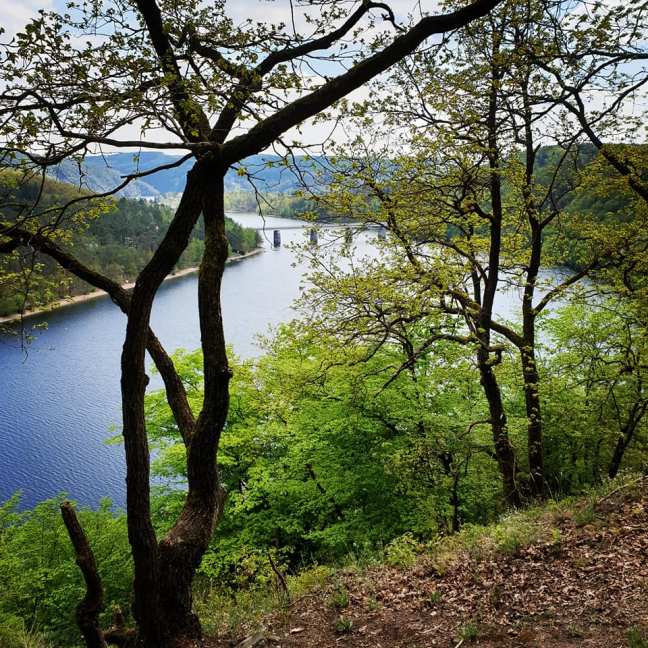
Finding peace and gratitude along the Vltava

I realized after writing my last blog entry that perhaps my words had been too aggressive. Most likely in a time of crisis few readers cared to hear my complaints about being lost in the quarantined world of Prague after leaving the Peace Corps. Those words did not come from a place of anger though: more of frustration because I had not yet been able to see friends I was missing for over a year. So that’s why I put my butt on a train and headed up the Vltava River.

It’s hard to explain the Vltava. It’s like the spinal cord of Bohemia or the Czech lands. It was on the hills above the river that Libuše had her vision of a city whose glory and light would shine for thousands of years. That city being Prague of course. It is where, per local legend, Horymír, atop his horse Šemík, jumped the waterway and fled en route to Neumětely. Along this river vagabond-hikers set up camps and spent their weekends in nature, or southern Bohemians first brewed the original Budvar (today’s Budweiser) in České Budějovice. But for me, the Vltava River represents calm. It represents continuity and simple beauty. It’s a river that runs from an unassuming source in the mountains and hills of the Šumava and carries its natural sustenance and history all the way to the Czech capital and beyond.

During the past week, I took a couple of short trips along the river, south of Prague (just under an hour away by car or train). Once at my destination, I either hiked my way back toward the city or did a forest circuit. My Tuesday hike was a celebration of spring. As I tromped up the hill away from the banks of the Vltava, I reveled in the embrace of fruit trees’ hugging branches as they shadowed the forest paths and ancient roads. The melodious hum of bees and wasps busy at work accompanied me along rows of cherry, apple and apricot trees in full bloom. As the sun shone and warmed the road, for the first time since returning home, I felt at peace. It was the peace at spring: of the healing sun and nature’s rebirth. Because of current restrictions, I was one of few people in the forest. Still, that made me all the more aware of how grateful I should be. I advanced along the path to reach the tops of bluffs along the river. There, I found the remains of campfires local villagers had enjoyed and later extinguished; I saw the view of the railroad bridge over the Vltava that I had travelled across only moments before. In a brisk wind looking down at Bohemia’s natural life source, I imagined all those who had come before me. How emperors and kings had traveled that river in the age of the Holy Roman Empire or Austria-Hungary. Or how the labors of loggers in the southern forests had sent wood down elaborate canal systems and into the river so that it could float to Prague for use on major construction projects of the day.

And on my trip yesterday, I saw a river full of hope. It was a Vltava that was enjoying a break from the busy swarms of Prague residents who rush to its banks as soon as warm weather allows. The river was calm, but it was ready… for people to return. That’s when I felt the most gratitude: as I watched random boats laze on the water floating around the area stilled by the Slapy dam. I was grateful for the river and the stories she knows: the stories she tells. I was grateful for the sustenance she brings in nourishment for the fruit trees and berry bushes along her banks. I was thankful for the livelihoods she supports as tourists and locals visit her to swim in her refreshing waters and relax over a half-liter of Bohemia’s most famous golden lagers. Yes, the river is my constant – a source of relaxation, beauty, learning and life. As long as she flows, I will live happily and delight in returning to hear her tales and will remain forever grateful for them.