Go to Prčice …

Do Prčic … it’s a funny phrase you learn when you first explore the Czech language. It essentially works out to mean “Oh crap”, “gosh darn it”, or “F*(k” in English. But it literally means “go to Prčice” a small village in the southeastern part of Central Bohemia. Besides being the namesake of a crazy, fun, torturous hike from Prague that takes place about this time in May every year, the area around Prčice is fun for day-walking and exploring.

I was just there last weekend and got to wear out my legs and take in springtime in the rolling hills of this area. It offers everything from sweet-smelling apple groves, to overabundant fields of rapeseed plants, on to nonplussed herds of cattle (Herefords, Charolais and Simmentals) grazing in newly vernal pastures. I love the area because it offers quiet, beautiful walks through fields and forests that are interspersed with ponds and lakes and sometimes the occasional horse farm.

The area is also beautiful because of the varied sites the villages have to offer: the colorful facades of homes and farms decorated in the village baroque (selské baroko) style or the animals, usually chickens, ducks or geese, who come to greet you as you pass the gates to their yards. Oftentimes tourist paths lead you alongside cool, babbling streams where frogs sing and make their homes or where ducks have recently begun to raise their young.

In the fields near Prčice, Javorová skála and Vojkov/Podolí, you can sometimes catch sight of deer as they make their way to the fields to seek food at dusk. Or, if you walk quietly, in the adjacent forests, you might happen across a random doe or buck, as they return to their herds in the nearby fields. Other times, you come across discoveries that can be less pleasant for certain hikers: like a mother garter snake protecting her nest of babies.

My favorite sites in the Prčice area include the climb up to Javorová skála to see the old post office that someone transplanted from the Czech Republic’s highest peak Sněžka to this random hilltop in Central Bohemia. Of, if you go a little farther, you can climb on top of Čertovo břemeno (which translates as the devil’s burden/load) which is rumored to be a huge boulder that that devil had been carrying to drop atop, and destroy, a newly-built village church before it’s consecration. Luckily, the devil was late in his mission and the church was consecrated before he could destroy it. So, he dropped the boulder in shock (or perhaps disappointment), leaving it perched atop a nearby hill.

Most recently, I took time during a hike to enjoy the teaching trail (naučná stezka in Czech) that is named after Sidonie Nadherná of Borotín, a Bohemian baroness who is famous for hosting literary salons and is known to have corresponded with German poet Rainer Rilke. The trail takes you through a newly-restored horse farm and riding school in another village called Podolí. It’s such a beautiful area, I took the opportunity to each my lunch under a lovely oak grove while I watched the farm’s owners lead their horses to and from the fields and exercise them. There are so many hidden gems in villages of Central Bohemia, so I as close this text, I can definitely advise … go to Prčice (or any of the villages nearby).
All those unfinished plans …

It feels like last week was the moment reality set in. After having had to leave northern Armenia suddenly because of the situation with COVID-19 and the realities of the new corona world, just 5 days ago I realized I had so much unfinished business in and around my adopted city of Vanadzor.

Of late, I like to blame Facebook for my melancholy. Well, not Facebook as such; instead that gosh darn “memories” function. That little tool contains a whole lot of bittersweet. Mind you, I don’t want to use my blogging to whine. My colleagues and I who left Armenia are well aware that there are persons in the world with bigger concerns and who are living in much more dire situations.

At the moment, my funk stems from having missed out on my/our (I usually speak of my time in Armenia as a joint adventure embarked upon by myself and 34 other American volunteers) first independent spring. By “independent” I mean that most of us had become adjusted to the towns and villages where we served, and we had plans for big adventures that warmer weather would allow. Mine included getting to the top of Maymekh mountain, finding that spot somewhere near Aragats where the water “flows upside down” and planning a long-anticipated visited to the “stans” with Ree jan and Natalie.

Now, it’s clear that those plans won’t soon happen, and I’ll need to make new ones. So I’ve thrown myself into a job search and doing some career analysis to see what the next chapter of my career involves. I’m not 100% sure of the answer yet, but I do know it will likely involve more adventure. My decision to travel to Armenia was one based on a need for change, a need to get away from the virtual world of marketing and communications for awhile, and a thirst for finding an experience that was genuine.

When the world re-opens and travel resumes, I encourage my readers to go enjoy, if they have the chance, a few sites I missed in Armenia and which I hope to one day see …

  • Surb Sargis mountain and its odd boat (between Vardablur and Kurtan in northern Armenia’s Lorri region)
  • Mount Aragats – the tallest mountain in today’s Armenia
  • Parz Lake and the nearby monastery in Gosh
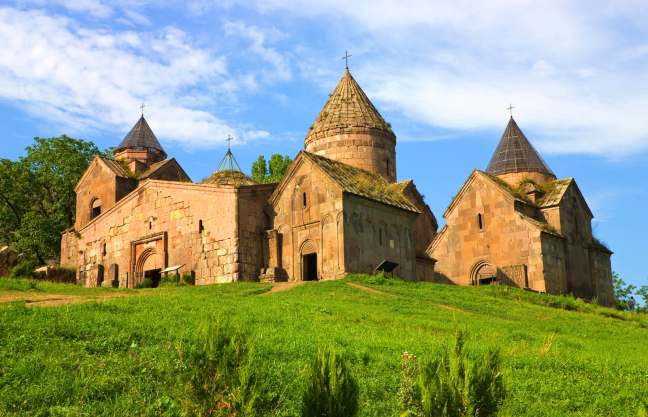
  • Sanahin and Haghpat monasteries (UNESCO heritage sites) near Alaverdi

I realize my words today aren’t particularly inspiring or fascinating. But this is the spot in which I find myself at the moment. I’m a little bit nostalgic, a tad bitter, but a whole lot of hopeful. For as the Armenians of the diaspora know all too well, I will one day find my way back home.

Main image courtesy of http://www.itinari.com blog.

Solace in the hills (how I fell in love with northern Armenia)

I became enamored with the mostly barren mountains of Armenia’s Lori region the first time my marshutni (minibus used for public transport) crossed over the mountain pass that enters the area just south of Spitak.  After a half-hour of travelling the road that lies in the shadow of Mt. Aragats northern side, the winding descent into Lori left my mouth gaping.

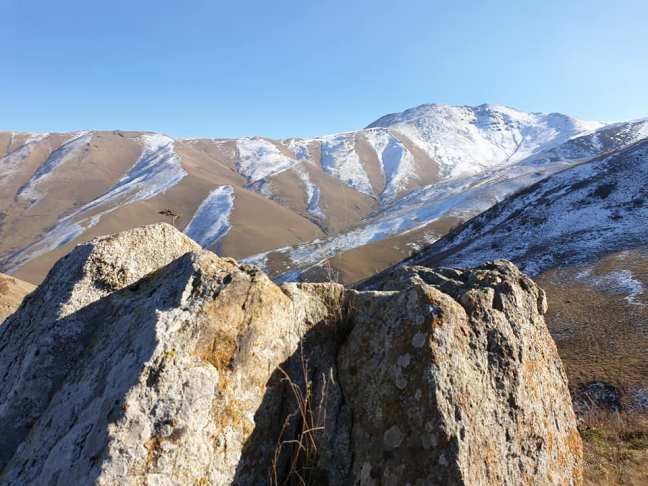
It’s hard to describe. There are the colors: the multiple shades of tan, brown and gray that make up the hillsides; tones which juxtapose nicely with the blotches of alabaster snow scattered on the mountaintops and the various shades of pale blue that tint the local skies.

The mountains of the Lori region are like a mother’s embrace. They fold over on you and welcome you each time you venture out to explore them.  Plus, there is a certain mysticism you feel as you climb each hill and arrive at increasingly better vantage points from which to look at nearby cities and villages.  The peaks of Lori offer a bird’s eye view of Armenia’s third-largest city Vanadzor or further west you can look down and take in the sprawl of Spitak, the town at the epicenter of the earthquake that hit Armenia in 1988.

Yet what’s even more special about the mountains of northern Armenia is the solitude they offer.  So many conversations I’ve had with local city-dwellers or even villagers begin with the question: why do you need to climb a mountain?  And my response, which is invariably the same, goes like this: to see if I can.  Each time I embark on a hike through the hills of Lori, I gain so much more than just a good workout. There is an opportunity to take in the silence, to revel in the ancientness of the land and to surmise what nomads or tradesman might have wandered these peaks and valley centuries ago as they made their way from Asia to Europe.

Perhaps my biggest joy derived from running to the hills nearby my beloved Vanadzor is knowing that, most likely, the journey will involve just me, my thoughts and the random shepherds I happen upon during my walk.  I recall a funny conversation I had with a shepherd one Saturday as plodded my way up Karmirsar (Red Mountain).  “Why are you here?”, the shepherd asked.  I shrugged and replied, “To enjoy the mountains and to imagine their history.” He offered a confused look and went on guiding his cattle down the hillside.  To be honest, I didn’t really know why I was there, except perhaps to enjoy the beautiful views and to soak in the warmth of the autumn sun.  But the truth is the hills of the Lori region have a very specific energy.  So, maybe I was just there to recharge.