Seeking Serenity in the Orbe Valley (Pt. 1)

Thanks to a friend’s accidental click-and-point approach to trail searches on a map of Switzerland, I was fortunate enough to come to know the peaceful beauty of the Orbe River this past year. I first hiked the river trails in June 2020, during an escape to Switzerland once Europe’s borders opened up after Round 1 of the Covid pandemic.

The Orbe is a meandering, bubbly, mountain river-stream deep in the Vaud region of Switzerland. It touches upon the base of the Jura Mountains some 40 or so kilometers north of Lausanne. My entry point to the river hiking routes has always been the quaint, little village of Les Clées, with its picturesque tower, church and stone bridges. From Les Clées, one can follow hiking and cycling routes east down to the town of Orbe or take the narrow hill paths to the West over to the waterfalls hidden next to the village of Le Day.

The best qualities of both paths include the calmness, the embrace of forest silence, and the soothing whispers of the Orbe as it gurgles to you from the sometimes scary drop below. The walk toward the town of Orbe begins as most of us imagine a Swiss hike should. The hiker trapses through meadows that hug the village of Les Clées. Soon, you approach the forest line, after passing a cow or two, and you walk along a sandy-rock path high above the mountain stream. The path offers tiny bits of natural wonder as you gaze at the stunning emerald moss that covers many of the trees and listen to the trickles of water from springs flowing from the hillsides. At times, wooden bridges help you over sections of the path, where the abundant water sources make the route too muddy to pass. Then a fork in the trail gives you the option to descend down to the bubbling, gurgling Orbe.

The descent can be daunting when the path is snowy or muddy. But with patience and care, you can make it down to the water safely. Plus, a slow downward walk affords the opportunity to notice the handiwork that has gone into developing forest staircases and root-formed guard rails that keep hikers from sliding directly down to the stream. At the bottom, the blue metal bridge gives a moment of respite and as the water lulls walkers into reflection. The blue of the bridge, the deep greens of the fluffy moss, the brown-grey-green-blue hues of the water and rocks offer a color harmony that overwhelm even a colorblind hiker like myself. My judgment of the various tones and hues is not that of the majority, yet still the natural color symphony takes my breath away. 

After several minutes of absorbing the sounds of the Orbe and its calming rush through the mountain rocks, I head upward along the what I call the southern bank, making my way back to Les Clées. That side of the stream offers vistas of the springs and waterfalls on the northern side; particularly, when hiking in late fall or winter after the leaves have fallen from the trees. Walkers have better views of the water as the hiking path rises above it and the mind quickly becomes overwhelmed by still more natural beauty. Part of you wants to sit and take in the river or, on a hot day, jump into the cool, soothing waters. Another part of you wants to indulge in the escape offered by these seemingly ancient forests in which you imagine Roman soldiers must have marched or where you feel like you may have been transported to the green moon of Endor as described in George Lucas’ Star Wars movies.

As you near the end of what I call the “East to Orbe” circuit (by returning to Les Clées), you catch glimpses cross-river of the green fields where the cows you saw earlier continue to graze or you notice from afar the village’s unmistakable tower. It lets you know that your car, and some well-earned rest, is not far away. This path has become a staple activity during my visits to friends in Lausanne. It puts my spirit at peace and makes me grateful for the simplicity of nature. The opportunities the Orbe offers for quiet hiking, smiles of non-speak with friends, and the curious meandering of our canine companions (specifically memories of my dear Mica) are priceless. In a restless world of Covid angst, the Orbe River surges with serenity.
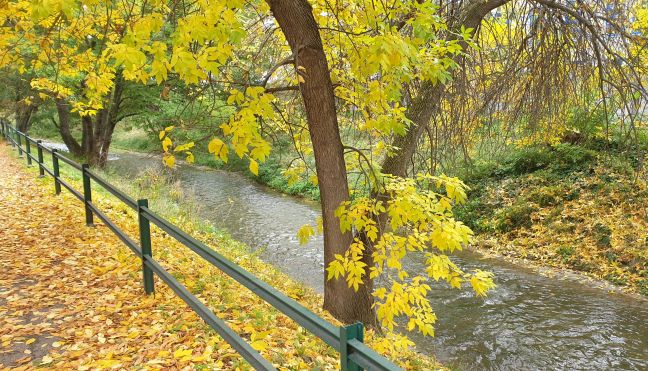
Autumn Lockdown

Walking from coffee, 
In anticipation of rain.
Thoughts like leaves, 
Flutter through my brain.

Could I make it to the river,
Without getting wet.
To guesstimate Prague weather,
Would be a fool's bet.

The day was so indifferent,
A sky of pinks and grays.
Colored leaves squealed the end of autumn,
Through a milky, sun-tinged haze.

I thought of coming seasons,
As I climbed the Kinský garden hills.
A virus has imprisoned us,
I fear a new year void of thrills.

So now I sit by the wading pond,
As dogs circle my legs.
One dashes into the water,
While the other nears me to beg.

Soon I will rise,
For to Malá Strana I descend.
My fall stroll will finish,
Having more coffee with friends.

Finding peace and gratitude along the Vltava

I realized after writing my last blog entry that perhaps my words had been too aggressive. Most likely in a time of crisis few readers cared to hear my complaints about being lost in the quarantined world of Prague after leaving the Peace Corps. Those words did not come from a place of anger though: more of frustration because I had not yet been able to see friends I was missing for over a year. So that’s why I put my butt on a train and headed up the Vltava River.

It’s hard to explain the Vltava. It’s like the spinal cord of Bohemia or the Czech lands. It was on the hills above the river that Libuše had her vision of a city whose glory and light would shine for thousands of years. That city being Prague of course. It is where, per local legend, Horymír, atop his horse Šemík, jumped the waterway and fled en route to Neumětely. Along this river vagabond-hikers set up camps and spent their weekends in nature, or southern Bohemians first brewed the original Budvar (today’s Budweiser) in České Budějovice. But for me, the Vltava River represents calm. It represents continuity and simple beauty. It’s a river that runs from an unassuming source in the mountains and hills of the Šumava and carries its natural sustenance and history all the way to the Czech capital and beyond.

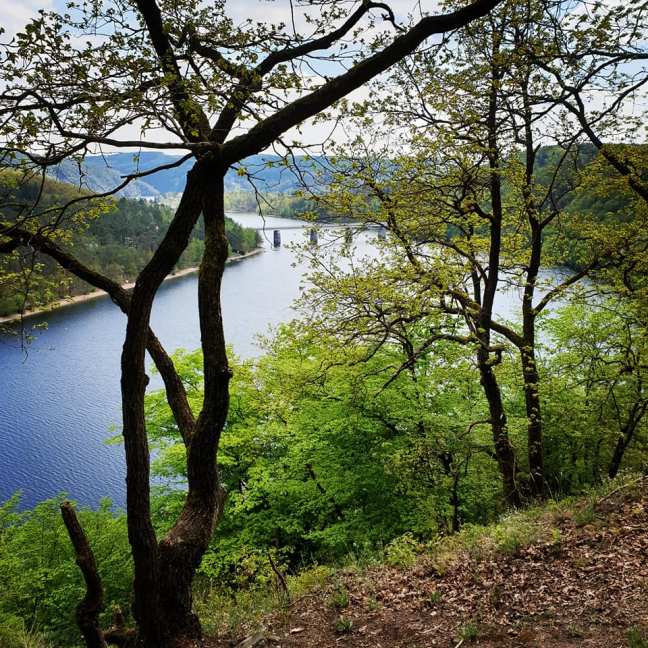
During the past week, I took a couple of short trips along the river, south of Prague (just under an hour away by car or train). Once at my destination, I either hiked my way back toward the city or did a forest circuit. My Tuesday hike was a celebration of spring. As I tromped up the hill away from the banks of the Vltava, I reveled in the embrace of fruit trees’ hugging branches as they shadowed the forest paths and ancient roads. The melodious hum of bees and wasps busy at work accompanied me along rows of cherry, apple and apricot trees in full bloom. As the sun shone and warmed the road, for the first time since returning home, I felt at peace. It was the peace at spring: of the healing sun and nature’s rebirth. Because of current restrictions, I was one of few people in the forest. Still, that made me all the more aware of how grateful I should be. I advanced along the path to reach the tops of bluffs along the river. There, I found the remains of campfires local villagers had enjoyed and later extinguished; I saw the view of the railroad bridge over the Vltava that I had travelled across only moments before. In a brisk wind looking down at Bohemia’s natural life source, I imagined all those who had come before me. How emperors and kings had traveled that river in the age of the Holy Roman Empire or Austria-Hungary. Or how the labors of loggers in the southern forests had sent wood down elaborate canal systems and into the river so that it could float to Prague for use on major construction projects of the day.

And on my trip yesterday, I saw a river full of hope. It was a Vltava that was enjoying a break from the busy swarms of Prague residents who rush to its banks as soon as warm weather allows. The river was calm, but it was ready… for people to return. That’s when I felt the most gratitude: as I watched random boats laze on the water floating around the area stilled by the Slapy dam. I was grateful for the river and the stories she knows: the stories she tells. I was grateful for the sustenance she brings in nourishment for the fruit trees and berry bushes along her banks. I was thankful for the livelihoods she supports as tourists and locals visit her to swim in her refreshing waters and relax over a half-liter of Bohemia’s most famous golden lagers. Yes, the river is my constant – a source of relaxation, beauty, learning and life. As long as she flows, I will live happily and delight in returning to hear her tales and will remain forever grateful for them.