Côtes du Rhône … where memories meet and happiness flows

Since I was a teenager, France has had a special power for me. It’s “meant to be-ness” has always made it feel safe. And celebrating a good friend’s birthday in Provence in September served as an important reminder of the need to cherish special certainties.

The givens of Pete fixing amazing food while tormenting me incessantly, or Jakub telling silly dad jokes, or Natalie being armed and ready with rosé, or Laura acting as the voice of reason. Not to mention Jean making sure we were all looked after and the house in order.

An insane route to the farmhouse we were staying at had me less than certain how our celebratory week in Provence would end up. But France, this time the southern part, did not disappoint. The smell of lavender, the rugged mountains hugging our local horizon, and the poplar or sycamore-lined roadways … they all told me that life was as it should be.

It’s funny that the French created the term je ne sais quoi. Because that’s how I often feel when describing why I am at home there. It’s an “I don’t know what” sentiment. I’m never 100% certain why but I always feel welcome when I move through the fruit and veggie markets, when I sit down for un crême, or when I escape inside a house of worship that dates back to the times of The Crusades. The beauty of the Rhone Valley immediately tells visitors, without their knowing why, that everything will be all right.

Our corner of Provence that we hid out in that week afforded us the best that France has to offer. Great wines from the ancient land of Popes (a Châteauneuf-du-Pape or a Gigondas) accompanied most of our meals. The shops welcomed us with the culinary artisanry that only the French can deliver: sumptuous sausages of the Camargue, excellent terrine de foie gras, or rillettes … food shopping in France is unique. Just brush off your French vocabulary from college days and enquire after which local farmers supply the shops and to what periods these agro-culinary traditions date back.

It’s in these moments that you slowly come to understand that the “I don’t know what” may just simply be a proud love or passion for traditions in food-making, animal-raising and store-owning that transcends time. Perhaps, it’s because the river lies nearby. But in the Rhone Valley and that area of France, there’s a fluidity: a phantom of centuries of trade routes that connected Ancient Rome to the Iberian peninsula. When you submit to the region of Provence, you feel these transitory moments. Of wine poured into glasses across the years, of floral scents being gathered for perfumes that would sweeten numerous decades, or of frankincense emanating from churches that would bring the religions of the Holy Land to the Empire’s marchlands.

There’s never a single, clear cause for the serenity and happiness flowing along the Rhone in Provence, but I’m certain it has something to do with the land always seeing to residents’ and visitors’ basic needs. You eat well. You drink well. And you relax as time nourishes you with the riches of the region’s traditions.

Laissez-vous en profiter de ce que la région vous offre.   
Meeting Missouri in the Moselle Valley

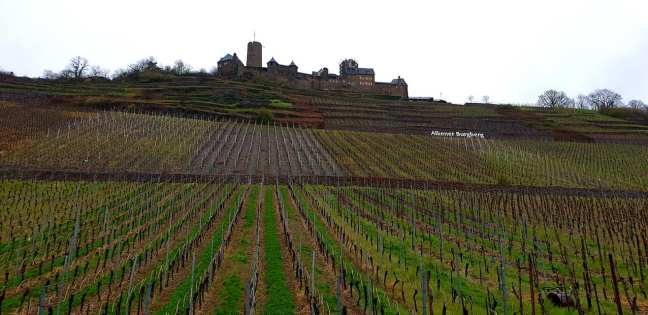
A couple weeks back I coerced a small group of close friends to road trip with me to spend my birthday south of Koblenz, Germany just below the point where the Moselle River flows into the Rhine. I had read somewhere years ago that many of the German immigrants who came to inhabit the area along the banks of the Missouri River (in the segment between Jefferson City and St. Louis) had once lived on the banks of the Moselle. They had made wine in Deutschland and later came to practice the same art in their chosen destination in middle America.

Although the steepness of the bluffs along the Moselle River was much more striking, I could see bits of Missouri in this landscape near the Franco-German border. The river was wide, a muddy green, as well as quick flowing: much like the Missouri River which also bears the nickname “Big Muddy”. However, what the Missouri lacks is the quant little villages and towns tucked in small valleys and ravines along the river banks where, theoretically, you can traipse from house to house ringing doorbells and asking to sample the last season’s wines.

As I chauffeured Laura, Natalie, Pete & Jakub between Moselle Valley hamlets, it became clear that there were a number of local rules that complicated the “drop by anytime” philosophy. The first was that the Weingüter operate only during afternoons on weekends. So after a couple of failed attempts in Kattenes, we decided to move on to the bigger town of Cochem. There, sampling the Moselle Rieslings was less about which vintners were open and willing to show off their wares and more about finding a restaurant with a good selection of local wines. 

In this beautiful Moselle Valley town dominated by a beautiful, yet haunting, castle, we snuck from restaurant to bistro and on stopping to enjoy the light, fragrant white wines and taking advantage of a decent block of sun we’d been offered on an otherwise rainy weekend. It was relaxing to absorb the warming sun along the near-flooding river and observe how spring was slowly starting in the region. That’s when we also got wind of another rule: tourist season along the Moselle doesn’t really start until Easter weekend so it’s better to come visit after that, once wine cellar owners are ready for the Riesling-imbibing crowds.

Still, despite our seemingly premature arrival, we did have a fun culinary and oenological weekend in the villages we visited. Whether it was Niederfell or Cochem or Alken, we had some good wine and spirits and indulged in the very tasty local version of schnitzel made using a special mustard to marinate the meat. Also, hats off to the patient restaurant owners and cooks who took the time to explain their local gastronomy and cuisine to us and who tolerated our crowd when perhaps a few too many wines had been sampled. Or the day of wine-tasting had started too early. 

Plus, kudos to the local tourist/hiker clubs or trailblazers who set up wonderful walking paths leading through local forests and taking wanderers to the tops of the bluffs that look out over the river valley. Despite some kinks in the weather, it was a wonderful weekend in one of Germany’s celebrated wine regions. The natural beauty coupled with the shenanigans of good friends made turning 50 a tolerable experience. 

I would like to close by thanking Werner Sander and his team at the Café-Konditorei-Pension Sander for their amazing hospitality and excellent pastries. Plus, a big thanks to the staff at the Moselblick Niederfell restaurant for the beer sampling and the wonderful service, food, and mainly patience during my birthday dinner. And finally, a big shout out to our new friends from Tortesia who made a great weekend even more special. A weekend in the Moselle Valley … I highly recommend it.